Meat and poultry
Pork chop nutrition, before and after the heat.
4 oz of raw pork chop comes to 144 calories. Protein accounts for 25 g of what is there. The record behind it is USDA’s “Pork, fresh, loin, center loin (chops), bone-in, separable lean only, raw”. How it reaches the plate decides the rest, with 100 g measured at 127 calories one way and 200 another. The panel underneath takes any serving and any amount, and the vitamin and mineral table tracks what you pick.
USDA FoodData Central records 167829, 168240, 167882, 168239 supply every value here. The calculation happens in this page.
Pork chop calories by portion
144 calories is the figure for 4 oz of raw pork chop; 127 is the figure per 100 g. Below are the remaining portions USDA measured.
| Serving | Weight (g) | Calories | Protein (g) | Carbs (g) | Fat (g) |
|---|---|---|---|---|---|
| 4 oz | 113 | 144 | 25 | 0 | 4.2 |
| 1 chop | 178 | 226 | 39 | 0 | 6.6 |
| 100 g | 100 | 127 | 22 | 0 | 3.7 |
How much protein is in pork chop?
Expect 25 g of protein from 4 oz of raw pork chop, roughly 50 percent of a 50 g day. Protein makes up 69 percent of the calories here, which places pork chop among the leanest sources you can buy.
Its energy is 28 percent fat, 0 percent carbohydrate and 72 percent protein, meaning it behaves as a protein food in a meal.
Does the method change pork chop?
Per 100 g, braised pork chop carries 57 percent more calories than raw — 200 against 127. The difference is water leaving, which concentrates everything that remains.
Weight is fixed at 113 g throughout, so the rows differ only in how the pork chop was prepared.
| Preparation | Calories | Protein (g) | Fat (g) | What it involves |
|---|---|---|---|---|
| Raw pork chop | 144 | 25 | 4.2 | Nothing added |
| Grilled pork chop | 203 | 30 | 8.2 | Dry heat |
| Fried pork chop | 220 | 33 | 8.7 | In cooking fat |
| Braised pork chop | 226 | 34 | 8.9 | Slow, moist heat |
This is the part a photo cannot always settle. A camera can tell a grilled piece from a fried one, but it cannot see how much oil stayed in the pan. How accurate AI calorie apps are covers where that uncertainty sits.
Kitchen notes on pork chop
Pork chops are individual cuts from the loin, running from the shoulder to the hip. They are sold bone-in or boneless. Rib chops have a curved bone and sweet fat, while loin chops contain the loin and tenderloin. Choose thick cuts with pale pink flesh and creamy white fat coverage. Avoid wet, grey meat.
High heat quickly sears the fat, while gentle finishing prevents the lean meat from drying out. The bone conducts heat slowly, keeping the surrounding meat juicy. The most common error is overcooking, which turns the lean loin dry and sawdust-textured. Brining beforehand helps the meat retain moisture during cooking.
Serve these chops alongside tart apple sauce or stewed prunes, as fruit cuts the rich pork fat. In British kitchens, sage and cider vinegar complement the meat. For East Asian preparations, coat the chop in breadcrumbs for tonkatsu, or marinate in soy and ginger before pan-frying.
Micronutrients in pork chop
Against the Daily Value, 4 oz of raw pork chop stands out for selenium at 74 percent of a day, vitamin B6 at 49 percent of a day, niacin at 49 percent of a day. The table follows the selector above, so change the serving or the method and it updates.
| Nutrient | Amount | % Daily Value |
|---|
How far pork chop goes in a day
4 oz of raw pork chop: 7 percent of 2,000 calories, 50 percent of the protein Daily Value. Those are reference numbers; the TDEE calculator finds yours, and the macro calculator converts them to grams.
Three ways to cook pork chop
From the Calorie Counter Team: three dishes built around pork chop, with per-serving nutrition calculated from the USDA data for every ingredient that goes in.
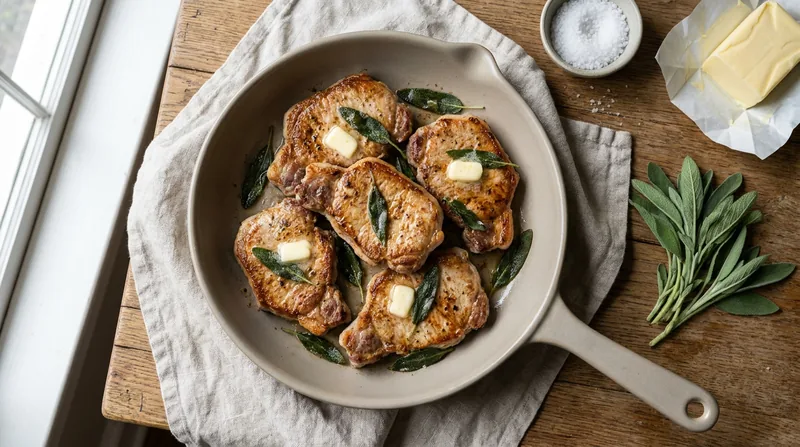
Dinner · British
Pan-Fried Pork Chops with Sage
Pork chops cooked in a frying pan with butter and fresh sage leaves.
Ingredients
- Pork chops 300 g
- Unsalted butter 15 g
- Olive oil 10 g
- Fresh sage 2 g
- Table salt 3 g
- Black pepper 1 g
Method
- Pat the pork chops dry with paper towels and season both sides with the salt and black pepper.
- Heat the olive oil in a heavy frying pan over a medium-high heat.
- Add the pork chops to the pan and cook for 4 minutes on each side until browned.
- Add the butter and sage leaves to the pan, spooning the melted butter over the meat for 2 minutes.
- Remove the chops from the pan and let them rest for 5 minutes before serving.
Nutrition per serving, calculated across 6 USDA ingredient records. Expect small differences once cooked.
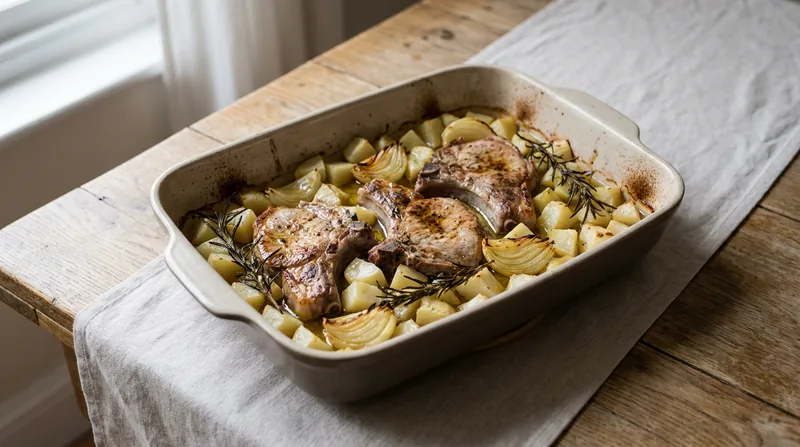
Lunch · British
Baked Pork Chop and Potato Traybake
A single-tin oven dish of pork chops, diced potatoes and onions roasted with rosemary.
Ingredients
- Pork chops 400 g
- White potatoes 400 g
- Yellow onion 150 g
- Olive oil 20 g
- Fresh rosemary 2 g
- Table salt 4 g
Method
- Preheat the oven to 200C.
- Chop the potatoes into 2cm cubes and slice the onions.
- Toss the potatoes, onions, rosemary, half the salt, and the olive oil together in a large roasting tin.
- Place the pork chops on top of the vegetables and season them with the remaining salt.
- Bake in the oven for 35 minutes until the potatoes are tender and the pork is cooked through.
Per serving, from 6 USDA FoodData Central records. Cooking changes weight and some nutrients; treat these as close rather than exact.
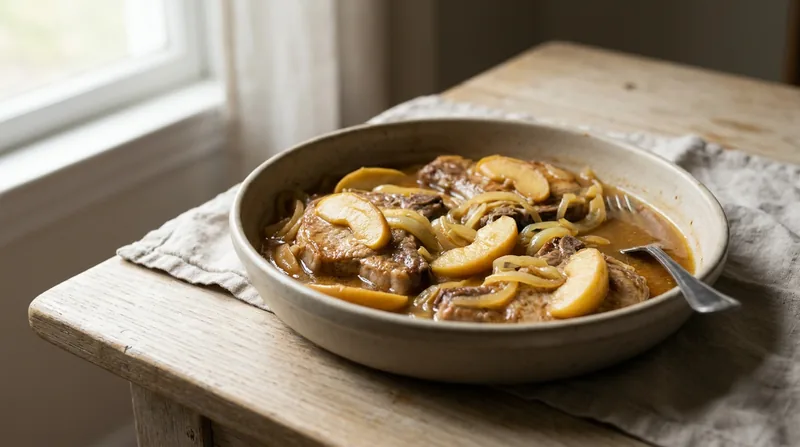
Dinner · British
Cider-Braised Pork Chops with Apples
Pork chops slowly simmered in apple cider with sliced apples and onions.
Ingredients
- Pork chops 300 g
- Apple 150 g
- Yellow onion 100 g
- Apple cider 200 g
- Unsalted butter 15 g
- Table salt 3 g
Method
- Season the pork chops with the salt on both sides.
- Melt the butter in a shallow casserole dish over a medium heat and brown the pork chops for 3 minutes on each side.
- Remove the pork, then add the sliced onion and sliced apple to the dish, frying for 5 minutes until soft.
- Pour in the apple cider, return the pork chops to the dish, and bring to a gentle simmer.
- Cover with a lid and cook on a low heat for 20 minutes until the pork is tender.
Per serving, from 6 USDA FoodData Central records. Cooking changes weight and some nutrients; treat these as close rather than exact.

Calorie Counter Team, food critic
What a meal with pork chop adds up to
A sample plate, not a prescription: pork chop plus two sides, each line sourced and the sum shown.
| Item | Serving | Calories | Protein (g) |
|---|---|---|---|
| Pork chop, grilled | 1 chop | 263 | 39 |
| Rice, cooked | 1 cup | 205 | 4.3 |
| Asparagus | 1 cup | 27 | 2.9 |
| Together | 495 | 46 |
Meat and poultry: where pork chop sits
Each food is shown per 100 g, in the form named beside it.
| Food | Form | Calories | Protein (g) | Carbs (g) | Fat (g) |
|---|---|---|---|---|---|
| Sausage | Fried | 325 | 19 | 1.4 | 27 |
| Ground beef | Raw | 215 | 19 | 0 | 15 |
| Lamb | Raw | 143 | 21 | 0 | 5.9 |
| Steak | Raw | 135 | 22 | 0 | 4.6 |
| Pork chop | Raw | 127 | 22 | 0 | 3.7 |
| Chicken thigh | Raw | 121 | 20 | 0 | 4.1 |
| Chicken breast | Raw | 120 | 23 | 0 | 2.6 |
Common questions on pork chop
How many calories are in 4 oz of raw pork chop?
The USDA figure is 144 calories, or 127 per 100 g. It is taken from the record “Pork, fresh, loin, center loin (chops), bone-in, separable lean only, raw”, FDC 167829.
How much protein does pork chop have?
You get 25 g from 4 oz of raw pork chop, equal to 50 percent of the daily reference amount; 100 g holds 22 g.
Does cooking change the calories in pork chop?
The weight stays the same but the number moves. 113 g of pork chop is 144 calories raw, rising to 226 braised.
Can you eat pork chop when trying to lose weight?
That depends on the rest of the day, not on pork chop. For planning: 4 oz of raw pork chop is 144 calories and 25 g of protein, 69 percent protein by energy, a strong ratio for staying full on fewer calories.
Why does the chop curl up in the pan?
The outer band of fat and connective tissue shrinks faster than the muscle when heated. This pulls the chop into a cup shape. Snip through the fat strip at intervals before cooking to keep the meat flat.
Should the bone be left on the chop during cooking?
Yes, cook the chop with the bone attached. The bone insulates the adjacent meat, slowing down the cooking process. This keeps that section tender and adds depth to the overall flavour of the meat.
Sources
- Pork, fresh, loin, center loin (chops), bone-in, separable lean only, raw — USDA FoodData Central, FDC ID 167829
- Pork, fresh, loin, center loin (chops), bone-in, separable lean only, cooked, braised — USDA FoodData Central, FDC ID 168239
- Pork, fresh, loin, center loin (chops), bone-in, separable lean only, cooked, broiled — USDA FoodData Central, FDC ID 168240
- Pork, fresh, loin, center loin (chops), bone-in, separable lean only, cooked, pan-fried — USDA FoodData Central, FDC ID 167882
- Daily Values for nutrition labelling, 21 CFR 101.9
Stop doing this by hand.
You just looked up one food. CalorieCounter reads a whole plate from a photo, serving and preparation included. It is coming to the App Store for iPhone — leave your email and you get the link the day it is live.