Meat and poultry
Chicken thigh nutrition, by serving and by method.
On USDA figures, 1 raw chicken thigh without skin works out at 180 calories and carries 29 g of protein. That is USDA’s figure for “Chicken, broilers or fryers, dark meat, thigh, meat only, raw”. Preparation shifts it more than most tables admit, from 121 calories per 100 g at the low end to 218 at the top. Change the amount below for your own portion. The panel and the nutrient breakdown both update.
Numbers come from USDA FoodData Central records 172387, 172388, 173627 and are worked out locally, with no sign-up.
The calorie count for chicken thigh
1 raw chicken thigh without skin supplies 180 calories, which scales to 121 per 100 g. Each serving listed underneath was weighed by USDA rather than estimated.
| Serving | Weight (g) | Calories | Protein (g) | Carbs (g) | Fat (g) |
|---|---|---|---|---|---|
| 4 oz | 113 | 137 | 22 | 0 | 4.7 |
| 1 thigh without skin | 149 | 180 | 29 | 0 | 6.1 |
| 100 g | 100 | 121 | 20 | 0 | 4.1 |
How much protein is in chicken thigh?
For protein, 1 raw chicken thigh without skin gives you 29 g, which fills 59 percent of the daily 50 g benchmark. Protein makes up 65 percent of the calories here, which places chicken thigh among the leanest sources you can buy.
Its energy is 32 percent fat, 0 percent carbohydrate and 68 percent protein, meaning it behaves as a protein food in a meal.
Chicken thigh calories by preparation
Per 100 g, fried chicken thigh carries 80 percent more calories than raw — 218 against 121. The difference is oil or butter taken up during cooking.
To keep it fair, all figures are for 149 g.
| Preparation | Calories | Protein (g) | Fat (g) | What it involves |
|---|---|---|---|---|
| Raw chicken thigh | 180 | 29 | 6.1 | Nothing added |
| Roasted chicken thigh | 267 | 37 | 12 | Dry heat, no added fat |
| Fried chicken thigh | 325 | 42 | 15 | In cooking fat |
This is the part a photo cannot always settle. A camera can tell a grilled piece from a fried one, but it cannot see how much oil stayed in the pan. How accurate AI calorie apps are covers where that uncertainty sits.
Choosing and cooking chicken thigh
Chicken thighs are the upper part of the bird's leg, sold either bone-in with the skin attached or boneless and skinless. Look for plump, pink flesh with a clean smell. Avoid packs with excess liquid in the tray. Skin-on thighs should have pale, dry skin that is not yellowed or torn.
This dark meat contains fat and connective tissue, meaning it remains juicy during slow cooking. High heat crisps the skin thoroughly, while braising melts the interior fat. The most common error is undercooking them; unlike breast meat, thighs taste better and have a more pleasant texture when cooked past basic safety.
Chop boneless thighs for North Indian curries, where they absorb spices without drying out. Alternatively, marinate them in soy and ginger for Japanese teriyaki. They pair excellently with root vegetables, garlic, prunes, or sharp citrus glazes. Slice the meat across the grain after resting to keep the juices intact.
The complete chicken thigh breakdown
Against the Daily Value, 1 raw chicken thigh without skin stands out for selenium (62 percent of the Daily Value), niacin (52 percent of the Daily Value), vitamin B6 (40 percent of the Daily Value). The table follows the selector above, so change the serving or the method and it updates.
| Nutrient | Amount | % Daily Value |
|---|
How far chicken thigh goes in a day
If you eat 2,000 calories a day, 1 raw chicken thigh without skin accounts for 9 percent of them, and for 59 percent of the 50 g protein benchmark. To replace 2,000 with your real number, use the TDEE calculator; to turn that into targets, the macro calculator.
Chicken thigh recipes, with the numbers
Three recipes from the Calorie Counter Team, each costed ingredient by ingredient against USDA records, so the per-serving figures are sums, not guesses.
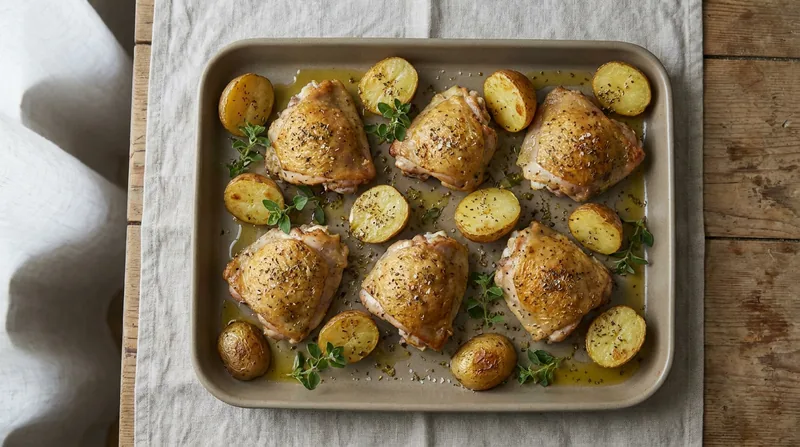
Dinner · British
Tray-Baked Chicken Thighs with Potatoes
Bone-in chicken thighs roasted on a tray with sliced potatoes and oregano.
Ingredients
- Chicken thighs, skin-on, bone-in 500 g
- Potatoes 400 g
- Olive oil 20 g
- Salt 6 g
- Dried oregano 2 g
Method
- Heat the oven to 200 degrees Celsius.
- Cut the potatoes into 2-centimetre pieces and toss them with 10 grams of olive oil and 2 grams of salt.
- Rub the chicken thighs with the remaining olive oil, salt, and dried oregano.
- Arrange the chicken and potatoes in a single layer on a baking tray.
- Bake for 40 minutes until the chicken reaches an internal temperature of 74 degrees Celsius.
Per serving, from 5 USDA FoodData Central records. Cooking changes weight and some nutrients; treat these as close rather than exact.
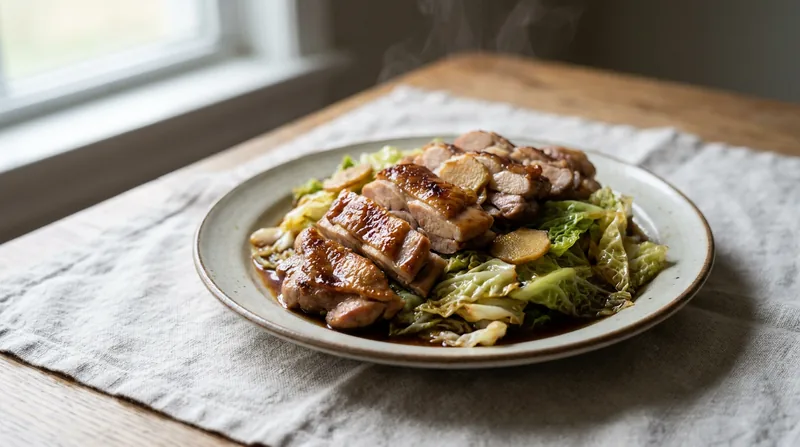
Lunch · East Asian
Ginger Soy Chicken Stir-Fry
Sliced boneless chicken thighs cooked quickly in a pan with cabbage and soy sauce.
Ingredients
- Chicken thighs, boneless, skinless 300 g
- Savoy cabbage 250 g
- Ginger root 15 g
- Vegetable oil 15 g
- Soy sauce 20 g
Method
- Slice the chicken thighs into 1-centimetre strips and finely shred the cabbage.
- Heat the vegetable oil in a large frying pan over high heat.
- Add the chicken and grated ginger, then fry for 6 minutes until the chicken is browned.
- Add the cabbage and soy sauce, then cook for a further 4 minutes until the cabbage softens.
5 USDA records went into this total. It describes the ingredients as weighed, not the dish after cooking losses.
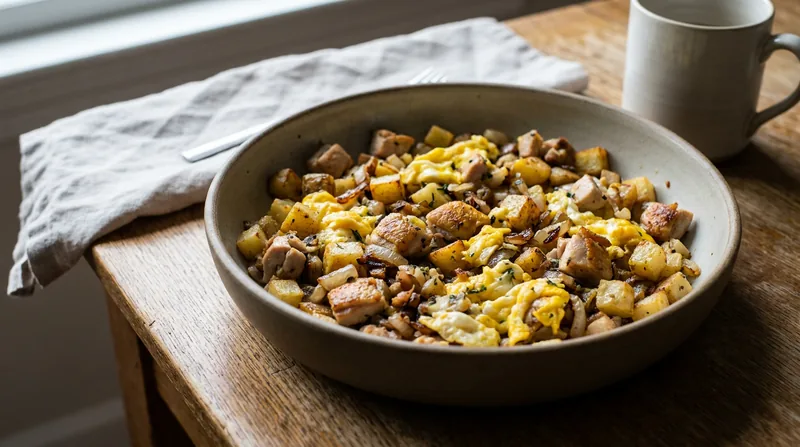
Breakfast · British
Chicken Thigh Breakfast Hash
Diced chicken thighs pan-fried with potatoes, onions, and eggs for a hearty breakfast.
Ingredients
- Chicken thighs, boneless, skinless 250 g
- Potatoes 200 g
- Onions 100 g
- Unsalted butter 20 g
- Whole eggs 100 g
- Salt 4 g
Method
- Cut the chicken, potatoes, and onions into 1-centimetre cubes.
- Melt the butter in a frying pan over medium heat and cook the potato cubes for 10 minutes.
- Add the chicken, onion, and salt, then cook for 10 minutes until the chicken is cooked through.
- Make two spaces in the pan, crack an egg into each space, and cover the pan with a lid.
- Cook for 4 minutes until the egg whites are completely set.
Nutrition per serving, calculated across 6 USDA ingredient records. Expect small differences once cooked.

Calorie Counter Team, food critic
Putting chicken thigh on a plate
A sample plate, not a prescription: chicken thigh plus two sides, each line sourced and the sum shown.
| Item | Serving | Calories | Protein (g) |
|---|---|---|---|
| Chicken thigh, roasted | 1 thigh without skin | 208 | 29 |
| Couscous, cooked | 1 cup, cooked | 176 | 6 |
| Asparagus | 1 cup | 27 | 2.9 |
| Together | 411 | 38 |
Meat and poultry: where chicken thigh sits
Same weight for every row, 100 g, so differences are not portion effects. The form column shows whether a row is raw, cooked or as sold.
| Food | Form | Calories | Protein (g) | Carbs (g) | Fat (g) |
|---|---|---|---|---|---|
| Spam | Canned | 315 | 13 | 4.6 | 27 |
| Ribeye steak | Raw | 241 | 19 | 0.2 | 18 |
| Ham | As sold | 164 | 17 | 3.6 | 8.8 |
| Pork chop | Raw | 127 | 22 | 0 | 3.7 |
| Chicken thigh | Raw | 121 | 20 | 0 | 4.1 |
| Chicken breast | Raw | 120 | 23 | 0 | 2.6 |
| Turkey breast | Raw | 114 | 24 | 0.1 | 1.5 |
Chicken thigh, asked and answered
How many calories are in 1 raw chicken thigh without skin?
The USDA figure is 180 calories, or 121 per 100 g. It is taken from the record “Chicken, broilers or fryers, dark meat, thigh, meat only, raw”, FDC 173627.
How much protein is in chicken thigh?
1 raw chicken thigh without skin has 29 g of protein. By weight that is 20 g per 100 g, and the serving covers 59 percent of the Daily Value.
Does cooking change the calories in chicken thigh?
Yes. At 149 g, raw is 180 calories and fried is 325. The table above compares each preparation of chicken thigh covered on this page.
Is chicken thigh good for weight loss?
No food causes or prevents weight loss on its own. The useful facts are that 1 raw chicken thigh without skin is 180 calories with 29 g of protein, which makes 65 percent of its calories protein; which is a favourable trade when calories are tight.
Should you remove the excess fat from chicken thighs before cooking?
Trim off any large, loose flaps of fat hanging from the edges, but leave the internal fat. This fat melts during cooking to keep the meat moist and provide flavour. Removing it entirely results in a drier finished dish.
Why do boneless chicken thighs sometimes look pink even when fully cooked?
This pink hue is natural in dark poultry meat, caused by pigments in the muscles. It does not mean the meat is raw. Check that the juices run clear and the texture feels firm rather than rubbery.
Sources
- Chicken, broilers or fryers, dark meat, thigh, meat only, raw — USDA FoodData Central, FDC ID 173627
- Chicken, broilers or fryers, thigh, meat only, cooked, roasted — USDA FoodData Central, FDC ID 172388
- Chicken, broilers or fryers, thigh, meat only, cooked, fried — USDA FoodData Central, FDC ID 172387
- Daily Values for nutrition labelling, 21 CFR 101.9
Stop doing this by hand.
You just looked up one food. CalorieCounter reads a whole plate from a photo, serving and preparation included. It is coming to the App Store for iPhone — leave your email and you get the link the day it is live.