Meat and poultry
Sausage nutrition, and what the pan changes.
1 link of pan-fried sausage is 75 calories and 4.3 g of protein. Specifically, this is the USDA record “Pork sausage, link/patty, cooked, pan-fried”. That figure is not fixed. Depending on how it is prepared, 100 g runs anywhere from 288 to 325 calories. The panel underneath takes any serving and any amount, and the vitamin and mineral table tracks what you pick.
Figures: USDA FoodData Central, records 172934, 174578. Calculated in your browser; nothing is uploaded.
How many calories are in sausage?
1 link of pan-fried sausage supplies 75 calories, which scales to 325 per 100 g. Each serving listed underneath was weighed by USDA rather than estimated.
| Serving | Weight (g) | Calories | Protein (g) | Carbs (g) | Fat (g) |
|---|---|---|---|---|---|
| 1 link | 23 | 75 | 4.3 | 0.3 | 6.3 |
| 1 patty | 27 | 88 | 5 | 0.4 | 7.4 |
| 1 serving | 48 | 156 | 8.9 | 0.7 | 13 |
| 100 g | 100 | 325 | 19 | 1.4 | 27 |
What sausage offers in protein
The protein count for 1 link of pan-fried sausage is 4.3 g, equal to 9 percent of the Daily Value. About 23 percent of its calories are protein. That is a useful contribution rather than a protein source you would build a meal around.
By calories rather than by weight the split is 23 percent protein, 75 percent fat and 2 percent carbohydrate, so in practice it is mostly a fat rather than anything else.
Sausage, method by method
As sold, sausage is 288 calories per 100 g; fried, it is 325. The extra 13 percent comes from evaporation, which packs more of the food into each gram.
Each line compares 23 g of sausage, prepared a different way.
| Preparation | Calories | Protein (g) | Fat (g) | What it involves |
|---|---|---|---|---|
| Sausage, as sold | 66 | 3.5 | 5.7 | As purchased |
| Fried sausage | 75 | 4.3 | 6.3 | In cooking fat |
Treat the fried figure as an average. Nobody’s database knows how much fat your pan left behind, a point our piece on AI calorie accuracy goes into.
Kitchen notes on sausage
Sausage consists of minced meat, fat, salt, and seasonings, usually stuffed into natural or synthetic casings. You can buy it raw, cured, or smoked. Look for plump links with dry casings. Avoid sausages where the fat has separated from the meat within the casing, as this indicates poor emulsion and results in a poor texture.
Pricking sausages is a common mistake; it lets rich juices escape, leaving the meat dry. Cook them slowly over gentle heat to develop an even, golden colour without bursting the skins. The fat must render slowly to baste the mince. High heat causes the casings to split and the filling to shrink.
Sausage pairs naturally with sharp, acidic ingredients that cut through its fat. Combine British varieties with mustard or apples, or simmer spicy chorizo with beans and tomatoes. In German cooking, cabbage and beer provide contrast. You can serve them whole, sliced in stews, or crumbled out of their casings to flavour sauces.
Everything USDA measures in sausage
The table follows the selector above, so change the serving or the method and every row updates. Values are per serving, not per 100 g, unless you pick 100 g.
| Nutrient | Amount | % Daily Value |
|---|
Watch the sodium: 814 mg in 100 g, or 35 percent of the recommended maximum for a day.
Putting sausage into a day of eating
1 link of pan-fried sausage: 4 percent of 2,000 calories, 9 percent of the protein Daily Value. Those are reference numbers; the TDEE calculator finds yours, and the macro calculator converts them to grams.
Cooking with sausage: three recipes
These are the Calorie Counter Team’s recipes for sausage. Their nutrition panels are arithmetic: ingredient weights multiplied through USDA records, divided by servings.
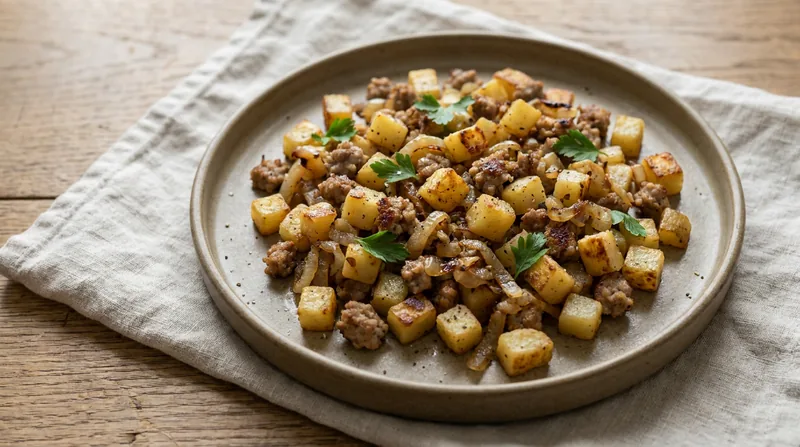
Breakfast · British
Sausage and Potato Hash
A pan-fried breakfast dish combining pork sausage meat, potatoes, and onions.
Ingredients
- pork sausage meat 225 g
- potatoes, diced 300 g
- onion, diced 100 g
- vegetable oil 15 g
- salt 3 g
- black pepper 2 g
Method
- Heat the vegetable oil in a frying pan over medium heat.
- Add the pork sausage meat and cook for 8 minutes, breaking it into small pieces with a spoon.
- Add the diced onion and cook for 5 minutes until soft.
- Stir in the diced potatoes, salt, and black pepper.
- Fry the mixture for 10 minutes, turning occasionally, until the potatoes are browned.
Nutrition per serving, calculated across 6 USDA ingredient records. Expect small differences once cooked.
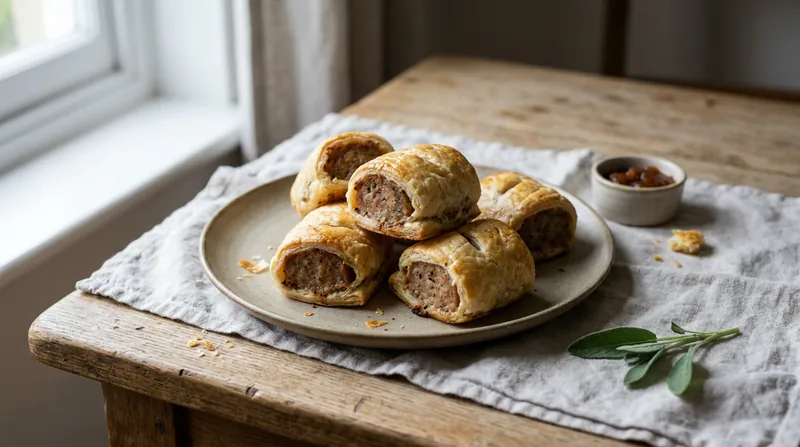
Snack · British
Pork Sausage Rolls
Seasoned sausage meat wrapped in puff pastry and baked until golden.
Ingredients
- pork sausage meat 400 g
- puff pastry sheet 320 g
- egg, beaten 50 g
- dried sage 2 g
- salt 3 g
- black pepper 2 g
Method
- Preheat the oven to 200 degrees Celsius.
- Mix the sausage meat, dried sage, salt, and black pepper in a bowl.
- Roll the puff pastry sheet out and cut it in half lengthways to make two long rectangles.
- Place the sausage mixture along the centre of each pastry strip.
- Brush the edges with beaten egg, roll the pastry over the filling to seal, and cut into 8 pieces.
- Place the rolls on a baking tray and bake for 25 minutes.
Figures are per serving and come from 6 USDA FoodData Central entries; cooking will shift them slightly.
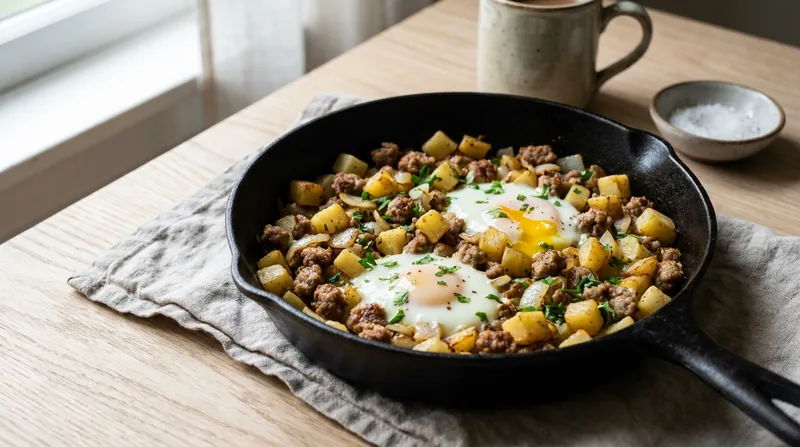
Breakfast · British
Sausage and Egg Breakfast Hash
A breakfast skillet combining pan-fried potatoes, pork sausage, and eggs.
Ingredients
- Diced raw potatoes 200 g
- Pork sausage meat 150 g
- Whole raw eggs 100 g
- Diced raw onion 50 g
- Vegetable oil 10 g
- Table salt 2 g
Method
- Heat the vegetable oil in a frying pan over medium heat.
- Add the diced potatoes and salt, then cook for ten minutes until they begin to soften.
- Crumble the pork sausage meat and diced onion into the pan.
- Fry the mixture for eight minutes until the sausage is browned and cooked through.
- Make two small wells in the mixture, crack an egg into each well, and cover the pan.
- Cook for four minutes until the egg whites are fully set.
Nutrition per serving, calculated across 6 USDA ingredient records. Expect small differences once cooked.

Calorie Counter Team, food critic
One meal, costed: sausage
A worked example, every line from the same USDA data as the table above. Swap any of it; the arithmetic is the point, not the menu.
| Item | Serving | Calories | Protein (g) |
|---|---|---|---|
| Sausage, pan-fried | 1 link | 75 | 4.3 |
| Rice, cooked | 1 cup | 205 | 4.3 |
| Asparagus | 1 cup | 27 | 2.9 |
| Together | 307 | 11 |
Sausage or something else?
Each food is shown per 100 g, in the form named beside it.
| Food | Form | Calories | Protein (g) | Carbs (g) | Fat (g) |
|---|---|---|---|---|---|
| Sausage | Fried | 325 | 19 | 1.4 | 27 |
| Hot dog | Cooked | 322 | 12 | 2.7 | 29 |
| Spam | Canned | 315 | 13 | 4.6 | 27 |
| Ribeye steak | Raw | 241 | 19 | 0.2 | 18 |
| Lamb | Raw | 143 | 21 | 0 | 5.9 |
| Pork chop | Raw | 127 | 22 | 0 | 3.7 |
| Chicken breast | Raw | 120 | 23 | 0 | 2.6 |
Sausage: common questions
How many calories does 1 link of pan-fried sausage have?
USDA measures 1 link of pan-fried sausage at 75 calories, or 325 calories for each 100 g. The record used is “Pork sausage, link/patty, cooked, pan-fried” (FDC 174578).
How much protein does sausage have?
4.3 g in 1 link of pan-fried sausage, or 19 g per 100 g. That is 9 percent of the 50 g Daily Value.
Is sausage higher in calories once it is prepared?
Yes, by a measurable amount: 23 g goes from 66 calories (as sold) to 75 (fried), depending on preparation.
Can you eat sausage when trying to lose weight?
It can fit any calorie target; no single food decides the outcome. What matters here is that 1 link of pan-fried sausage costs 75 calories and returns 4.3 g of protein, so 23 percent of its energy is protein — which means it needs a protein-rich partner on the plate.
How do you know when raw sausage is cooked through?
The centre must lose its pinkness and feel firm when pressed. A meat thermometer inserted into the middle should register the safe internal standard, but avoid piercing the casing repeatedly, which drains the fat and dries the meat.
Should you remove the casing before cooking sausage?
Only if you want crumbled meat for sauces or stuffing. Otherwise, keep the casing intact. It holds the shape, seals in the melting fat during cooking, and creates a crisp outer texture that contrasts with the soft filling.
Sources
- Pork sausage, link/patty, unprepared — USDA FoodData Central, FDC ID 172934
- Pork sausage, link/patty, cooked, pan-fried — USDA FoodData Central, FDC ID 174578
- Daily Values for nutrition labelling, 21 CFR 101.9
Stop doing this by hand.
You just looked up one food. CalorieCounter reads a whole plate from a photo, serving and preparation included. It is coming to the App Store for iPhone — leave your email and you get the link the day it is live.