Meat and poultry
Chicken breast nutrition, by serving and by method.
4 oz of raw chicken breast comes to 136 calories. Protein accounts for 25 g of what is there. The record behind it is USDA’s “Chicken, broiler or fryers, breast, skinless, boneless, meat only, raw”. Cook it differently and that moves: the spread across the forms below is 120 to 187 calories per 100 g. Pick a portion in the panel and it recalculates on the spot; the nutrient table further down moves with it.
Every value traces to USDA FoodData Central (171078, 171477, 171077, 171534); Daily Values follow the FDA label rules.
The calorie count for chicken breast
At 120 calories per 100 g, 4 oz of raw chicken breast comes to 136. The weights shown for each portion come straight from the USDA record.
| Serving | Weight (g) | Calories | Protein (g) | Carbs (g) | Fat (g) |
|---|---|---|---|---|---|
| 4 oz | 113 | 136 | 25 | 0 | 3 |
| 1 piece | 272 | 326 | 61 | 0 | 7.1 |
| 1 package | 926 | 1,111 | 208 | 0 | 24 |
| 100 g | 100 | 120 | 23 | 0 | 2.6 |
What chicken breast offers in protein
4 oz of raw chicken breast provides 25 g of protein. Set beside the 50 g reference intake, that is 51 percent. With 75 percent of its calories coming from protein, chicken breast is close to pure protein in practical terms.
Its energy is 21 percent fat, 0 percent carbohydrate and 79 percent protein, meaning it behaves as a protein food in a meal.
Does the method change chicken breast?
Per 100 g, fried chicken breast carries 56 percent more calories than raw — 187 against 120. The difference is fat absorbed from the pan while moisture cooks off.
Each line compares 113 g of chicken breast, prepared a different way.
| Preparation | Calories | Protein (g) | Fat (g) | What it involves |
|---|---|---|---|---|
| Raw chicken breast | 136 | 25 | 3 | Nothing added |
| Grilled chicken breast | 171 | 35 | 3.6 | Dry heat |
| Roasted chicken breast | 186 | 35 | 4 | Dry heat, no added fat |
| Fried chicken breast | 211 | 38 | 5.3 | In cooking fat |
Treat the fried figure as an average. Nobody’s database knows how much fat your pan left behind, a point our piece on AI calorie accuracy goes into.
Buying, cooking and using chicken breast
Chicken breast is the lean pectoral muscle of the bird. You can buy it with the skin and rib bone attached, or as boneless, skinless fillets. Look for plump meat with a pale pink colour. Avoid packets containing excess liquid at the bottom, which suggests the meat has absorbed water during processing.
This cut has little fat, meaning heat dries it out very quickly. The muscle fibres shrink and squeeze out moisture if cooked too long. The common mistake is overcooking it through fear of undercooking. Searing the meat and then poaching or baking gently keeps the centre moist.
Cold shredded breast meat works well in British coronation salads with mayonnaise and curry powder. In stir-fries, thin strips cook rapidly and absorb soy and ginger. The mild flavour also pairs well with tarragon and cream sauces, or sliced inside sandwiches with crisp lettuce and salty bacon.
The complete chicken breast breakdown
4 oz of raw chicken breast delivers niacin (68 percent of the Daily Value), vitamin B6 (54 percent of the Daily Value), selenium (47 percent of the Daily Value). Everything else USDA reports for it is in the table, scaled to your serving.
| Nutrient | Amount | % Daily Value |
|---|
Putting chicken breast into a day of eating
Budget-wise, 4 oz of raw chicken breast costs 7 percent of a 2,000 calorie day and pays back 51 percent of the day’s protein. The TDEE calculator and macro calculator will tell you what those percentages look like against your own targets.
Chicken breast recipes, with the numbers
From the Calorie Counter Team: three dishes built around chicken breast, with per-serving nutrition calculated from the USDA data for every ingredient that goes in.
Lunch · British
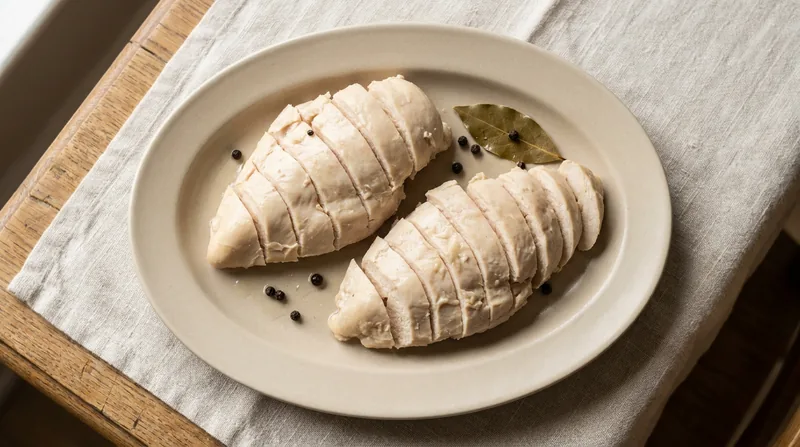
Poached Chicken Breast
Poached chicken breast for salads, sandwiches, or weekly meal preparation.
Ingredients
- Boneless skinless chicken breast 300 g
- Water 1,000 g
- Table salt 5 g
- Whole black peppercorns 2 g
- Dried bay leaf 1 g
Method
- Place the chicken breasts, salt, peppercorns, and bay leaf in a medium saucepan.
- Pour the cold water over the ingredients to cover them completely.
- Bring the water to a gentle simmer over medium heat.
- Reduce the heat to low, cover the pan with a lid, and cook for 15 minutes.
- Remove the chicken from the hot liquid and let it rest for 5 minutes before slicing.
Nutrition per serving, calculated across 5 USDA ingredient records. Expect small differences once cooked.
Dinner · Asian
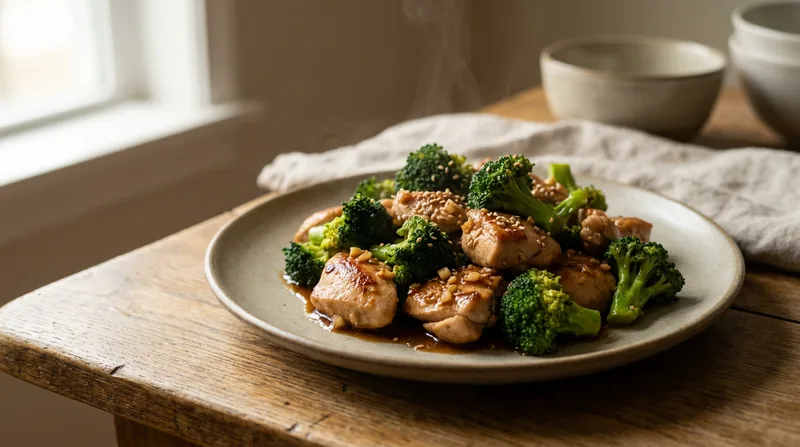
Chicken and Broccoli Stir-Fry
A quick chicken and broccoli stir-fry cooked in a hot pan with ginger and soy sauce.
Ingredients
- Boneless skinless chicken breast 300 g
- Broccoli florets 150 g
- Sesame oil 15 g
- Soy sauce 30 g
- Garlic clove 6 g
- Ginger root 10 g
Method
- Slice the chicken breast into strips of 1 centimetre thickness.
- Heat the sesame oil in a large frying pan over high heat.
- Add the chicken, minced garlic, and grated ginger to the pan and stir constantly for 4 minutes.
- Add the broccoli florets and soy sauce to the mixture.
- Cook the ingredients for 4 more minutes until the chicken is cooked through and the broccoli is tender.
Per serving, from 6 USDA FoodData Central records. Cooking changes weight and some nutrients; treat these as close rather than exact.
Dinner · British
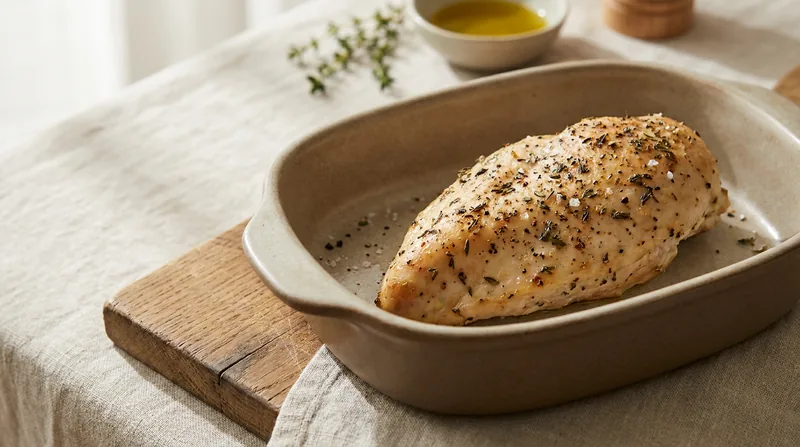
Herb-Baked Chicken Breast
Oven-baked chicken breast seasoned with dried thyme, salt, and black pepper.
Ingredients
- Boneless skinless chicken breast 400 g
- Olive oil 15 g
- Dried thyme 2 g
- Table salt 4 g
- Ground black pepper 2 g
Method
- Preheat the oven to 200 degrees Celsius.
- Rub the chicken breasts evenly with the olive oil, dried thyme, salt, and black pepper.
- Place the seasoned chicken breasts in a shallow baking dish in a single layer.
- Bake in the oven for 20 minutes until the internal temperature of the thickest part reaches 75 degrees Celsius.
- Remove the dish from the oven and let the chicken rest for 5 minutes before serving.
Figures are per serving and come from 5 USDA FoodData Central entries; cooking will shift them slightly.

Calorie Counter Team, food critic
Chicken breast as part of a meal
A sample plate, not a prescription: chicken breast plus two sides, each line sourced and the sum shown.
| Item | Serving | Calories | Protein (g) |
|---|---|---|---|
| Chicken breast, roasted | 1/2 breast | 142 | 27 |
| Pasta | 1 cup spaghetti not packed | 196 | 7.2 |
| Pumpkin | 1 cup | 30 | 1.2 |
| Together | 368 | 35 |
Meat and poultry: where chicken breast sits
All figures are for 100 g. Check the form column before comparing a raw food with a cooked one.
| Food | Form | Calories | Protein (g) | Carbs (g) | Fat (g) |
|---|---|---|---|---|---|
| Bacon | Fried | 468 | 34 | 1.7 | 35 |
| Sausage | Fried | 325 | 19 | 1.4 | 27 |
| Spam | Canned | 315 | 13 | 4.6 | 27 |
| Pork chop | Raw | 127 | 22 | 0 | 3.7 |
| Chicken thigh | Raw | 121 | 20 | 0 | 4.1 |
| Chicken breast | Raw | 120 | 23 | 0 | 2.6 |
| Turkey breast | Raw | 114 | 24 | 0.1 | 1.5 |
What people ask about chicken breast
How many calories are in 4 oz of raw chicken breast?
136 calories, according to USDA FoodData Central: the record is “Chicken, broiler or fryers, breast, skinless, boneless, meat only, raw”, FDC 171077. That works out at 120 per 100 g.
How much protein does chicken breast have?
Per 100 g, chicken breast contains 23 g of protein. 4 oz of raw chicken breast therefore gives 25 g, which is 51 percent of a 50 g day.
Does cooking change the calories in chicken breast?
Yes, by a measurable amount: 113 g goes from 136 calories (raw) to 211 (fried), depending on preparation.
Can you eat chicken breast when trying to lose weight?
It can fit any calorie target; no single food decides the outcome. What matters here is that 4 oz of raw chicken breast costs 136 calories and returns 25 g of protein, so 75 percent of its energy is protein — a ratio that tends to make a target easier to hold.
Why does chicken breast sometimes have a rubbery texture?
This happens when the meat is overcooked, forcing the tightly coiled fibres to contract and squeeze out all moisture. It can also occur if the raw meat was woody, a structural defect in the breast muscle.
How do you stop chicken breast from drying out on the grill?
Flattening the breast to an even thickness using a rolling pin before cooking ensures all parts cook at the same rate. Marinating the meat in yoghurt or oil also protects the lean exterior from the direct heat.
Sources
- Chicken, broiler or fryers, breast, skinless, boneless, meat only, raw — USDA FoodData Central, FDC ID 171077
- Chicken, broilers or fryers, breast, meat only, cooked, roasted — USDA FoodData Central, FDC ID 171477
- Chicken, broiler or fryers, breast, skinless, boneless, meat only, cooked, grilled — USDA FoodData Central, FDC ID 171534
- Chicken, broilers or fryers, breast, meat only, cooked, fried — USDA FoodData Central, FDC ID 171078
- Daily Values for nutrition labelling, 21 CFR 101.9
Stop doing this by hand.
You just looked up one food. CalorieCounter reads a whole plate from a photo, serving and preparation included. It is coming to the App Store for iPhone — leave your email and you get the link the day it is live.