Vegetables
Eggplant nutrition, by serving and by method.
1 cup of eggplant cubes lands at 21 calories and brings 0.8 g of protein with it. In USDA’s database this is “Eggplant, raw”. How it reaches the plate decides the rest, with 100 g measured at 25 calories one way and 35 another. Set the serving below and the panel works it out, with the full nutrient table following your choice.
Figures: USDA FoodData Central, records 169228, 169229. Calculated in your browser; nothing is uploaded.
Eggplant calories by portion
1 cup of eggplant cubes is 21 calories. Per 100 g it is 25. USDA publishes the serving weights below, so these are measured portions rather than rounded guesses.
| Serving | Weight (g) | Calories | Protein (g) | Carbs (g) | Fat (g) |
|---|---|---|---|---|---|
| 1 cup, cubes | 82 | 21 | 0.8 | 4.8 | 0.1 |
| 1 eggplant, peeled (from 1-1/4 lb) | 458 | 115 | 4.5 | 27 | 0.8 |
| 1 eggplant, unpeeled | 548 | 137 | 5.4 | 32 | 1 |
| 100 g | 100 | 25 | 1 | 5.9 | 0.2 |
How much protein does eggplant provide?
Expect 0.8 g of protein from 1 cup of eggplant cubes, roughly 2 percent of a 50 g day. Eggplant carries almost no protein. It earns its place in a day through carbohydrate, not through protein.
Of every 100 calories, 13 come from protein, 6 from fat and 81 from carbohydrate.
How preparation changes eggplant
Per 100 g, boiled eggplant carries 40 percent more calories than raw — 35 against 25. The difference is water leaving, which concentrates everything that remains.
Same eggplant, same 82 g, different treatment:
| Preparation | Calories | Protein (g) | Fat (g) | What it involves |
|---|---|---|---|---|
| Raw eggplant | 21 | 0.8 | 0.1 | Nothing added |
| Boiled eggplant | 29 | 0.7 | 0.2 | Water only |
Kitchen notes on eggplant
Eggplant, or aubergine, is a spongy fruit grown in various shapes. Common types include the large, dark purple globe variety, slender Asian cultivars, and small green globes. Choose specimens that feel heavy for their size with smooth, taut skin. Avoid any with soft spots, brown patches, or dull, wrinkled skin which indicates age.
This flesh acts like a sponge, drawing in oil during frying. The most common error is undercooking, which leaves the texture rubbery and bitter. High heat or long baking collapses the internal structure, turning the white flesh creamy and mild. Salt drawing out moisture before cooking helps prevent excess oil absorption.
Cooked aubergine accepts strong flavours readily. It features in Levantine dips mashed with sesame paste, and in Mediterranean stews alongside tomatoes, garlic, and olive oil. East Asian preparations often pair the sliced fruit with soy sauce, ginger, and fermented bean pastes. Always cook aubergine fully before eating.
Everything USDA measures in eggplant
The table follows the selector above, so change the serving or the method and every row updates. Values are per serving, not per 100 g, unless you pick 100 g.
| Nutrient | Amount | % Daily Value |
|---|
There are 3 g of fibre in 100 g, roughly 11 percent of the daily figure.
Eggplant against a daily budget
Budget-wise, 1 cup of eggplant cubes costs 1 percent of a 2,000 calorie day and pays back 2 percent of the day’s protein. The TDEE calculator and macro calculator will tell you what those percentages look like against your own targets.
Cooking with eggplant: three recipes
Written by the Calorie Counter Team. The nutrition under each one is not an estimate: every ingredient is matched to its USDA FoodData Central record and the totals are summed from those, then divided by the servings.
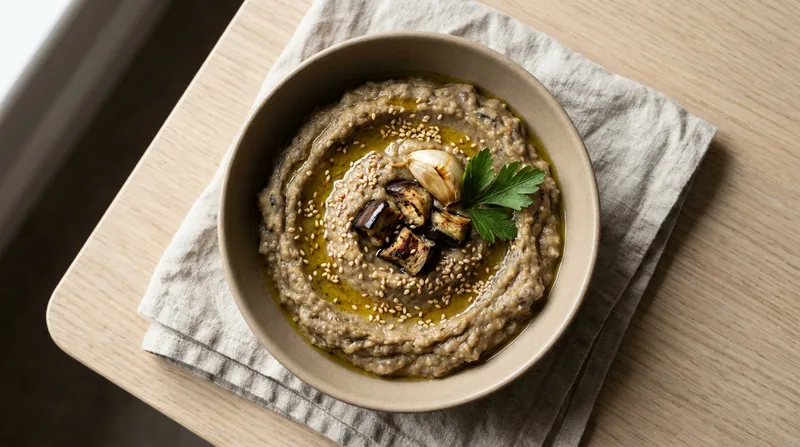
Snack · Middle Eastern
Roasted Aubergine Dip
A thick dip made from roasted aubergine, sesame paste, and lemon juice.
Ingredients
- Aubergine 500 g
- Tahini 30 g
- Lemon juice 15 g
- Garlic 6 g
- Olive oil 15 g
- Salt 3 g
Method
- Prick the aubergines with a fork and roast them at 200 degrees Celsius for 40 minutes.
- Cut the aubergines open, scoop out the flesh, and discard the skins.
- Place the flesh in a colander for 10 minutes to drain excess liquid.
- Mash the flesh with a fork until it forms a coarse paste.
- Stir in the tahini, lemon juice, minced garlic, olive oil, and salt.
Figures are per serving and come from 6 USDA FoodData Central entries; cooking will shift them slightly.
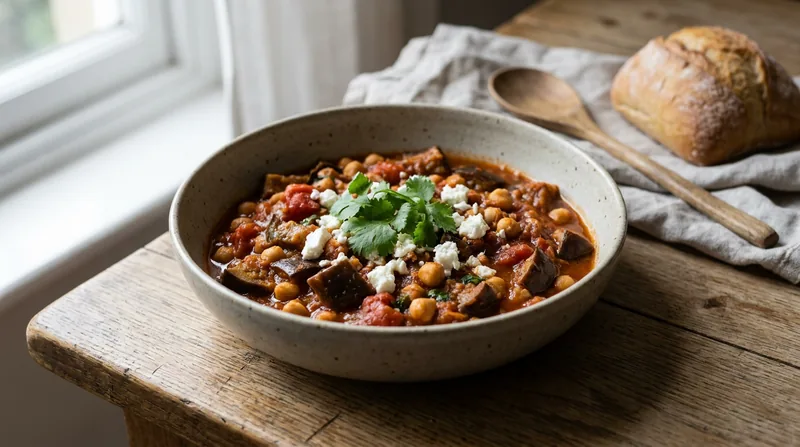
Dinner · Mediterranean
Aubergine and Chickpea Stew
A hearty stew of aubergine, chickpeas, and tomatoes, seasoned with cumin.
Ingredients
- Aubergine 400 g
- Canned chickpeas 240 g
- Canned chopped tomatoes 400 g
- Onion 110 g
- Olive oil 20 g
- Garlic 6 g
- Ground cumin 2 g
- Salt 4 g
Method
- Chop the aubergine into 2-centimetre cubes and finely dice the onion and garlic.
- Heat the olive oil in a saucepan over medium heat and cook the onion for 5 minutes.
- Add the aubergine, garlic, cumin, and salt, then cook for 10 minutes.
- Pour in the canned tomatoes and drained chickpeas.
- Simmer the mixture on low heat for 15 minutes, stirring occasionally.
Figures are per serving and come from 8 USDA FoodData Central entries; cooking will shift them slightly.
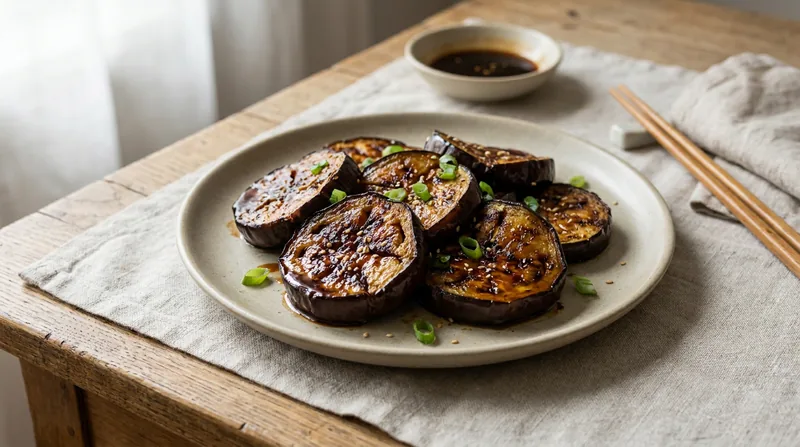
Lunch · East Asian
Pan-Seared Aubergine Slices
Aubergine slices cooked in a frying pan and coated in a sweet soy glaze.
Ingredients
- Aubergine 300 g
- Canola oil 15 g
- Soy sauce 15 g
- Honey 15 g
- Water 30 g
- Sesame seeds 3 g
Method
- Slice the aubergine into rounds of 1-centimetre thickness.
- Whisk the soy sauce, honey, and water together in a bowl.
- Heat the canola oil in a frying pan over medium heat and fry the slices for 4 minutes on each side.
- Pour the soy sauce mixture into the pan and cook for 2 minutes until the liquid thickens.
- Transfer the slices to a plate and sprinkle with sesame seeds.
6 USDA records went into this total. It describes the ingredients as weighed, not the dish after cooking losses.

Calorie Counter Team, food critic
A plate built around eggplant
What a meal containing eggplant comes to, using USDA numbers for every part of it.
| Item | Serving | Calories | Protein (g) |
|---|---|---|---|
| Eggplant | 1 cup, cubes | 21 | 0.8 |
| Ham, roasted | 3 oz | 140 | 19 |
| Rice, cooked | 1 cup | 205 | 4.3 |
| Together | 366 | 24 |
Vegetables: where eggplant sits
Compared gram for gram, with the form of each food stated. Follow any link for that food’s full page.
| Food | Form | Calories | Protein (g) | Carbs (g) | Fat (g) |
|---|---|---|---|---|---|
| Potato | Raw | 77 | 2.1 | 17 | 0.1 |
| Bell pepper | Raw | 26 | 1 | 6 | 0.3 |
| Eggplant | Raw | 25 | 1 | 5.9 | 0.2 |
| Cabbage | Raw | 25 | 1.3 | 5.8 | 0.1 |
| Cauliflower | Raw | 25 | 1.9 | 5 | 0.3 |
| Zucchini | Raw | 17 | 1.2 | 3.1 | 0.3 |
| Celery | Raw | 14 | 0.7 | 3 | 0.2 |
Common questions on eggplant
How many calories does 1 cup of eggplant cubes have?
1 cup of eggplant cubes is 21 calories. That comes from the USDA record “Eggplant, raw” (FDC 169228), which is 25 calories per 100 g.
Is there much protein in eggplant?
You get 0.8 g from 1 cup of eggplant cubes, equal to 2 percent of the daily reference amount; 100 g holds 1 g.
Do the calories in eggplant change with how it is prepared?
Yes. At 82 g, raw is 21 calories and boiled is 29. The table above compares each preparation of eggplant covered on this page.
Is eggplant good for weight loss?
No food causes or prevents weight loss on its own. The useful facts are that 1 cup of eggplant cubes is 21 calories with 0.8 g of protein, which makes 16 percent of its calories protein; so pair it with something that carries more protein.
Do you need to peel eggplant before cooking?
Peeling is unnecessary for young, small aubergines with tender skins. Larger, older specimens often have thick, bitter skins that are tough to chew. You should peel these older fruits or scoop out the cooked flesh after roasting.
How do you stop eggplant from absorbing too much oil?
Salt the sliced flesh and let it rest to draw out moisture, then pat dry before cooking. Alternatively, brushing the slices lightly with oil rather than pouring oil into the pan prevents the flesh from soaking up too much liquid.
Sources
- Eggplant, raw — USDA FoodData Central, FDC ID 169228
- Eggplant, cooked, boiled, drained, without salt — USDA FoodData Central, FDC ID 169229
- Daily Values for nutrition labelling, 21 CFR 101.9
Stop doing this by hand.
You just looked up one food. CalorieCounter reads a whole plate from a photo, serving and preparation included. It is coming to the App Store for iPhone — leave your email and you get the link the day it is live.