Grains and starches
Couscous nutrition, by serving and by method.
1 cup of cooked couscous comes to 176 calories. Protein accounts for 6 g of what is there. Those numbers describe “Couscous, cooked” in USDA FoodData Central. Between the lightest and heaviest preparation listed here, 100 g differs by 264 calories. The panel underneath takes any serving and any amount, and the vitamin and mineral table tracks what you pick.
Source data is USDA FoodData Central (169700, 169699). The sums run on your device and nothing leaves it.
How many calories are in couscous?
1 cup of cooked couscous supplies 176 calories, which scales to 112 per 100 g. Each serving listed underneath was weighed by USDA rather than estimated.
| Serving | Weight (g) | Calories | Protein (g) | Carbs (g) | Fat (g) |
|---|---|---|---|---|---|
| yield of 1 oz dry | 86 | 96 | 3.3 | 20 | 0.1 |
| 1 cup, cooked | 157 | 176 | 6 | 36 | 0.3 |
| yield of 1 cup dry | 528 | 591 | 20 | 123 | 0.8 |
| 100 g | 100 | 112 | 3.8 | 23 | 0.2 |
Protein in couscous, measured
1 cup of cooked couscous carries 6 g of protein, which is 12 percent of the 50 g Daily Value. You would not choose couscous for protein: just 14 percent of its calories come from it.
By calories rather than by weight the split is 14 percent protein, 1 percent fat and 85 percent carbohydrate, so in practice it is mostly a carbohydrate rather than anything else.
Does the method change couscous?
Cooked, couscous is 112 calories per 100 g; as sold, it is 376. The extra 236 percent comes from water absorbed during cooking, which dilutes every gram.
Same couscous, same 157 g, different treatment:
| Preparation | Calories | Protein (g) | Fat (g) | What it involves |
|---|---|---|---|---|
| Cooked couscous | 176 | 6 | 0.3 | Prepared |
| Couscous, as sold | 590 | 20 | 1 | As purchased |
Kitchen notes on couscous
This steamed semolina pasta comes in several sizes. Fine grains are common for North African dishes, whilst larger pearl couscous, sometimes called Israeli couscous, has a chewier texture. Look for uniform colour and dry, separate grains. Avoid packages with fine dust at the bottom, which indicates the grains have rubbed together and broken.
Standard couscous needs steaming or soaking in hot liquid rather than boiling. The most frequent error is overwatering, which yields a sticky porridge. After the grains absorb the liquid, you must fluff them with a fork to separate them. Pearl varieties require boiling and draining, behaving more like traditional pasta.
Serve fine couscous under slow-cooked Levantine stews or Moroccan tagines to catch the rich juices. It also works cold in Mediterranean salads, tossed with olive oil, lemon, and chopped herbs. The neutral grain readily absorbs the flavours of whatever broth or fat you add during preparation.
Micronutrients in couscous
Against the Daily Value, 1 cup of cooked couscous stands out for 79 percent of a day’s selenium. The table follows the selector above, so change the serving or the method and it updates.
| Nutrient | Amount | % Daily Value |
|---|
Couscous and your daily targets
On a 2,000 calorie day, 1 cup of cooked couscous is 9 percent of the budget and 12 percent of the protein Daily Value. Whether that is a lot depends on your own numbers rather than on 2,000: the TDEE calculator gives you what you burn, and the macro calculator turns a target into grams.
Three recipes built around couscous
From the Calorie Counter Team: three dishes built around couscous, with per-serving nutrition calculated from the USDA data for every ingredient that goes in.
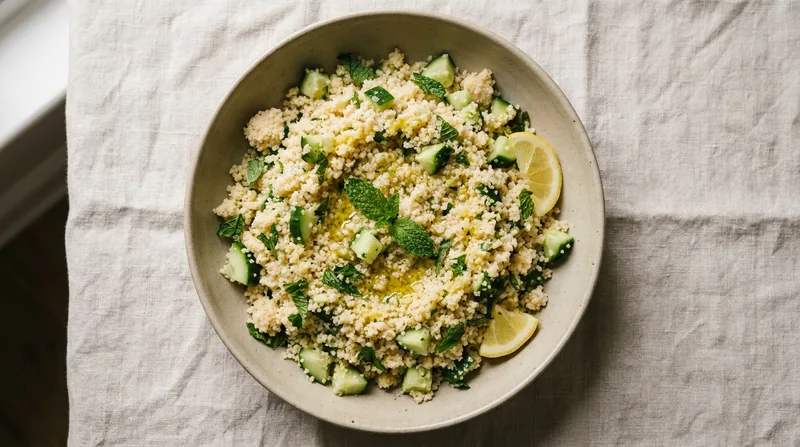
Lunch · Mediterranean
Lemon and Herb Couscous Salad
A cold couscous salad mixed with fresh cucumber, mint, and lemon juice.
Ingredients
- Dry couscous 150 g
- Boiling water 150 g
- Olive oil 15 g
- Lemon juice 15 g
- Cucumber 100 g
- Fresh mint 5 g
- Table salt 2 g
Method
- Place the dry couscous and salt in a heatproof bowl.
- Pour the boiling water over the couscous.
- Cover the bowl with a plate for five minutes.
- Fluff the warm couscous with a fork.
- Stir in the olive oil, lemon juice, cucumber, and mint.
Per serving, from 7 USDA FoodData Central records. Cooking changes weight and some nutrients; treat these as close rather than exact.
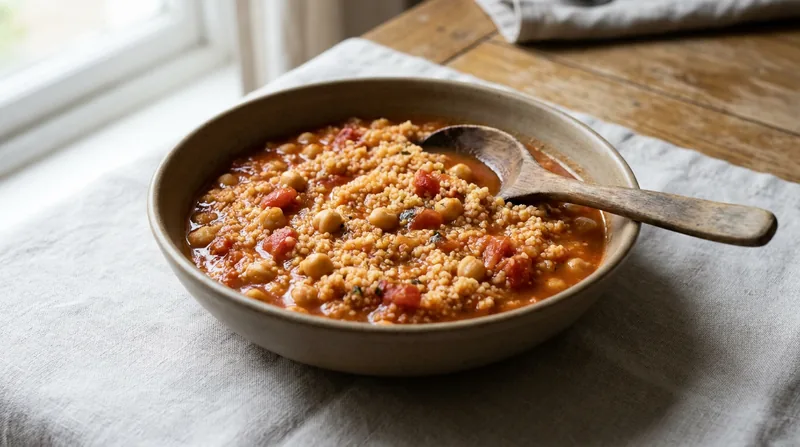
Dinner · North African
Chickpea and Tomato Couscous
A warm one-pot meal of couscous cooked in a tomato broth with chickpeas.
Ingredients
- Dry couscous 120 g
- Olive oil 14 g
- Onion 80 g
- Canned chickpeas 150 g
- Canned chopped tomatoes 200 g
- Vegetable stock 150 g
- Table salt 3 g
Method
- Heat the olive oil in a saucepan.
- Sauté the onion for five minutes.
- Add the tomatoes, chickpeas, vegetable stock, and salt.
- Bring the liquid to a boil.
- Stir in the dry couscous and cover the saucepan.
- Let the pan stand off the heat for five minutes.
Per serving, from 7 USDA FoodData Central records. Cooking changes weight and some nutrients; treat these as close rather than exact.
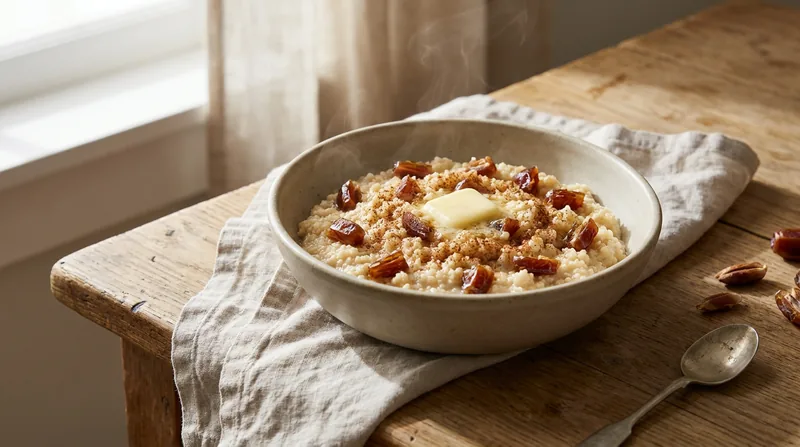
Breakfast · Middle Eastern
Warm Date and Cinnamon Couscous
A warm breakfast couscous cooked in milk with sweet dates and ground cinnamon.
Ingredients
- Dry couscous 100 g
- Whole milk 200 g
- Dried dates 40 g
- Unsalted butter 10 g
- Ground cinnamon 1 g
Method
- Combine the milk, butter, dates, and cinnamon in a saucepan.
- Heat the mixture until it reaches a gentle simmer.
- Stir in the dry couscous.
- Cover the saucepan with a lid.
- Let the pan stand off the heat for seven minutes.
- Stir the warm mixture before serving.
Nutrition per serving, calculated across 5 USDA ingredient records. Expect small differences once cooked.

Calorie Counter Team, food critic
One meal, costed: couscous
One way to build a meal around couscous, costed from the same records. Substitute freely; the method carries over.
| Item | Serving | Calories | Protein (g) |
|---|---|---|---|
| Couscous, cooked | 1 cup, cooked | 176 | 6 |
| Chicken breast, roasted | 1/2 breast | 142 | 27 |
| Bell pepper | 1 medium | 31 | 1.2 |
| Together | 349 | 34 |
Grains and starches: where couscous sits
Each food is shown per 100 g, in the form named beside it.
| Food | Form | Calories | Protein (g) | Carbs (g) | Fat (g) |
|---|---|---|---|---|---|
| Waffle | Cooked | 291 | 7.9 | 33 | 14 |
| English muffin | As sold | 235 | 7.7 | 46 | 1.8 |
| Pancake | Cooked | 227 | 6.4 | 28 | 9.7 |
| Barley | Cooked | 123 | 2.3 | 28 | 0.4 |
| Brown rice | Cooked | 123 | 2.7 | 26 | 1 |
| Quinoa | Cooked | 120 | 4.4 | 21 | 1.9 |
| Couscous | Cooked | 112 | 3.8 | 23 | 0.2 |
Questions about couscous
How many calories are in 1 cup of cooked couscous?
176 calories, according to USDA FoodData Central: the record is “Couscous, cooked”, FDC 169700. That works out at 112 per 100 g.
How much protein is in couscous?
3.8 g per 100 g, so 1 cup of cooked couscous supplies 6 g. Against the Daily Value that is 12 percent.
Does cooking change the calories in couscous?
Yes, by a measurable amount: 157 g goes from 176 calories (cooked) to 590 (as sold), depending on preparation.
Is couscous good for weight loss?
It can fit any calorie target; no single food decides the outcome. What matters here is that 1 cup of cooked couscous costs 176 calories and returns 6 g of protein, so 14 percent of its energy is protein — useful alongside a protein source rather than as one.
Why is my cooked couscous clumping together?
You likely used too much liquid or neglected to fluff it immediately. Pouring a small amount of oil or melted butter through the grains before adding the hot liquid helps keep them separate.
Can I use couscous as a substitute for rice?
Yes, but remember that couscous is pasta, not a grain, so it softens much faster. It will not withstand long simmering in a pot of soup like rice does; add it only at the very end.
Sources
- Couscous, dry — USDA FoodData Central, FDC ID 169699
- Couscous, cooked — USDA FoodData Central, FDC ID 169700
- Daily Values for nutrition labelling, 21 CFR 101.9
Stop doing this by hand.
You just looked up one food. CalorieCounter reads a whole plate from a photo, serving and preparation included. It is coming to the App Store for iPhone — leave your email and you get the link the day it is live.