Grains and starches
Barley nutrition, and what the pan changes.
On USDA figures, 1 cup of cooked barley works out at 193 calories and carries 3.5 g of protein. Those numbers describe “Barley, pearled, cooked” in USDA FoodData Central. How it reaches the plate decides the rest, with 100 g measured at 123 calories one way and 352 another. Change the amount below for your own portion. The panel and the nutrient breakdown both update.
Figures: USDA FoodData Central, records 170285, 170284. Calculated in your browser; nothing is uploaded.
How many calories does barley have?
1 cup of cooked barley supplies 193 calories, which scales to 123 per 100 g. Each serving listed underneath was weighed by USDA rather than estimated.
| Serving | Weight (g) | Calories | Protein (g) | Carbs (g) | Fat (g) |
|---|---|---|---|---|---|
| 1 cup | 157 | 193 | 3.5 | 44 | 0.7 |
| 100 g | 100 | 123 | 2.3 | 28 | 0.4 |
Barley and its protein content
For protein, 1 cup of cooked barley gives you 3.5 g, which fills 7 percent of the daily 50 g benchmark. Only 7 percent of its calories come from protein, so treat barley as something you eat for other reasons and count the protein as a bonus.
The calorie breakdown runs 7 percent protein to 3 percent fat to 90 percent carbohydrate. Functionally, that is mostly a carbohydrate.
Does the method change barley?
Per 100 g, raw barley carries 186 percent more calories than cooked — 352 against 123. The difference is water absorbed during cooking, which dilutes every gram.
Every row below is the same 157 g of barley, so the only thing that differs is the method.
| Preparation | Calories | Protein (g) | Fat (g) | What it involves |
|---|---|---|---|---|
| Cooked barley | 193 | 3.5 | 0.7 | Prepared |
| Raw barley | 553 | 16 | 1.8 | Nothing added |
What to know before you cook barley
This cereal grain appears in shops as hulled barley or pearl barley. Hulled barley retains its outer bran layer, appearing dark brown. Pearl barley is polished, showing a pale cream colour. Choose pearl barley for quicker cooking. Look for uniform grain sizes in the packet to ensure even cooking later. Avoid dusty packets.
Barley releases starch as it simmers, thickening its cooking liquid into a slick broth. The grains swell significantly but retain a distinct, chewy bite even when fully cooked. The most common mistake is failing to rinse pearl barley, which leaves excess surface starch that makes dishes gummy rather than pleasantly thick.
British cooks traditionally stir pearl barley into slow-cooked beef stews to absorb the rich meat juices. In Italian kitchens, it replaces rice in a slow-stirred, creamy dish called orzotto. The grain pairs exceptionally well with earthy mushrooms, root vegetables, woody herbs like rosemary, and sharp cheeses.
Barley: the full nutrient profile
1 cup of cooked barley delivers selenium (25 percent of the Daily Value), niacin (20 percent of the Daily Value). Everything else USDA reports for it is in the table, scaled to your serving.
| Nutrient | Amount | % Daily Value |
|---|
Fibre runs to 3.8 g per 100 g, or 14 percent of the Daily Value.
Putting barley into a day of eating
If you eat 2,000 calories a day, 1 cup of cooked barley accounts for 10 percent of them, and for 7 percent of the 50 g protein benchmark. To replace 2,000 with your real number, use the TDEE calculator; to turn that into targets, the macro calculator.
Three ways to cook barley
Each of these comes from the Calorie Counter Team, and each carries nutrition worked out from its ingredients’ USDA entries rather than estimated from the finished dish.
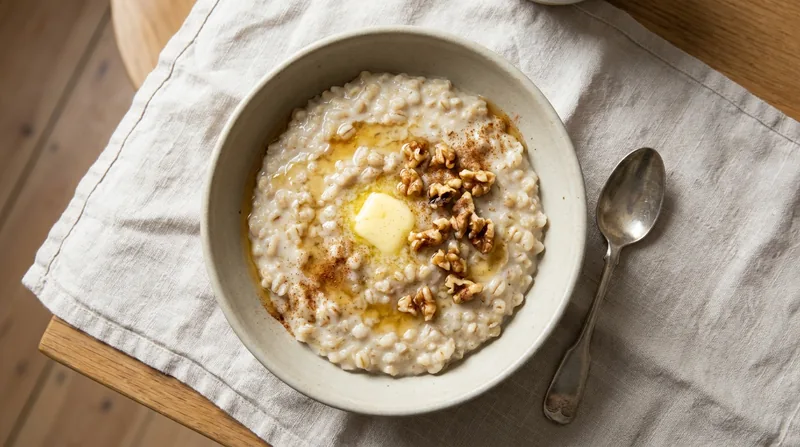
Breakfast · British
Barley Breakfast Porridge
A hot breakfast cereal made with simmered pearled barley, milk and honey.
Ingredients
- Pearled barley 100 g
- Whole milk 300 g
- Water 300 g
- Salt 2 g
- Honey 20 g
Method
- Rinse the barley in cold water and drain it.
- Combine the rinsed barley, milk, water and salt in a small saucepan.
- Bring the liquid to a boil over medium heat.
- Simmer gently for 40 minutes, stirring occasionally, until the barley is tender.
- Stir in the honey before serving.
Per serving, from 5 USDA FoodData Central records. Cooking changes weight and some nutrients; treat these as close rather than exact.
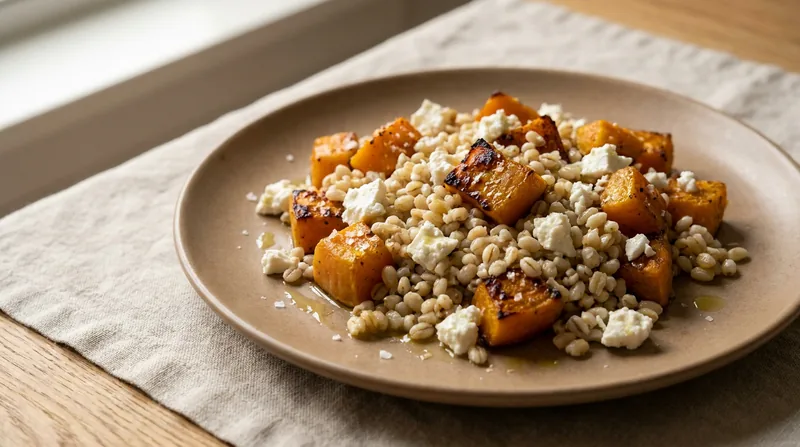
Side · British
Roasted Squash and Barley Salad
A warm salad of baked butternut squash, boiled barley and crumbled feta cheese.
Ingredients
- Pearled barley 200 g
- Butternut squash 400 g
- Olive oil 27 g
- Feta cheese 100 g
- Salt 3 g
- Water 800 g
Method
- Heat the oven to 200 degrees Celsius.
- Toss the cubed butternut squash with 14 grams of olive oil and 1 gram of salt on a baking tray.
- Roast the squash in the oven for 25 minutes.
- Boil the barley in the water with 2 grams of salt for 35 minutes, then drain.
- Combine the warm barley, roasted squash, remaining olive oil and crumbled feta cheese in a bowl.
Figures are per serving and come from 6 USDA FoodData Central entries; cooking will shift them slightly.
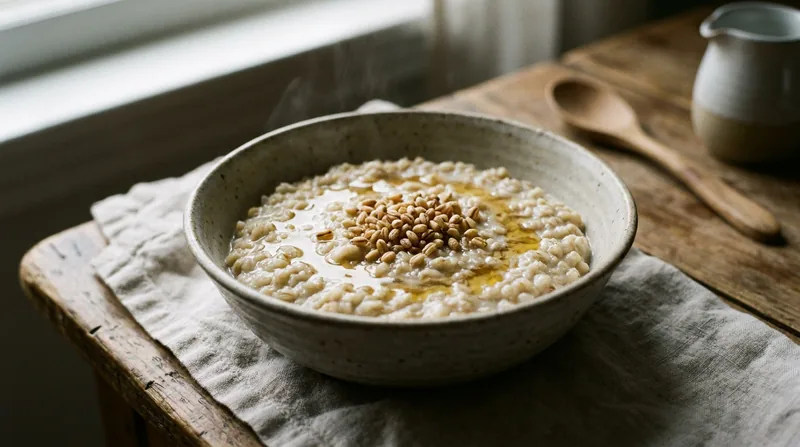
Breakfast · British
Pearl Barley Breakfast Porridge
A hot breakfast porridge made with simmered pearl barley, whole milk, and honey.
Ingredients
- pearl barley 100 g
- water 400 g
- salt 2 g
- whole milk 150 g
- honey 15 g
Method
- Rinse 100g of pearl barley in a sieve under cold water.
- Combine the barley, 400g of water, and 2g of salt in a saucepan.
- Simmer the mixture on low heat for 40 minutes.
- Pour in 150g of whole milk and cook for 10 minutes.
- Stir 15g of honey into the porridge.
Built from 5 USDA ingredient records. A cooked dish never matches its raw sum exactly, but it stays close.

Calorie Counter Team, food critic
One meal, costed: barley
What a meal containing barley comes to, using USDA numbers for every part of it.
| Item | Serving | Calories | Protein (g) |
|---|---|---|---|
| Barley, cooked | 1 cup | 193 | 3.5 |
| Pork chop, grilled | 1 chop | 263 | 39 |
| Bell pepper | 1 medium | 31 | 1.2 |
| Together | 487 | 44 |
Barley against other grains and starches
Each food is shown per 100 g, in the form named beside it.
| Food | Form | Calories | Protein (g) | Carbs (g) | Fat (g) |
|---|---|---|---|---|---|
| Rice cake | As sold | 387 | 8.2 | 82 | 2.8 |
| Bagel | As sold | 275 | 11 | 53 | 1.6 |
| Rice | Cooked | 130 | 2.7 | 28 | 0.3 |
| Barley | Cooked | 123 | 2.3 | 28 | 0.4 |
| Brown rice | Cooked | 123 | 2.7 | 26 | 1 |
| Quinoa | Cooked | 120 | 4.4 | 21 | 1.9 |
| Couscous | Cooked | 112 | 3.8 | 23 | 0.2 |
What people ask about barley
How many calories does 1 cup of cooked barley have?
1 cup of cooked barley is 193 calories. That comes from the USDA record “Barley, pearled, cooked” (FDC 170285), which is 123 calories per 100 g.
Is there much protein in barley?
3.5 g in 1 cup of cooked barley, or 2.3 g per 100 g. That is 7 percent of the 50 g Daily Value.
Is barley higher in calories once it is prepared?
Yes. At 157 g, cooked is 193 calories and raw is 553. The table above compares each preparation of barley covered on this page.
Is barley good for weight loss?
It can fit any calorie target; no single food decides the outcome. What matters here is that 1 cup of cooked barley costs 193 calories and returns 3.5 g of protein, so 7 percent of its energy is protein — so pair it with something that carries more protein.
Do I need to soak barley before cooking it?
Soaking is not required for pearl barley, though it reduces the boiling time. Hulled barley benefits from soaking beforehand in cold water. Soaking helps the tough outer bran layer soften more evenly during subsequent simmering.
How can I tell when barley is fully cooked?
Cooked barley is tender but retains a distinct, springy resistance in the centre when bitten. If the grain is mushy, it is overcooked. If the centre feels chalky or hard, continue simmering with more liquid.
Sources
- Barley, pearled, raw — USDA FoodData Central, FDC ID 170284
- Barley, pearled, cooked — USDA FoodData Central, FDC ID 170285
- Daily Values for nutrition labelling, 21 CFR 101.9
Stop doing this by hand.
You just looked up one food. CalorieCounter reads a whole plate from a photo, serving and preparation included. It is coming to the App Store for iPhone — leave your email and you get the link the day it is live.