Grains and starches
Popcorn nutrition, before and after the heat.
31 calories and 1 g of protein: that is 1 cup of popcorn. Those numbers describe “Snacks, popcorn, air-popped” in USDA FoodData Central. Preparation shifts it more than most tables admit, from 387 calories per 100 g at the low end to 500 at the top. Set the serving below and the panel works it out, with the full nutrient table following your choice.
Every value traces to USDA FoodData Central (167959, 169861); Daily Values follow the FDA label rules.
Popcorn calories by portion
At 387 calories per 100 g, 1 cup of popcorn comes to 31. The weights shown for each portion come straight from the USDA record.
| Serving | Weight (g) | Calories | Protein (g) | Carbs (g) | Fat (g) |
|---|---|---|---|---|---|
| 1 cup | 8 | 31 | 1 | 6.2 | 0.4 |
| 1 oz | 28 | 110 | 3.7 | 22 | 1.3 |
| 100 g | 100 | 387 | 13 | 78 | 4.5 |
How much protein is in popcorn?
Protein in 1 cup of popcorn comes to 1 g. Against the 50 g Daily Value, that covers 2 percent. Protein is a minor part of popcorn, at 13 percent of its calories. The case for eating it lies elsewhere.
Its energy is 10 percent fat, 77 percent carbohydrate and 13 percent protein, meaning it behaves as mostly a carbohydrate in a meal.
Popcorn, method by method
As sold, popcorn is 387 calories per 100 g; oil-popped, it is 500. The extra 29 percent comes from the cooking fat, which stays in the food after the water has gone.
To keep it fair, all figures are for 8 g.
| Preparation | Calories | Protein (g) | Fat (g) | What it involves |
|---|---|---|---|---|
| Popcorn, as sold | 31 | 1 | 0.4 | As purchased |
| Oil-popped popcorn | 40 | 0.7 | 2.2 | Popped in oil |
The fried row carries the most uncertainty of any on this page, since absorbed fat is invisible to a camera and a database alike. More on that in how accurate AI calorie apps are.
What to know before you cook popcorn
Popcorn is a specific variety of flint maize with a hard outer hull holding a small droplet of water. You can buy it as loose kernels, categorised by the shape they take when popped: butterfly shapes, or round mushroom shapes. Choose kernels sold in sealed containers to keep their internal moisture level constant.
Heat causes the trapped water inside the kernel to expand into steam. This pressure builds until the hull ruptures, turning the starch inside out. The most common error is keeping the lid completely sealed. This traps steam in the pan, which dampens the popped kernels and makes them chewy rather than crisp.
Serve popcorn warm. It carries fat and dry seasonings well. In North America, cooks toss it with melted butter and salt. In Mexico, people shake it with lime juice and chilli powder. In East Asia, cooks season the popped corn with seaweed flakes, sesame seeds and savoury soy powder.
Popcorn: the full nutrient profile
The table follows the selector above, so change the serving or the method and every row updates. Values are per serving, not per 100 g, unless you pick 100 g.
| Nutrient | Amount | % Daily Value |
|---|
Popcorn packs 15 g of fibre into 100 g, covering 52 percent of what the label rules call a day’s worth.
Where popcorn fits in a day
If you eat 2,000 calories a day, 1 cup of popcorn accounts for 2 percent of them, and for 2 percent of the 50 g protein benchmark. To replace 2,000 with your real number, use the TDEE calculator; to turn that into targets, the macro calculator.
Recipes that start with popcorn
From the Calorie Counter Team: three dishes built around popcorn, with per-serving nutrition calculated from the USDA data for every ingredient that goes in.
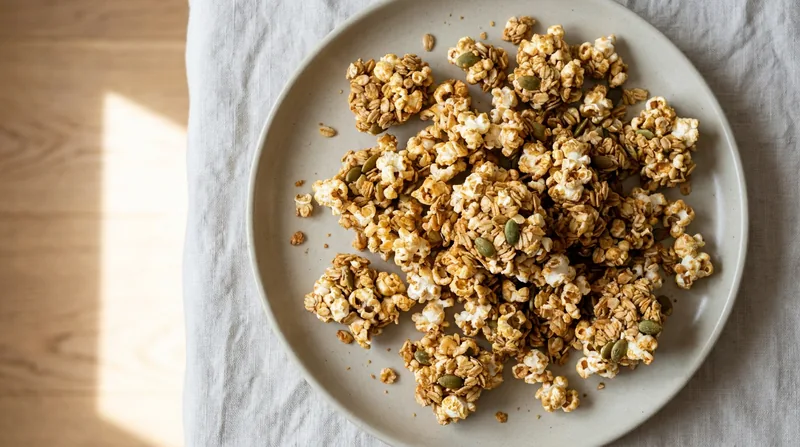
Breakfast · British
Popcorn Granola
Oat and popcorn clusters sweetened with honey and baked until firm.
Ingredients
- popped popcorn 30 g
- rolled oats 100 g
- honey 60 g
- sunflower oil 30 g
- pumpkin seeds 40 g
Method
- Preheat the oven to 150 degrees Celsius and line a baking sheet with parchment paper.
- Mix the popped popcorn, rolled oats, and pumpkin seeds in a 3-litre mixing bowl.
- Warm the honey and sunflower oil in a 1-litre saucepan over low heat until combined.
- Pour the warm liquid over the dry ingredients and stir until evenly coated.
- Spread the mixture onto the prepared baking sheet in a single layer.
- Bake for 20 minutes, stirring halfway through, then cool completely before breaking into clusters.
Nutrition per serving, calculated across 5 USDA ingredient records. Expect small differences once cooked.
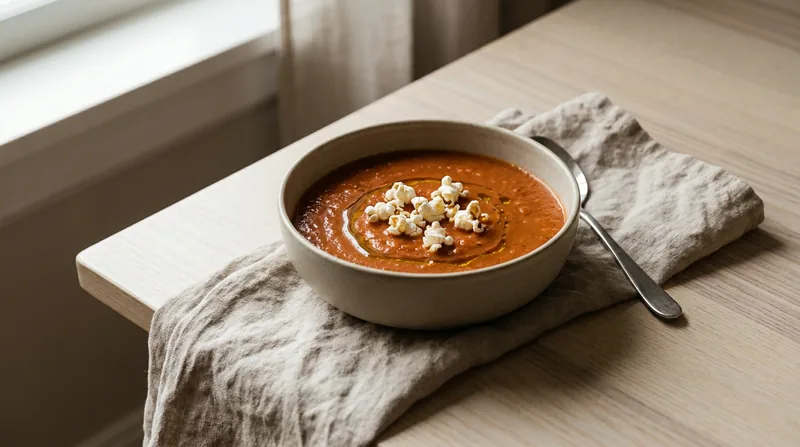
Lunch · British
Popcorn Tomato Soup
A thick tomato soup using blended popcorn as a starch binder.
Ingredients
- popped popcorn 40 g
- canned chopped tomatoes 400 g
- vegetable broth 300 g
- olive oil 15 g
- yellow onion 110 g
- table salt 4 g
Method
- Cook the chopped yellow onion in the olive oil in a 2-litre saucepan over medium heat for five minutes.
- Add the canned chopped tomatoes, vegetable broth, and table salt to the saucepan.
- Stir thirty grams of the popped popcorn into the liquid and simmer for ten minutes.
- Puree the mixture using a hand blender until the soup is completely smooth.
- Pour the soup into bowls and scatter the remaining ten grams of popcorn on top before serving.
Summed from 6 USDA records and divided by servings. Heat alters weight and a few nutrients, so read it as a close figure.
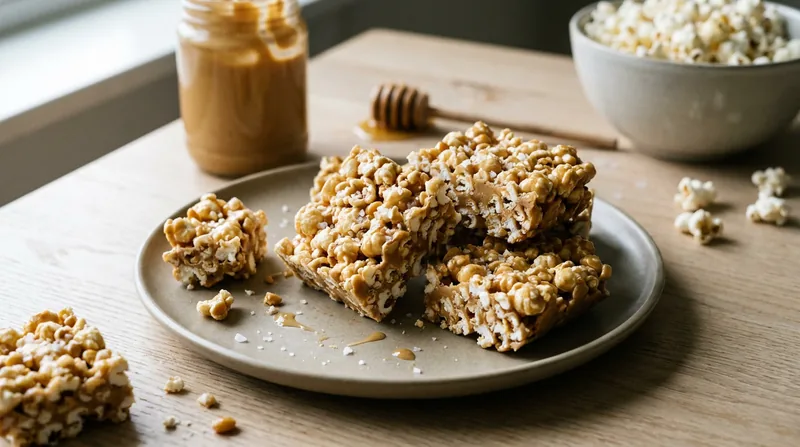
Snack · British
Peanut Popcorn Bars
A firm snack bar made from popped corn bound with sweetened peanut butter.
Ingredients
- plain air-popped popcorn 40 g
- smooth peanut butter 120 g
- honey 85 g
- salt 2 g
Method
- Heat the peanut butter and honey in a saucepan over low heat for 3 minutes until runny.
- Stir the salt into the warm peanut butter mixture.
- Pour the mixture over the popcorn in a large bowl and stir until the popcorn is coated.
- Press the mixture firmly into an 18-centimetre square baking tin lined with greaseproof paper.
- Chill the tin in the fridge for 30 minutes until firm.
- Slice into 4 equal bars using a sharp knife.
Nutrition per serving, calculated across 4 USDA ingredient records. Expect small differences once cooked.

Calorie Counter Team, food critic
One meal, costed: popcorn
One way to build a meal around popcorn, costed from the same records. Substitute freely; the method carries over.
| Item | Serving | Calories | Protein (g) |
|---|---|---|---|
| Popcorn | 1 cup | 31 | 1 |
| Lamb, roasted | 3 oz | 172 | 23 |
| Pumpkin | 1 cup | 30 | 1.2 |
| Together | 233 | 25 |
Grains and starches: where popcorn sits
Same weight for every row, 100 g, so differences are not portion effects. The form column shows whether a row is raw, cooked or as sold.
| Food | Form | Calories | Protein (g) | Carbs (g) | Fat (g) |
|---|---|---|---|---|---|
| Croissant | As sold | 406 | 8.2 | 46 | 21 |
| Popcorn | As sold | 387 | 13 | 78 | 4.5 |
| Rice cake | As sold | 387 | 8.2 | 82 | 2.8 |
| Oats | As sold | 379 | 13 | 68 | 6.5 |
| Tortilla | As sold | 306 | 8.2 | 49 | 8 |
| Pancake | Cooked | 227 | 6.4 | 28 | 9.7 |
| Brown rice | Cooked | 123 | 2.7 | 26 | 1 |
Popcorn, asked and answered
What is the calorie count for 1 cup of popcorn?
1 cup of popcorn is 31 calories. That comes from the USDA record “Snacks, popcorn, air-popped” (FDC 167959), which is 387 calories per 100 g.
How much protein is in popcorn?
13 g per 100 g, so 1 cup of popcorn supplies 1 g. Against the Daily Value that is 2 percent.
Do the calories in popcorn change with how it is prepared?
The weight stays the same but the number moves. 8 g of popcorn is 31 calories as sold, rising to 40 oil-popped.
Is popcorn good for weight loss?
It can fit any calorie target; no single food decides the outcome. What matters here is that 1 cup of popcorn costs 31 calories and returns 1 g of protein, so 13 percent of its energy is protein — so pair it with something that carries more protein.
Why do some kernels remain unpopped at the bottom of the pan?
Unpopped kernels lack the necessary moisture inside to create enough steam pressure. If the hull is cracked, the water escapes before building pressure. Old, dry kernels will also fail to pop.
Should you wash or soak popcorn kernels before cooking them?
Do not wash or soak the kernels. Adding surface water prevents the pan from reaching the high dry heat needed for popping. It also softens the hull, which stops the steam pressure from building up properly.
Sources
- Snacks, popcorn, air-popped — USDA FoodData Central, FDC ID 167959
- Snacks, popcorn, home-prepared, oil-popped, unsalted — USDA FoodData Central, FDC ID 169861
- Daily Values for nutrition labelling, 21 CFR 101.9
Stop doing this by hand.
You just looked up one food. CalorieCounter reads a whole plate from a photo, serving and preparation included. It is coming to the App Store for iPhone — leave your email and you get the link the day it is live.