Grains and starches
Oats nutrition, and what the pan changes.
1 cup of dry oats lands at 307 calories and brings 11 g of protein with it. Specifically, this is the USDA record “Cereals, oats, regular and quick, not fortified, dry”. How it reaches the plate decides the rest, with 100 g measured at 71 calories one way and 379 another. Choose how much you are eating and the panel does the arithmetic from there.
Source data is USDA FoodData Central (173904, 173905). The sums run on your device and nothing leaves it.
How many calories are in oats?
At 379 calories per 100 g, 1 cup of dry oats comes to 307. The weights shown for each portion come straight from the USDA record.
| Serving | Weight (g) | Calories | Protein (g) | Carbs (g) | Fat (g) |
|---|---|---|---|---|---|
| 1/3 cup | 27 | 102 | 3.6 | 18 | 1.8 |
| 1 cup | 81 | 307 | 11 | 55 | 5.3 |
| 100 g | 100 | 379 | 13 | 68 | 6.5 |
What oats offers in protein
1 cup of dry oats carries 11 g of protein, which is 21 percent of the 50 g Daily Value. You would not choose oats for protein: just 14 percent of its calories come from it.
The calorie breakdown runs 14 percent protein to 15 percent fat to 71 percent carbohydrate. Functionally, that is mostly a carbohydrate.
What cooking does to oats
As sold oats comes in at 379 calories per 100 g against 71 for cooked, a gap of 434 percent. What explains it is cooking water soaked up by the dry ingredient.
The table holds the weight constant at 81 g, which leaves the preparation as the single variable.
| Preparation | Calories | Protein (g) | Fat (g) | What it involves |
|---|---|---|---|---|
| Cooked oats | 58 | 2.1 | 1.2 | Prepared |
| Oats, as sold | 307 | 11 | 5.3 | As purchased |
Choosing and cooking oats
Oats are cereal grains sold in several distinct cuts. Groats are the whole kernel. Steel-cut oats are chopped groats. Rolled oats are steamed and flattened by heavy rollers. Quick oats are rolled thinner for rapid water absorption. Look for dust-free packages without broken fragments or damp clumps. Seek out whole, plump flakes with a clean, nutty scent.
Simmering oats in liquid coaxes out starch, creating a thick, creamy texture. Stirring too vigorously during this process breaks the delicate structures and yields a sticky, gluey paste. The most common error is boiling them too rapidly without stirring occasionally. Gentle heat and patience allow the grains to swell and soften without burning.
This grain serves as breakfast porridge across northern Europe, often sweetened with brown sugar or fruit. Scottish tradition favours a savoury preparation with salt and butter. In other regions, cooks stir toasted oats into haggis, grind them into flour for griddle cakes, or mix them into meatloaves to retain juices.
The complete oats breakdown
Top of the list for 1 cup of dry oats: 43 percent of a day’s selenium, 31 percent of a day’s thiamin, 27 percent of a day’s zinc. The remaining nutrients are tabulated underneath and update live.
| Nutrient | Amount | % Daily Value |
|---|
Oats packs 10 g of fibre into 100 g, covering 36 percent of what the label rules call a day’s worth.
Oats and your daily targets
If you eat 2,000 calories a day, 1 cup of dry oats accounts for 15 percent of them, and for 21 percent of the 50 g protein benchmark. To replace 2,000 with your real number, use the TDEE calculator; to turn that into targets, the macro calculator.
Three recipes built around oats
Written by the Calorie Counter Team. The nutrition under each one is not an estimate: every ingredient is matched to its USDA FoodData Central record and the totals are summed from those, then divided by the servings.
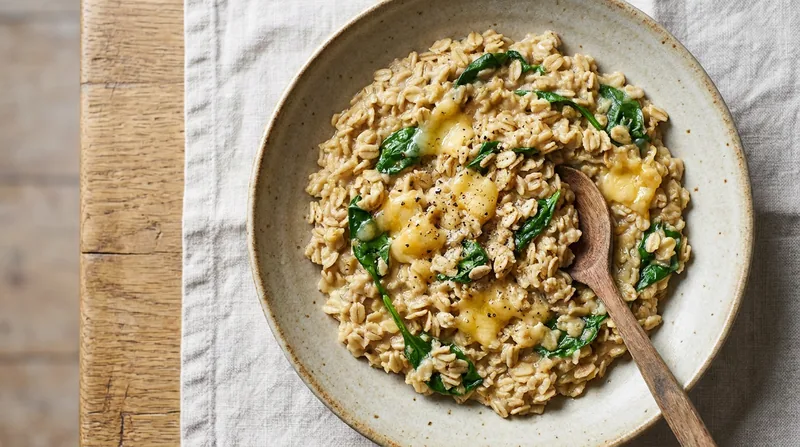
Breakfast · British
Savoury Cheese and Spinach Oats
A warm savoury breakfast porridge cooked with fresh spinach and mature cheddar cheese.
Ingredients
- Rolled oats 100 g
- Tap water 500 g
- Fine salt 2 g
- Fresh spinach 40 g
- Mature cheddar cheese 50 g
- Ground black pepper 1 g
Method
- Combine the rolled oats, water, and salt in a medium saucepan.
- Bring the mixture to a boil over medium heat, then reduce to a low simmer.
- Stir constantly for 5 minutes until the oats are thick and soft.
- Add the spinach and stir for 1 minute until wilted.
- Remove from the heat, stir in the cheddar cheese and black pepper, and serve immediately.
Built from 6 USDA ingredient records. A cooked dish never matches its raw sum exactly, but it stays close.
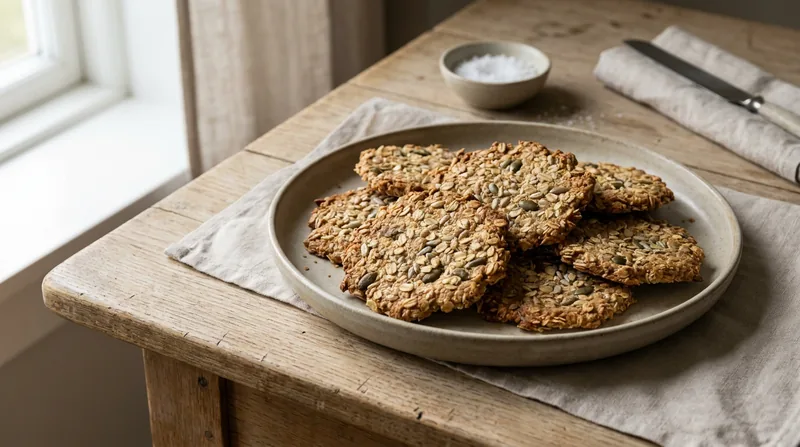
Snack · British
Baked Oat and Seed Crispbreads
Crisp savoury flatbreads made from rolled oats, mixed seeds, and water, baked until firm.
Ingredients
- Rolled oats 150 g
- Sunflower seeds 50 g
- Pumpkin seeds 50 g
- Fine salt 3 g
- Olive oil 15 g
- Tap water 200 g
Method
- Heat the oven to 180 degrees Celsius and line a baking sheet with baking paper.
- Mix the rolled oats, sunflower seeds, pumpkin seeds, and salt in a bowl.
- Pour in the olive oil and water, then stir until the mixture forms a wet paste.
- Spread the paste onto the baking sheet in a flat layer 5 millimetres thick.
- Bake for 20 minutes, score into rectangles, then bake for another 15 minutes until dry and crisp.
Summed from 6 USDA records and divided by servings. Heat alters weight and a few nutrients, so read it as a close figure.
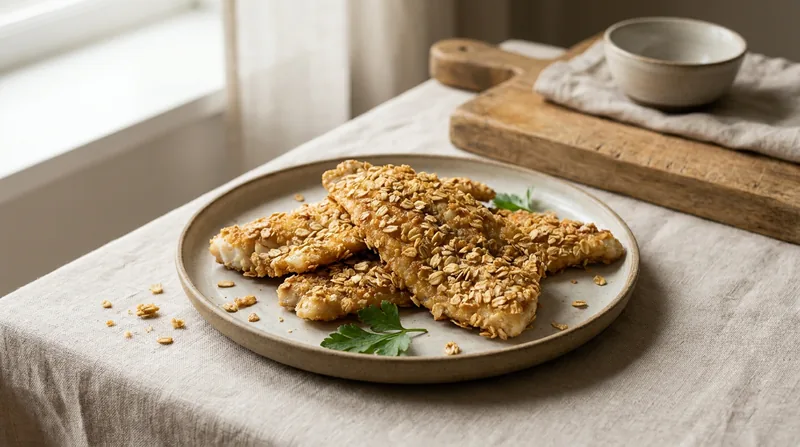
Dinner · British
Oat-Crusted Fish Fillets
White fish fillets coated in seasoned ground oats and shallow-fried in a pan until golden.
Ingredients
- Haddock fillets 300 g
- Rolled oats 80 g
- Medium egg 50 g
- Fine salt 2 g
- Ground black pepper 1 g
- Vegetable oil 28 g
Method
- Crush the rolled oats with a rolling pin until they resemble coarse breadcrumbs.
- Whisk the egg in a shallow bowl, and place the ground oats, salt, and black pepper in a second bowl.
- Dip each fish fillet into the egg, then press into the seasoned oats to coat both sides.
- Heat the vegetable oil in a frying pan over medium heat.
- Fry the fillets for 3 minutes on each side until the coating is crisp and the fish is cooked through.
Summed from 6 USDA records and divided by servings. Heat alters weight and a few nutrients, so read it as a close figure.

Calorie Counter Team, food critic
Oats as part of a meal
One way to build a meal around oats, costed from the same records. Substitute freely; the method carries over.
| Item | Serving | Calories | Protein (g) |
|---|---|---|---|
| Oats, cooked | 3/4 cup | 124 | 4.4 |
| Ground turkey, grilled | 3 oz | 176 | 22 |
| Sweet potato | 1 sweet potato, 5 in long | 112 | 2 |
| Together | 412 | 28 |
Oats against other grains and starches
All figures are for 100 g. Check the form column before comparing a raw food with a cooked one.
| Food | Form | Calories | Protein (g) | Carbs (g) | Fat (g) |
|---|---|---|---|---|---|
| Croissant | As sold | 406 | 8.2 | 46 | 21 |
| Popcorn | As sold | 387 | 13 | 78 | 4.5 |
| Rice cake | As sold | 387 | 8.2 | 82 | 2.8 |
| Oats | As sold | 379 | 13 | 68 | 6.5 |
| Bagel | As sold | 275 | 11 | 53 | 1.6 |
| Bread | As sold | 266 | 8.9 | 49 | 3.3 |
| Grits | Cooked | 71 | 1.7 | 15 | 0.5 |
Questions about oats
How many calories does 1 cup of dry oats have?
The USDA figure is 307 calories, or 379 per 100 g. It is taken from the record “Cereals, oats, regular and quick, not fortified, dry”, FDC 173904.
Is there much protein in oats?
1 cup of dry oats has 11 g of protein. By weight that is 13 g per 100 g, and the serving covers 21 percent of the Daily Value.
Is oats higher in calories once it is prepared?
The weight stays the same but the number moves. 81 g of oats is 58 calories cooked, rising to 307 as sold.
Can you eat oats when trying to lose weight?
Weight change comes from the whole week’s intake. 1 cup of dry oats contributes 307 calories and 11 g of protein (14 percent of its energy), useful alongside a protein source rather than as one.
Why do my cooked oats taste bitter?
Old oats can go rancid because of their natural oils. Exposure to air, light and warmth accelerates this spoilage. Store your oats in an airtight container placed in a cool, dark cupboard to prevent this unpleasant change in flavour.
Can I use rolled oats instead of steel-cut oats in a recipe?
Yes, but you must adjust the liquid and cooking duration. Rolled oats absorb water much faster than steel-cut pieces. Your final dish will have a significantly softer, less chewy texture than the recipe intended.
Sources
- Cereals, oats, regular and quick, not fortified, dry — USDA FoodData Central, FDC ID 173904
- Cereals, oats, regular and quick, unenriched, cooked with water (includes boiling and microwaving), without salt — USDA FoodData Central, FDC ID 173905
- Daily Values for nutrition labelling, 21 CFR 101.9
Stop doing this by hand.
You just looked up one food. CalorieCounter reads a whole plate from a photo, serving and preparation included. It is coming to the App Store for iPhone — leave your email and you get the link the day it is live.