Fruit
Plum nutrition, weighed and measured.
For 1 plum, count 30 calories. The protein in that portion is 0.5 g. Specifically, this is the USDA record “Plums, raw”. Preparation shifts it more than most tables admit, from 46 calories per 100 g at the low end to 89 at the top. The panel underneath takes any serving and any amount, and the vitamin and mineral table tracks what you pick.
Drawn from USDA FoodData Central, FDC 169949, 168162, 168183. No account, no upload, percentages against FDA Daily Values.
Plum calories by portion
1 plum is 30 calories. Per 100 g it is 46. USDA publishes the serving weights below, so these are measured portions rather than rounded guesses.
| Serving | Weight (g) | Calories | Protein (g) | Carbs (g) | Fat (g) |
|---|---|---|---|---|---|
| 1 fruit | 66 | 30 | 0.5 | 7.5 | 0.2 |
| 1 serving | 151 | 69 | 1.1 | 17 | 0.4 |
| 1 cup, sliced | 165 | 76 | 1.2 | 19 | 0.5 |
| 100 g | 100 | 46 | 0.7 | 11 | 0.3 |
What plum offers in protein
The protein count for 1 plum is 0.5 g, equal to 1 percent of the Daily Value. There is next to no protein in plum; nearly all of its energy is carbohydrate.
Energy-wise, protein contributes 5 percent, fat 5 percent and carbohydrate 90 percent, which makes it mostly a carbohydrate.
Does the method change plum?
Canned plum comes in at 89 calories per 100 g against 46 for raw, a gap of 93 percent. What explains it is what processing adds or removes.
Same plum, same 66 g, different treatment:
| Preparation | Calories | Protein (g) | Fat (g) | What it involves |
|---|---|---|---|---|
| Raw plum | 30 | 0.5 | 0.2 | Nothing added |
| Canned plum | 59 | 0.3 | 0.1 | In heavy syrup |
| Dried plum | 158 | 1.4 | 0.3 | Water removed |
What to know before you buy plum
Plums arrive as clingstone or freestone varieties, showing skins of deep purple, red, or yellow. Look for a dusty bloom on the skin, which indicates minimal handling. The fruit should feel heavy and yield to gentle pressure near the blossom end. Avoid specimens with broken skins or soft, leaking patches.
Heating plums releases their juices and intensifies their sharp acidity. The skins contain much of this sourness, which bleeds into the sweet flesh during poaching or baking. Cooks frequently underestimate this tartness and under-sweeten the fruit. Keep the heat moderate to prevent the flesh collapsing into an unstructured purée.
Raw plums complement salty cheeses and cured meats on cold platters. When cooked, their acidity cuts through rich meats like duck or pork, a combination favoured in Chinese cookery. In Central Europe, cooks bake them into yeasted tarts or preserve them as spiced compotes to accompany game.
Vitamins and minerals in plum
Plum spreads its micronutrients thinly. Every value USDA reports is listed, tied to your chosen portion.
| Nutrient | Amount | % Daily Value |
|---|
Of its 11 g of carbohydrate, 9.9 g is sugar. In whole fruit that sugar arrives with fibre and water, which is the difference between eating it and drinking it.
How far plum goes in a day
On a 2,000 calorie day, 1 plum is 2 percent of the budget and 1 percent of the protein Daily Value. Whether that is a lot depends on your own numbers rather than on 2,000: the TDEE calculator gives you what you burn, and the macro calculator turns a target into grams.
Three ways to use plum
The Calorie Counter Team wrote these. Under every recipe the numbers are added up from the USDA record for each ingredient and split across the servings.
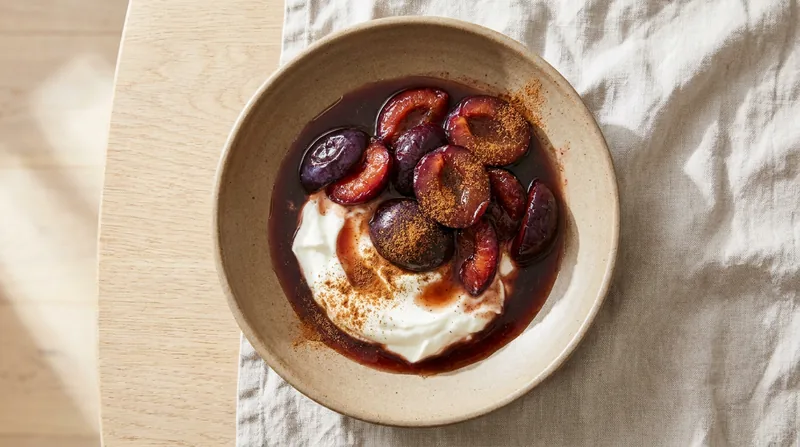
Breakfast · British
Stewed Plums with Yoghurt
Warm stewed plums with ground cinnamon served over plain Greek yoghurt.
Ingredients
- Fresh plums 300 g
- Water 30 g
- Granulated white sugar 15 g
- Ground cinnamon 1 g
- Plain Greek yoghurt 150 g
Method
- Halve and stone the plums, then slice them into 1-centimetre wedges.
- Place the sliced plums, water, sugar, and ground cinnamon into a small saucepan.
- Simmer over medium heat for 8 minutes until the fruit is soft but retains its shape.
- Leave the mixture to cool for 10 minutes.
- Divide the yoghurt between two bowls and spoon the warm plums over the top.
Built from 5 USDA ingredient records. A cooked dish never matches its raw sum exactly, but it stays close.
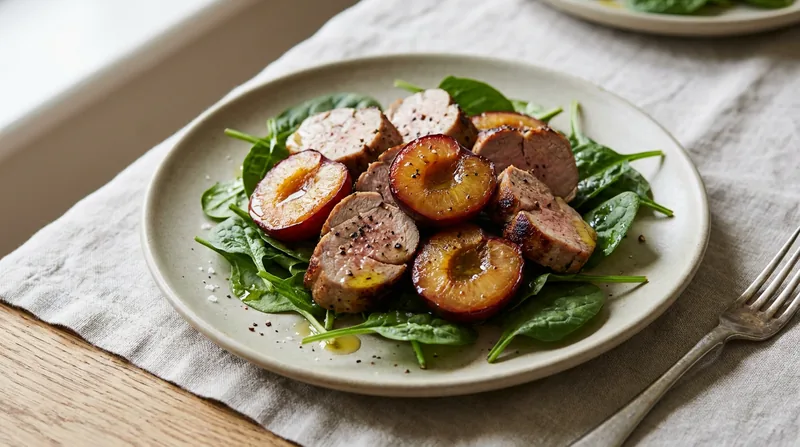
Dinner · British
Roasted Plum and Pork Salad
Warm roasted plums and seared pork tenderloin served on a bed of fresh spinach.
Ingredients
- Fresh plums 200 g
- Pork tenderloin 250 g
- Olive oil 14 g
- Table salt 2 g
- Ground black pepper 1 g
- Fresh spinach 100 g
Method
- Heat the oven to 200 degrees Celsius and cut the plums into quarters.
- Rub the pork tenderloin with 7 grams of olive oil, 1 gram of salt, and 1 gram of black pepper.
- Sear the pork in a hot pan for 4 minutes, then transfer to a baking tray with the plums.
- Roast in the oven for 12 minutes until the pork reaches an internal temperature of 63 degrees Celsius.
- Slice the pork and toss it with the roasted plums, spinach, and the remaining olive oil and salt.
Built from 6 USDA ingredient records. A cooked dish never matches its raw sum exactly, but it stays close.
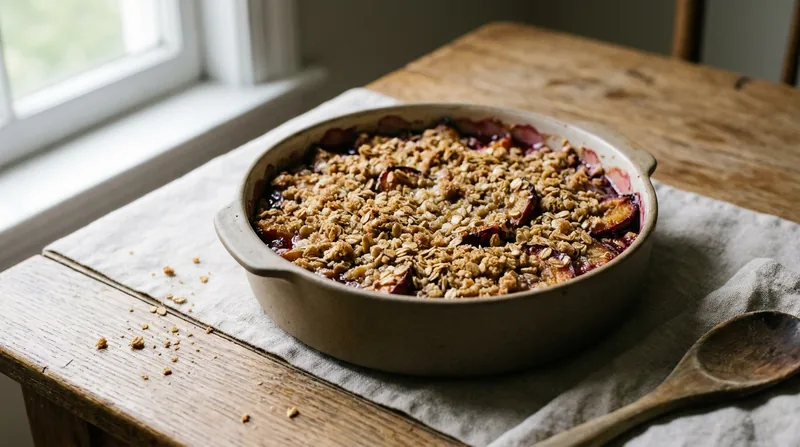
Snack · British
Baked Plum Crumble
Baked plums topped with a crisp mixture of oats, butter, and brown sugar.
Ingredients
- Fresh plums 400 g
- Plain wheat flour 50 g
- Rolled oats 30 g
- Unsalted butter 40 g
- Brown sugar 30 g
Method
- Heat the oven to 180 degrees Celsius and grease a 20-centimetre baking dish.
- Slice the plums into quarters, remove the stones, and arrange them in the dish.
- Rub the butter into the flour, oats, and brown sugar using your fingertips until clumpy.
- Scatter the oat mixture evenly over the plums.
- Bake for 25 minutes until the topping is golden brown and the fruit juices bubble.
Built from 5 USDA ingredient records. A cooked dish never matches its raw sum exactly, but it stays close.

Calorie Counter Team, food critic
What a meal with plum adds up to
A sample plate, not a prescription: plum plus two sides, each line sourced and the sum shown.
| Item | Serving | Calories | Protein (g) |
|---|---|---|---|
| Plum | 1 fruit | 30 | 0.5 |
| Ice cream | 1/2 cup | 137 | 2.3 |
| Chia seeds | 1 oz | 138 | 4.7 |
| Together | 305 | 7.5 |
Fruit: where plum sits
Per 100 g, each in the form its own page leads with; the second column says which.
| Food | Form | Calories | Protein (g) | Carbs (g) | Fat (g) |
|---|---|---|---|---|---|
| Olives | Canned | 116 | 0.8 | 6 | 11 |
| Apricot | Raw | 48 | 1.4 | 11 | 0.4 |
| Orange | Raw | 47 | 0.9 | 12 | 0.1 |
| Plum | Raw | 46 | 0.7 | 11 | 0.3 |
| Cranberries | Raw | 46 | 0.5 | 12 | 0.1 |
| Papaya | Raw | 43 | 0.5 | 11 | 0.3 |
| Peach | Raw | 42 | 0.9 | 10 | 0.3 |
Plum: common questions
How many calories are in 1 plum?
The USDA figure is 30 calories, or 46 per 100 g. It is taken from the record “Plums, raw”, FDC 169949.
How much protein is in plum?
0.7 g per 100 g, so 1 plum supplies 0.5 g. Against the Daily Value that is 1 percent.
Is plum higher in calories once it is prepared?
Yes. At 66 g, raw is 30 calories and canned is 59. The table above compares each preparation of plum covered on this page.
Is plum good for weight loss?
It can fit any calorie target; no single food decides the outcome. What matters here is that 1 plum costs 30 calories and returns 0.5 g of protein, so 6 percent of its energy is protein — useful alongside a protein source rather than as one.
How do you easily remove the stone from a plum?
Slice the plum completely around its natural seam down to the stone. Twist the sides in opposite directions to separate them. Use the tip of a spoon to scoop the stone out from the side that retains it.
Why are some plums sour even when they feel soft?
Plums ripen from the inside out, meaning the flesh softens before the sugars fully develop near the skin. The skin also retains its natural tartness, which remains strong even when the fruit is fully ripe.
Sources
- Plums, raw — USDA FoodData Central, FDC ID 169949
- Plums, canned, heavy syrup, drained — USDA FoodData Central, FDC ID 168183
- Plums, dried (prunes), uncooked — USDA FoodData Central, FDC ID 168162
- Daily Values for nutrition labelling, 21 CFR 101.9
Stop doing this by hand.
You just looked up one food. CalorieCounter reads a whole plate from a photo, serving and preparation included. It is coming to the App Store for iPhone — leave your email and you get the link the day it is live.