Fruit
Orange nutrition, by the piece and by the cup.
Weigh out 1 orange and you are looking at 62 calories, with 1.2 g of protein inside them. The record behind it is USDA’s “Oranges, raw, all commercial varieties”. Where it earns its place is vitamin C. The selector beneath handles other portions, and the nutrient table responds to it.
Every value traces to USDA FoodData Central (169097); Daily Values follow the FDA label rules.
Orange calories by portion
62 calories is the figure for 1 orange; 47 is the figure per 100 g. Below are the remaining portions USDA measured.
| Serving | Weight (g) | Calories | Protein (g) | Carbs (g) | Fat (g) |
|---|---|---|---|---|---|
| 1 small | 96 | 45 | 0.9 | 11 | 0.1 |
| 1 fruit | 131 | 62 | 1.2 | 15 | 0.2 |
| 1 cup, sections | 180 | 85 | 1.7 | 21 | 0.2 |
| 1 large | 184 | 86 | 1.7 | 22 | 0.2 |
| 100 g | 100 | 47 | 0.9 | 12 | 0.1 |
What orange offers in protein
The protein count for 1 orange is 1.2 g, equal to 2 percent of the Daily Value. Protein is close to absent in orange. Its calories come from carbohydrate instead.
Energy-wise, protein contributes 7 percent, fat 2 percent and carbohydrate 91 percent, which makes it mostly a carbohydrate.
Orange in the kitchen
Look for heavy fruits with smooth, thin skins, which yield the most juice. Avoid puffy skins. Bitter Seville oranges arrive in winter for marmalade. Sweet options include seedless navels for eating and thin-skinned Valencias for juicing. Blood oranges offer a deep crimson flesh and berry undertones.
Prolonged boiling turns orange juice bitter and dulls the bright flavour. Gentle heating preserves the acidity. The biggest error is grating the white pith beneath the orange rind, which ruins dishes with an intense, unpleasant bitterness. Use only the coloured outer zest, removing it with a light touch.
Raw segments suit green salads, whilst the juice deglazes pans for French duck sauces. The zest cuts through rich Middle Eastern lamb stews. Orange pairs naturally with dark chocolate, fennel, cloves and red onion, balancing fatty meats and bringing bright acidity to cooked winter root vegetables.
Orange: the full nutrient profile
Against the Daily Value, 1 orange stands out for vitamin C at 77 percent of a day. The table follows the selector above, so change the serving or the method and it updates.
| Nutrient | Amount | % Daily Value |
|---|
It carries 2.4 g of fibre per 100 g, about 9 percent of a day.
9.4 g of the 12 g of carbohydrate in 100 g is sugar. Eaten whole, it comes packaged with water and fibre, which slows the whole thing down.
Putting orange into a day of eating
If you eat 2,000 calories a day, 1 orange accounts for 3 percent of them, and for 2 percent of the 50 g protein benchmark. To replace 2,000 with your real number, use the TDEE calculator; to turn that into targets, the macro calculator.
Recipes that start with orange
From the Calorie Counter Team: three dishes built around orange, with per-serving nutrition calculated from the USDA data for every ingredient that goes in.
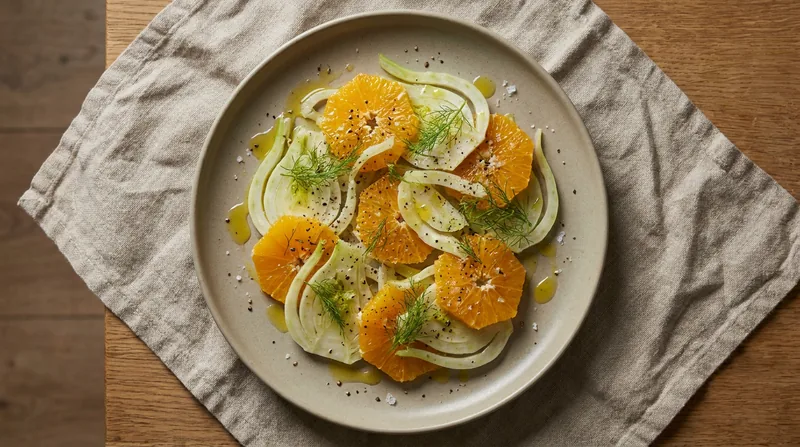
Side · Mediterranean
Orange and Fennel Salad
A salad of sliced fennel bulb and orange segments dressed with olive oil, salt and pepper.
Ingredients
- Oranges 200 g
- Fennel bulb 150 g
- Olive oil 15 g
- Salt 2 g
- Black pepper 1 g
Method
- Peel the oranges and cut them into segments, removing the white pith.
- Slice the fennel bulb to a thickness of 2 millimetres.
- Combine the orange segments and sliced fennel in a mixing bowl.
- Whisk the olive oil, salt and black pepper together in a cup.
- Pour the dressing over the salad and toss gently to combine.
Figures are per serving and come from 5 USDA FoodData Central entries; cooking will shift them slightly.
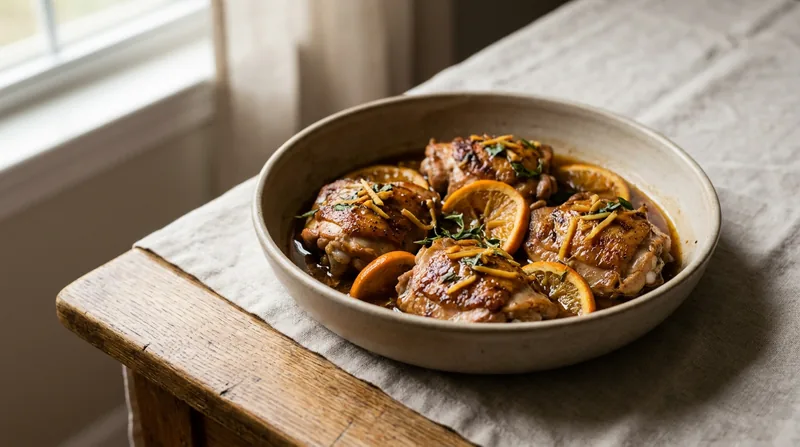
Dinner · Asian
Braised Orange Chicken Thighs
Chicken thighs seared and simmered in a sauce of orange juice, ginger and soy sauce.
Ingredients
- Boneless, skinless chicken thighs 400 g
- Oranges 300 g
- Ginger root 10 g
- Soy sauce 30 g
- Vegetable oil 15 g
- Salt 3 g
Method
- Grate the zest from one orange and extract 150 grams of juice from the fruits.
- Season the chicken thighs with the salt on both sides.
- Heat the vegetable oil in a frying pan over medium heat and brown the chicken for 5 minutes on each side.
- Pour the orange juice, orange zest, grated ginger and soy sauce into the pan.
- Simmer uncovered for 15 minutes until the chicken is cooked through and the sauce reduces.
Nutrition per serving, calculated across 6 USDA ingredient records. Expect small differences once cooked.
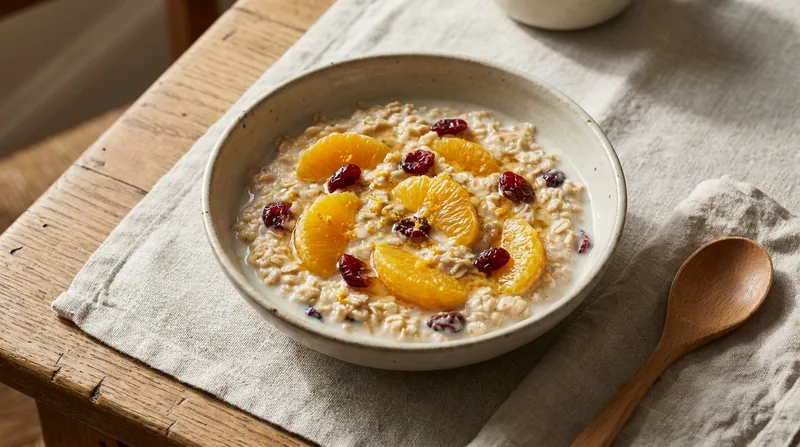
Breakfast · British
Orange Cranberry Porridge
Oats simmered in milk with orange segments and dried cranberries.
Ingredients
- Rolled oats 80 g
- Whole milk 300 g
- Oranges 120 g
- Dried cranberries 30 g
- Honey 15 g
Method
- Peel the orange, remove the seeds and chop the flesh into 1 centimetre pieces.
- Combine the rolled oats, milk and dried cranberries in a saucepan over medium heat.
- Bring the mixture to a boil, then reduce the heat to low.
- Simmer for 5 minutes, stirring constantly until the oats are soft.
- Stir in the chopped orange and honey, then cook for 1 further minute before serving.
Figures are per serving and come from 5 USDA FoodData Central entries; cooking will shift them slightly.

Calorie Counter Team, food critic
One meal, costed: orange
A worked example, every line from the same USDA data as the table above. Swap any of it; the arithmetic is the point, not the menu.
| Item | Serving | Calories | Protein (g) |
|---|---|---|---|
| Orange | 1 fruit | 62 | 1.2 |
| Feta cheese | 1 oz | 75 | 4 |
| Cashews | 1 oz | 157 | 5.2 |
| Together | 294 | 10 |
Orange beside its neighbours
Same weight for every row, 100 g, so differences are not portion effects. The form column shows whether a row is raw, cooked or as sold.
| Food | Form | Calories | Protein (g) | Carbs (g) | Fat (g) |
|---|---|---|---|---|---|
| Dates | As sold | 277 | 1.8 | 75 | 0.2 |
| Fig | Raw | 74 | 0.8 | 19 | 0.3 |
| Kiwi | Raw | 61 | 1.1 | 15 | 0.5 |
| Apricot | Raw | 48 | 1.4 | 11 | 0.4 |
| Orange | Raw | 47 | 0.9 | 12 | 0.1 |
| Cranberries | Raw | 46 | 0.5 | 12 | 0.1 |
| Plum | Raw | 46 | 0.7 | 11 | 0.3 |
Common questions on orange
How many calories are in 1 orange?
1 orange is 62 calories. That comes from the USDA record “Oranges, raw, all commercial varieties” (FDC 169097), which is 47 calories per 100 g.
How much protein is in orange?
Per 100 g, orange contains 0.9 g of protein. 1 orange therefore gives 1.2 g, which is 2 percent of a 50 g day.
Can you eat orange when trying to lose weight?
Weight change comes from the whole week’s intake. 1 orange contributes 62 calories and 1.2 g of protein (8 percent of its energy), so pair it with something that carries more protein.
How much carbohydrate does orange contain?
15 g in 1 orange, of which 3.1 g is fibre and 12 g is sugar.
How do you get the most juice out of an orange?
Bring the fruit to room temperature before squeezing. Roll it firmly against the worktop under your palm to soften the flesh and break the internal membranes. This releases significantly more liquid when you cut and press the fruit.
Can you freeze orange zest?
Yes, grate the coloured skin directly into a sealed container before using the fruit. It keeps its bright aroma for several months in the freezer. Add it straight from frozen into cake batters, sauces or stews.
Sources
- Oranges, raw, all commercial varieties — USDA FoodData Central, FDC ID 169097
- Daily Values for nutrition labelling, 21 CFR 101.9
Stop doing this by hand.
You just looked up one food. CalorieCounter reads a whole plate from a photo, serving and preparation included. It is coming to the App Store for iPhone — leave your email and you get the link the day it is live.