Vegetables
Onion nutrition, and what the pan changes.
On USDA figures, 1 medium onion works out at 44 calories and carries 1.2 g of protein. USDA files this under “Onions, raw”, and that is the record used here. Cook it differently and that moves: the spread across the forms below is 19 to 44 calories per 100 g. The selector beneath handles other portions, and the nutrient table responds to it.
Figures: USDA FoodData Central, records 170000, 170001, 170002, 170003. Calculated in your browser; nothing is uploaded.
How many calories does onion have?
At 40 calories per 100 g, 1 medium onion comes to 44. The weights shown for each portion come straight from the USDA record.
| Serving | Weight (g) | Calories | Protein (g) | Carbs (g) | Fat (g) |
|---|---|---|---|---|---|
| 1 slice, thin | 9 | 4 | 0.1 | 0.8 | 0 |
| 1 tbsp chopped | 10 | 4 | 0.1 | 0.9 | 0 |
| 1 slice, medium | 14 | 6 | 0.2 | 1.3 | 0 |
| 1 slice, large | 38 | 15 | 0.4 | 3.5 | 0 |
| 10 rings | 60 | 24 | 0.7 | 5.6 | 0.1 |
| 1 small | 70 | 28 | 0.8 | 6.5 | 0.1 |
| 1 medium | 110 | 44 | 1.2 | 10 | 0.1 |
| 1 cup, sliced | 115 | 46 | 1.3 | 11 | 0.1 |
| 1 large | 150 | 60 | 1.7 | 14 | 0.2 |
| 1 cup, chopped | 160 | 64 | 1.8 | 15 | 0.2 |
| 100 g | 100 | 40 | 1.1 | 9.3 | 0.1 |
Protein in onion, measured
The protein count for 1 medium onion is 1.2 g, equal to 2 percent of the Daily Value. There is next to no protein in onion; nearly all of its energy is carbohydrate.
Its energy is 2 percent fat, 88 percent carbohydrate and 10 percent protein, meaning it behaves as mostly a carbohydrate in a meal.
Onion, method by method
Boiled onion comes in at 44 calories per 100 g against 19 for canned, a gap of 132 percent. What explains it is evaporation, which packs more of the food into each gram.
To keep it fair, all figures are for 110 g.
| Preparation | Calories | Protein (g) | Fat (g) | What it involves |
|---|---|---|---|---|
| Canned onion | 21 | 0.9 | 0.1 | Packed, with its liquid |
| Raw onion | 44 | 1.2 | 0.1 | Nothing added |
| Boiled onion | 48 | 1.5 | 0.2 | Water only |
| Dried onion | 384 | 9.8 | 0.5 | Water removed |
What to know before you cook onion
This pungent allium bulb is sold as dry globes, spring green shoots, or sweet salad varieties. Look for firm, heavy bulbs with papery skins that rustle. Avoid any with soft necks, damp spots, or green sprouts emerging from the top. The skins should be dry and unbroken to ensure the flesh inside remains crisp.
High heat scorches onions, turning them bitter. Gentle sweating draws out moisture and softens the texture, whilst slow frying coaxes out natural sugars until they caramelise to a deep brown. Cooks often rush this browning process, using high heat instead of patience, which burns the outer layers while leaving the inside raw and sharp.
Raw slices add sharp bite to British pub sandwiches and Mexican salsas. When gently cooked, they form the sweet, rich base for French soups, Indian curries, and Italian sauces. They pair naturally with sage, thyme, beef, and cheese, providing a savoury depth that binds other ingredients together.
Onion: the full nutrient profile
The table follows the selector above, so change the serving or the method and every row updates. Values are per serving, not per 100 g, unless you pick 100 g.
| Nutrient | Amount | % Daily Value |
|---|
Onion and your daily targets
Budget-wise, 1 medium onion costs 2 percent of a 2,000 calorie day and pays back 2 percent of the day’s protein. The TDEE calculator and macro calculator will tell you what those percentages look like against your own targets.
Onion recipes, with the numbers
From the Calorie Counter Team: three dishes built around onion, with per-serving nutrition calculated from the USDA data for every ingredient that goes in.
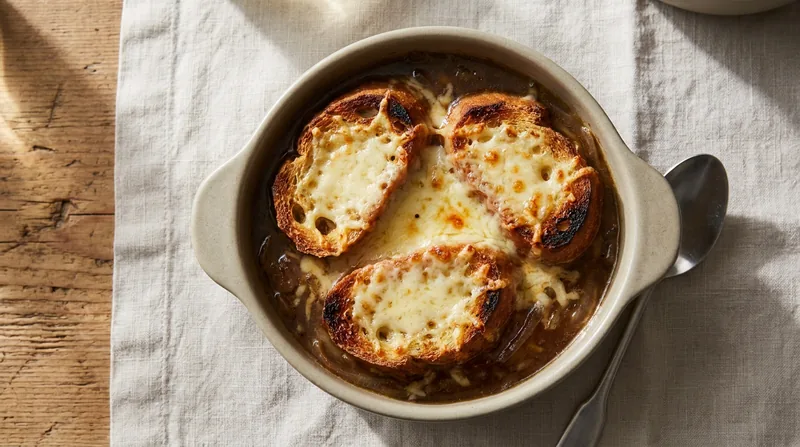
Lunch · French
Classic French Onion Soup
A traditional soup made by slowly caramelising yellow onions in butter before simmering in beef stock.
Ingredients
- Yellow onions, peeled and sliced 500 g
- Unsalted butter 30 g
- Beef stock 750 g
- French baguette, sliced 80 g
- Gruyere cheese, grated 60 g
- Table salt 4 g
Method
- Melt the butter in a heavy saucepan over medium heat, then add the sliced onions and salt.
- Cook the onions for 40 minutes, stirring regularly, until they turn a deep brown colour.
- Pour in the beef stock and simmer the mixture gently for 15 minutes.
- Toast the bread slices until they are firm.
- Ladle the soup into heatproof bowls, place the toasted bread on top, and cover with the grated cheese.
- Place the bowls under a hot grill for 3 minutes until the cheese melts.
Summed from 6 USDA records and divided by servings. Heat alters weight and a few nutrients, so read it as a close figure.
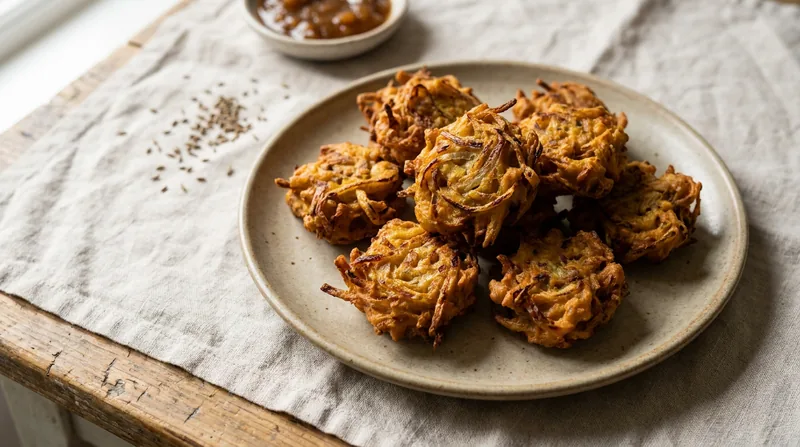
Snack · Indian
Crispy Onion Bhajis
Spiced onion strips bound in chickpea flour batter and shallow fried until crisp.
Ingredients
- Yellow onions, sliced thinly 300 g
- Chickpea flour 100 g
- Tap water 80 g
- Vegetable oil 150 g
- Cumin seeds 3 g
- Ground turmeric 2 g
- Table salt 3 g
Method
- Mix the chickpea flour, cumin seeds, turmeric, and salt in a bowl.
- Stir in the water gradually to form a thick batter.
- Add the sliced onions to the bowl and stir until they are coated in the batter.
- Heat the vegetable oil in a deep frying pan over medium-high heat.
- Drop spoonfuls of the onion mixture into the hot oil and fry for 4 minutes, turning once.
- Remove the cooked bhajis with a slotted spoon and drain on paper towels.
7 USDA records went into this total. It describes the ingredients as weighed, not the dish after cooking losses.
This total counts every gram of the frying oil. Most of that oil stays in the pan, so what reaches the plate is lower.
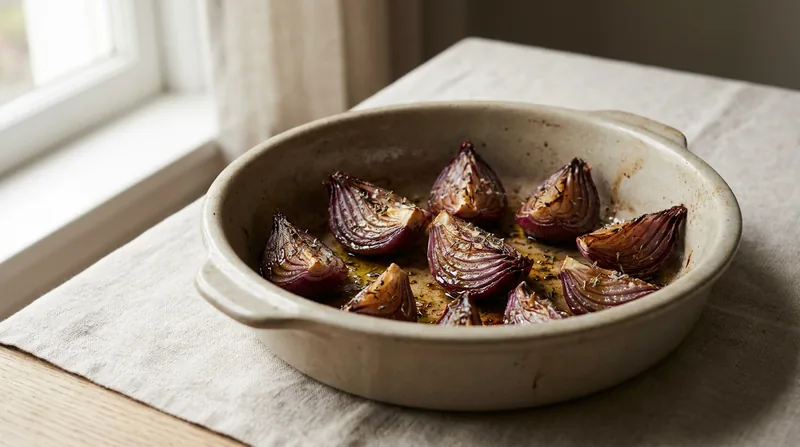
Side · British
Roasted Balsamic Red Onions
Red onion wedges roasted with olive oil, dried thyme, and balsamic vinegar.
Ingredients
- Red onions, peeled 400 g
- Olive oil 20 g
- Balsamic vinegar 15 g
- Table salt 3 g
- Dried thyme 1 g
Method
- Preheat the oven to 200 degrees Celsius.
- Cut each onion into six wedges, keeping the root intact to hold them together.
- Toss the onion wedges in a baking dish with the olive oil, salt, and dried thyme.
- Roast in the oven for 25 minutes.
- Drizzle the balsamic vinegar over the onions and roast for another 10 minutes until tender.
5 USDA records went into this total. It describes the ingredients as weighed, not the dish after cooking losses.

Calorie Counter Team, food critic
A plate built around onion
What a meal containing onion comes to, using USDA numbers for every part of it.
| Item | Serving | Calories | Protein (g) |
|---|---|---|---|
| Onion | 1 medium | 44 | 1.2 |
| Chicken wing, roasted | 1 piece | 216 | 20 |
| Barley, cooked | 1 cup | 193 | 3.5 |
| Together | 453 | 25 |
How onion compares with similar foods
All figures are for 100 g. Check the form column before comparing a raw food with a cooked one.
| Food | Form | Calories | Protein (g) | Carbs (g) | Fat (g) |
|---|---|---|---|---|---|
| Butternut squash | Raw | 45 | 1 | 12 | 0.1 |
| Beets | Raw | 43 | 1.6 | 9.6 | 0.2 |
| Brussels sprouts | Raw | 43 | 3.4 | 9 | 0.3 |
| Carrot | Raw | 41 | 0.9 | 9.6 | 0.2 |
| Onion | Raw | 40 | 1.1 | 9.3 | 0.1 |
| Pumpkin | Raw | 26 | 1 | 6.5 | 0.1 |
| Bell pepper | Raw | 26 | 1 | 6 | 0.3 |
Onion, asked and answered
How many calories does 1 medium onion have?
44 calories, according to USDA FoodData Central: the record is “Onions, raw”, FDC 170000. That works out at 40 per 100 g.
How much protein does onion have?
Per 100 g, onion contains 1.1 g of protein. 1 medium onion therefore gives 1.2 g, which is 2 percent of a 50 g day.
Do the calories in onion change with how it is prepared?
Yes, by a measurable amount: 110 g goes from 21 calories (canned) to 48 (boiled), depending on preparation.
Does onion fit a calorie deficit?
Weight change comes from the whole week’s intake. 1 medium onion contributes 44 calories and 1.2 g of protein (11 percent of its energy), which means it needs a protein-rich partner on the plate.
How do you stop onions from making you cry when chopping?
Chill the bulb before cutting to slow down the release of the irritating gas. Use a very sharp knife to slice cleanly through the cells rather than crushing them, which releases more of the crying agent into the air.
How should whole raw onions be stored?
Keep them in a cool, dark, dry place with plenty of air circulation, like a wire basket. Do not store them near potatoes, as the moisture and gases released will cause them to spoil much faster.
Sources
- Onions, raw — USDA FoodData Central, FDC ID 170000
- Onions, cooked, boiled, drained, without salt — USDA FoodData Central, FDC ID 170001
- Onions, canned, solids and liquids — USDA FoodData Central, FDC ID 170003
- Onions, dehydrated flakes — USDA FoodData Central, FDC ID 170002
- Daily Values for nutrition labelling, 21 CFR 101.9
Stop doing this by hand.
You just looked up one food. CalorieCounter reads a whole plate from a photo, serving and preparation included. It is coming to the App Store for iPhone — leave your email and you get the link the day it is live.