Vegetables
Butternut squash nutrition, and what the pan changes.
On USDA figures, 1 cup of butternut squash cubes works out at 63 calories and carries 1.4 g of protein. The record behind it is USDA’s “Squash, winter, butternut, raw”. Preparation shifts it more than most tables admit, from 39 calories per 100 g at the low end to 45 at the top. Use the selector that follows to match your own portion; the panel and the nutrient table track it.
Every value traces to USDA FoodData Central (169295, 169296, 168474); Daily Values follow the FDA label rules.
How many calories does butternut squash have?
Count 63 calories for 1 cup of butternut squash cubes, or 45 for every 100 g. The portion weights in the table are USDA’s own measurements.
| Serving | Weight (g) | Calories | Protein (g) | Carbs (g) | Fat (g) |
|---|---|---|---|---|---|
| 1 cup, cubes | 140 | 63 | 1.4 | 16 | 0.1 |
| 100 g | 100 | 45 | 1 | 12 | 0.1 |
Butternut squash and its protein content
Expect 1.4 g of protein from 1 cup of butternut squash cubes, roughly 3 percent of a 50 g day. Butternut squash carries almost no protein. It earns its place in a day through carbohydrate, not through protein.
By calories rather than by weight the split is 8 percent protein, 2 percent fat and 91 percent carbohydrate, so in practice it is mostly a carbohydrate rather than anything else.
What cooking does to butternut squash
The rows below come from separate USDA samples, so part of the 15 percent gap between them is the butternut squash itself rather than what was done to it.
Weight is fixed at 140 g throughout, so the rows differ only in how the butternut squash was prepared.
| Preparation | Calories | Protein (g) | Fat (g) | What it involves |
|---|---|---|---|---|
| Boiled butternut squash | 55 | 1.7 | 0.1 | Water only |
| Baked butternut squash | 56 | 1.3 | 0.1 | Dry heat |
| Raw butternut squash | 63 | 1.4 | 0.1 | Nothing added |
Butternut squash in the kitchen
This pear-shaped winter squash has pale, tan skin and dense orange flesh. You can buy it whole or pre-cut into cubes. Choose specimens that feel heavy for their size with matte, firm skin. Avoid squash with soft spots, green wrinkles, or deep gashes. An intact stem helps prevent the flesh from drying out.
Roasting caramelises the natural sugars, intensifying the sweet flavour. Boiling makes the flesh watery and bland, which is a common mistake. If you steam or bake the squash until tender, the flesh purées into a smooth, thick consistency. Always peel the tough outer skin and scrape out the seeds before cooking.
This squash suits savoury and sweet dishes. In Italian cooking, cooks use the purée as a filling for ravioli, seasoned with nutmeg and sage. In Indian curries, cubed squash absorbs robust spices like cumin and chilli. It pairs excellently with sharp cheeses, roasted pecans, and cured meats.
Everything USDA measures in butternut squash
Against the Daily Value, 1 cup of butternut squash cubes stands out for 83 percent of a day’s vitamin A, 33 percent of a day’s vitamin C. The table follows the selector above, so change the serving or the method and it updates.
| Nutrient | Amount | % Daily Value |
|---|
Fibre runs to 2 g per 100 g, or 7 percent of the Daily Value.
Butternut squash against a daily budget
Budget-wise, 1 cup of butternut squash cubes costs 3 percent of a 2,000 calorie day and pays back 3 percent of the day’s protein. The TDEE calculator and macro calculator will tell you what those percentages look like against your own targets.
Three ways to cook butternut squash
Three recipes from the Calorie Counter Team, each costed ingredient by ingredient against USDA records, so the per-serving figures are sums, not guesses.
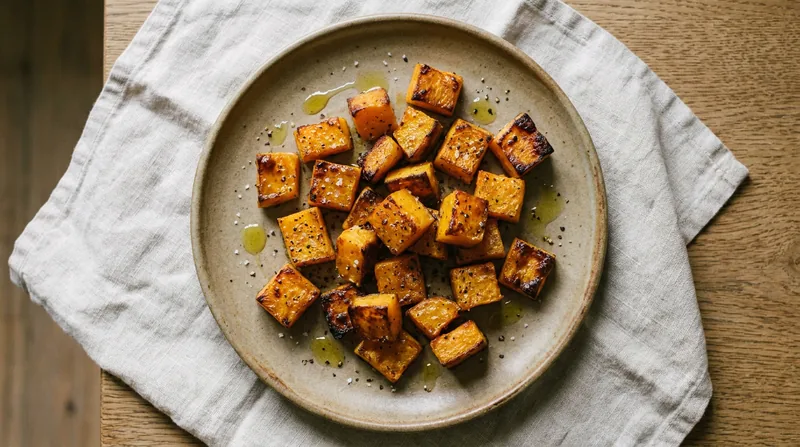
Side · British
Roasted Butternut Squash
Oven-roasted butternut squash cubes seasoned with olive oil, salt and black pepper.
Ingredients
- Butternut squash, peeled and cubed 500 g
- Olive oil 15 g
- Salt 3 g
- Ground black pepper 1 g
Method
- Heat the oven to 200C.
- Toss the squash cubes with the olive oil, salt and black pepper in a bowl.
- Spread the squash in a single layer on a baking tray.
- Roast for 30 minutes until the edges turn brown and the flesh is tender.
Figures are per serving and come from 4 USDA FoodData Central entries; cooking will shift them slightly.
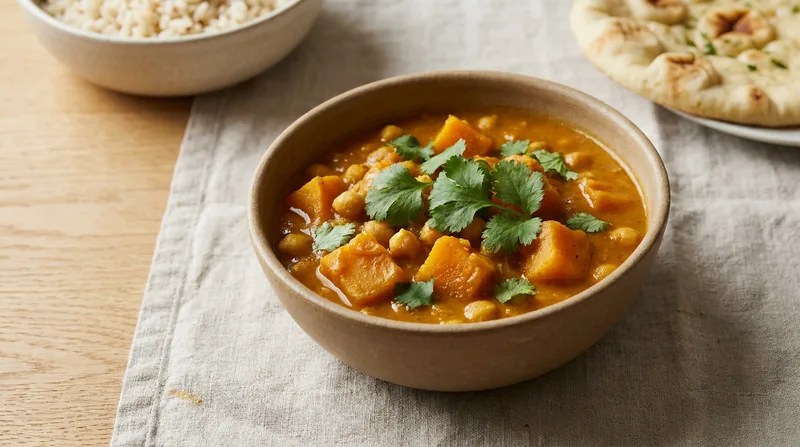
Dinner · Indian
Butternut Squash and Chickpea Curry
A mild curry combining butternut squash and chickpeas in a coconut milk and tomato sauce.
Ingredients
- Butternut squash, peeled and cubed 400 g
- Canned chickpeas, drained 240 g
- Coconut milk 400 g
- Canned chopped tomatoes 400 g
- Onion, chopped 110 g
- Vegetable oil 14 g
- Curry powder 6 g
- Salt 5 g
Method
- Heat the vegetable oil in a large pan over medium heat.
- Fry the onion for 5 minutes until translucent, then stir in the curry powder for 1 minute.
- Add the butternut squash, chickpeas, chopped tomatoes and coconut milk.
- Bring to a simmer, cover, and cook for 25 minutes until the squash is tender.
- Season with the salt.
Nutrition per serving, calculated across 8 USDA ingredient records. Expect small differences once cooked.
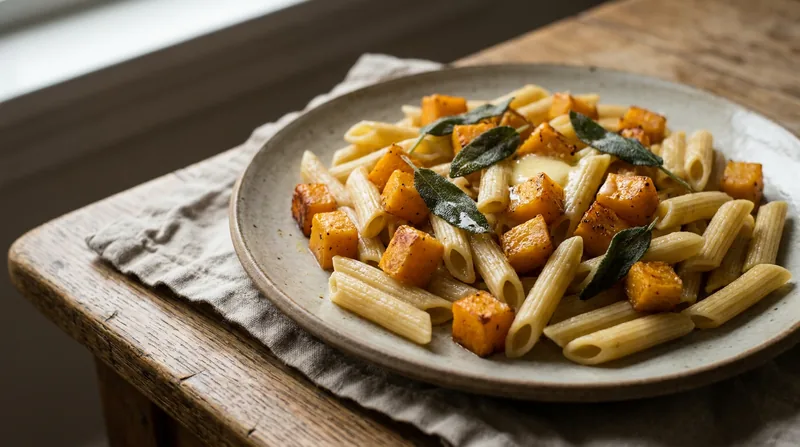
Dinner · Italian
Butternut squash and sage pasta
Pasta tossed with pan-fried butternut squash, butter and fresh sage.
Ingredients
- Dry penne pasta 150 g
- Butternut squash, peeled and finely diced 300 g
- Butter unsalted 30 g
- Olive oil 10 g
- Fresh sage leaves 5 g
- Parmesan cheese, grated 20 g
- Salt 2 g
Method
- Boil the pasta in salted water for 10 minutes.
- Drain the pasta, reserving 50 millilitres of the cooking water.
- Sauté the diced squash in olive oil and half the butter for 8 minutes.
- Add the remaining butter and sage leaves to the pan, cooking for 2 minutes.
- Stir the pasta, cheese and reserved water into the pan.
7 USDA records went into this total. It describes the ingredients as weighed, not the dish after cooking losses.

Calorie Counter Team, food critic
Butternut squash as part of a meal
A sample plate, not a prescription: butternut squash plus two sides, each line sourced and the sum shown.
| Item | Serving | Calories | Protein (g) |
|---|---|---|---|
| Butternut squash | 1 cup, cubes | 63 | 1.4 |
| Chicken breast, roasted | 1/2 breast | 142 | 27 |
| Rice, cooked | 1 cup | 205 | 4.3 |
| Together | 410 | 32 |
How butternut squash compares with similar foods
Here is how butternut squash sits among its neighbours per 100 g; the form column keeps raw and cooked apart.
| Food | Form | Calories | Protein (g) | Carbs (g) | Fat (g) |
|---|---|---|---|---|---|
| Leek | Raw | 61 | 1.5 | 14 | 0.3 |
| Artichoke | Raw | 47 | 3.3 | 11 | 0.2 |
| Butternut squash | Raw | 45 | 1 | 12 | 0.1 |
| Beets | Raw | 43 | 1.6 | 9.6 | 0.2 |
| Brussels sprouts | Raw | 43 | 3.4 | 9 | 0.3 |
| Spinach | Raw | 23 | 2.9 | 3.6 | 0.4 |
| Cucumber | Raw | 15 | 0.7 | 3.6 | 0.1 |
What people ask about butternut squash
How many calories does 1 cup of butternut squash cubes have?
63 calories, according to USDA FoodData Central: the record is “Squash, winter, butternut, raw”, FDC 169295. That works out at 45 per 100 g.
How much protein is in butternut squash?
Per 100 g, butternut squash contains 1 g of protein. 1 cup of butternut squash cubes therefore gives 1.4 g, which is 3 percent of a 50 g day.
Is butternut squash good for weight loss?
Weight change comes from the whole week’s intake. 1 cup of butternut squash cubes contributes 63 calories and 1.4 g of protein (9 percent of its energy), useful alongside a protein source rather than as one.
How much carbohydrate does butternut squash contain?
Expect 16 g of carbs from 1 cup of butternut squash cubes, including 2.8 g of fibre and 3.1 g of sugar.
Can you eat the skin of a butternut squash?
Yes, the skin is edible and becomes soft enough to eat when roasted thoroughly. However, because the skin is quite thick and chewy, most cooks prefer to peel it for a smoother texture in soups and purées.
How do you peel a butternut squash easily?
Pierce the skin with a fork, then microwave the whole squash briefly to soften the rind. Cut off the stem and base, then use a sharp vegetable peeler to remove the skin in downward strokes.
Sources
- Squash, winter, butternut, raw — USDA FoodData Central, FDC ID 169295
- Squash, winter, butternut, frozen, cooked, boiled, without salt — USDA FoodData Central, FDC ID 168474
- Squash, winter, butternut, cooked, baked, without salt — USDA FoodData Central, FDC ID 169296
- Daily Values for nutrition labelling, 21 CFR 101.9
Stop doing this by hand.
You just looked up one food. CalorieCounter reads a whole plate from a photo, serving and preparation included. It is coming to the App Store for iPhone — leave your email and you get the link the day it is live.