Fruit
Fig nutrition, weighed and measured.
1 medium fig is 37 calories and 0.4 g of protein. USDA files this under “Figs, raw”, and that is the record used here. The method matters: USDA holds separate records for it, ranging between 53 and 74 calories for the same 100 g. The panel underneath takes any serving and any amount, and the vitamin and mineral table tracks what you pick.
Source data is USDA FoodData Central (173021, 173022, 174665). The sums run on your device and nothing leaves it.
The calorie count for fig
37 calories is the figure for 1 medium fig; 74 is the figure per 100 g. Below are the remaining portions USDA measured.
| Serving | Weight (g) | Calories | Protein (g) | Carbs (g) | Fat (g) |
|---|---|---|---|---|---|
| 1 small | 40 | 30 | 0.3 | 7.7 | 0.1 |
| 1 medium | 50 | 37 | 0.4 | 9.6 | 0.2 |
| 1 large | 64 | 47 | 0.5 | 12 | 0.2 |
| 100 g | 100 | 74 | 0.8 | 19 | 0.3 |
Protein in fig, measured
Protein in 1 medium fig comes to 0.4 g. Against the 50 g Daily Value, that covers 1 percent. There is next to no protein in fig; nearly all of its energy is carbohydrate.
The calorie breakdown runs 4 percent protein to 3 percent fat to 93 percent carbohydrate. Functionally, that is mostly a carbohydrate.
Fig calories by preparation
USDA measured these preparations on different samples, and with fig the variety matters as much as the method. Read the 40 percent spread below as a range, not as the effect of cooking.
The table holds the weight constant at 50 g, which leaves the preparation as the single variable.
| Preparation | Calories | Protein (g) | Fat (g) | What it involves |
|---|---|---|---|---|
| Canned fig | 27 | 0.2 | 0.1 | Packed in water |
| Raw fig | 37 | 0.4 | 0.2 | Nothing added |
| Dried fig | 125 | 1.7 | 0.5 | Water removed |
What to know before you buy fig
Fresh figs are soft, teardrop-shaped fruits with tender skin, whilst dried figs are chewy and concentrated. Look for plump fresh specimens that yield slightly to gentle pressure. Avoid those with wet, weeping bottoms or a sour, fermented smell. The stems should be firm and free of mould. Green, purple, and black varieties all have distinct skin colours when ripe.
Heat softens the flesh of fresh figs and coaxes out their natural sugars, making them jammy. Gentle poaching or roasting prevents them from collapsing into mush. The most common mistake is cooking them too long, which dissolves their delicate structure. Dried figs require soaking in hot liquid to plump up before puréeing or baking.
Fresh figs complement salty cured meats and tangy cheeses in Mediterranean salads. In Middle Eastern kitchens, dried figs are stewed with lamb or cooked into spiced relishes. They go well with bitter salad leaves, walnuts, and balsamic vinegar. Eat them raw, skin and all, after gently wiping away any dirt.
Everything USDA measures in fig
Nothing in fig reaches a large share of a Daily Value per serving. The full record is tabulated below and follows the panel.
| Nutrient | Amount | % Daily Value |
|---|
There are 2.9 g of fibre in 100 g, roughly 10 percent of the daily figure.
Of its 19 g of carbohydrate, 16 g is sugar. In whole fruit that sugar arrives with fibre and water, which is the difference between eating it and drinking it.
Fig against a daily budget
1 medium fig: 2 percent of 2,000 calories, 1 percent of the protein Daily Value. Those are reference numbers; the TDEE calculator finds yours, and the macro calculator converts them to grams.
Three recipes built around fig
The Calorie Counter Team wrote these. Under every recipe the numbers are added up from the USDA record for each ingredient and split across the servings.
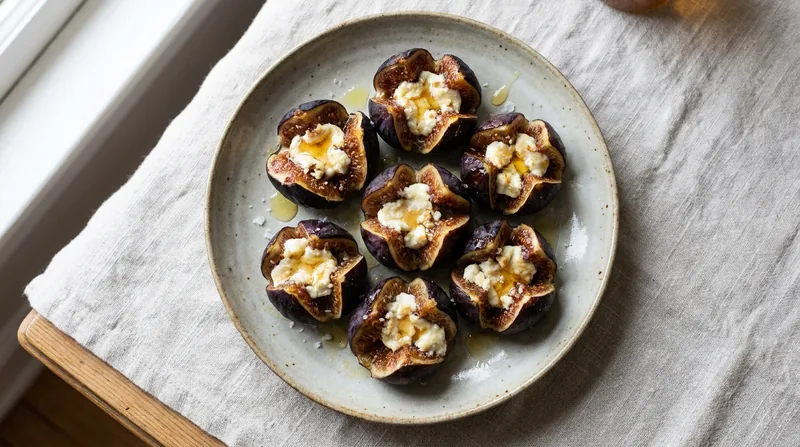
Side · British
Roasted Figs with Goat's Cheese
Roasted figs topped with soft goat's cheese and honey.
Ingredients
- Fresh figs 300 g
- Soft goat's cheese 100 g
- Raw honey 20 g
- Olive oil 10 g
- Table salt 2 g
- Black pepper 1 g
Method
- Heat the oven to 200C.
- Cut the figs in half lengthways and place them cut-side up in a baking dish.
- Drizzle the olive oil and honey over the figs, then sprinkle with the salt and black pepper.
- Bake in the oven for 15 minutes until the figs are soft.
- Spoon the goat's cheese onto the hot figs before serving.
Summed from 6 USDA records and divided by servings. Heat alters weight and a few nutrients, so read it as a close figure.
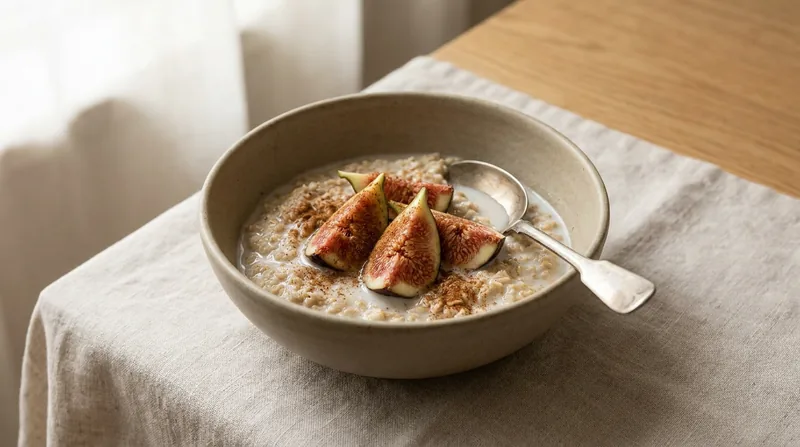
Breakfast · British
Fig and Cinnamon Porridge
Warm porridge oats cooked with fresh figs, milk, and ground cinnamon.
Ingredients
- Fresh figs 150 g
- Rolled oats 80 g
- Whole milk 300 g
- Water 100 g
- Ground cinnamon 2 g
- Table salt 1 g
Method
- Chop the fresh figs into small pieces.
- Combine the oats, milk, water, cinnamon, salt, and half of the chopped figs in a saucepan.
- Simmer the mixture over medium heat for 6 minutes, stirring constantly.
- Pour the porridge into bowls and top with the remaining chopped figs.
Nutrition per serving, calculated across 6 USDA ingredient records. Expect small differences once cooked.
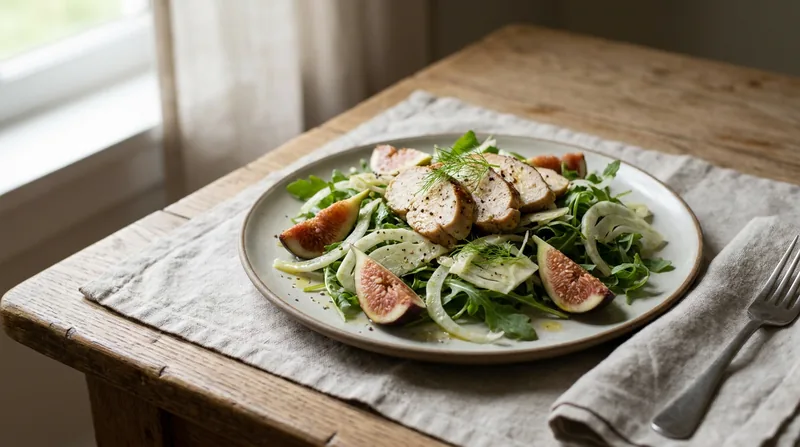
Dinner · British
Fig and Fennel Chicken Salad
A cold salad of sliced fresh figs, cooked chicken breast, and shaved fennel bulb.
Ingredients
- Fresh figs 200 g
- Cooked chicken breast 150 g
- Fennel bulb 100 g
- Arugula 50 g
- Olive oil 15 g
- Lemon juice 10 g
- Table salt 2 g
Method
- Slice the figs into quarters and thinly shave the fennel bulb.
- Shred the cooked chicken breast into bite-sized pieces.
- Whisk the olive oil, lemon juice, and salt in a large bowl.
- Add the arugula, fennel, chicken, and figs to the bowl.
- Toss the ingredients gently to coat them with the dressing.
7 USDA records went into this total. It describes the ingredients as weighed, not the dish after cooking losses.

Calorie Counter Team, food critic
Putting fig on a plate
To see how fig adds up in a meal, here it is beside two ordinary companions, all three from USDA figures.
| Item | Serving | Calories | Protein (g) |
|---|---|---|---|
| Fig | 1 medium | 37 | 0.4 |
| Parmesan | 1 oz | 119 | 8.1 |
| Cashews | 1 oz | 157 | 5.2 |
| Together | 313 | 14 |
Fig against other fruit
Same weight for every row, 100 g, so differences are not portion effects. The form column shows whether a row is raw, cooked or as sold.
| Food | Form | Calories | Protein (g) | Carbs (g) | Fat (g) |
|---|---|---|---|---|---|
| Olives | Canned | 116 | 0.8 | 6 | 11 |
| Pomegranate | Raw | 83 | 1.7 | 19 | 1.2 |
| Fig | Raw | 74 | 0.8 | 19 | 0.3 |
| Grapes | Raw | 69 | 0.7 | 18 | 0.2 |
| Cherries | Raw | 63 | 1.1 | 16 | 0.2 |
| Raspberries | Raw | 52 | 1.2 | 12 | 0.7 |
| Peach | Raw | 42 | 0.9 | 10 | 0.3 |
What people ask about fig
What is the calorie count for 1 medium fig?
1 medium fig is 37 calories. That comes from the USDA record “Figs, raw” (FDC 173021), which is 74 calories per 100 g.
How much protein is in fig?
0.4 g in 1 medium fig, or 0.8 g per 100 g. That is 1 percent of the 50 g Daily Value.
Is fig good for weight loss?
That depends on the rest of the day, not on fig. For planning: 1 medium fig is 37 calories and 0.4 g of protein, 4 percent protein by energy, useful alongside a protein source rather than as one.
How much carbohydrate does fig contain?
Carbohydrate comes to 9.6 g per serving of 1 medium fig: 8.1 g as sugar and 1.5 g as fibre.
Should you peel fresh figs before eating them?
No, the skin of a fresh fig is entirely edible and tender. You only need to trim off the tough woody stem at the top before eating or cooking the fruit.
How should fresh figs be stored?
Store fresh figs in a flat layer on a plate lined with paper towels in the fridge. Keep them dry, as moisture hastens spoilage, and use them quickly because they deteriorate rapidly.
Sources
- Figs, raw — USDA FoodData Central, FDC ID 173021
- Figs, canned, water pack, solids and liquids — USDA FoodData Central, FDC ID 173022
- Figs, dried, uncooked — USDA FoodData Central, FDC ID 174665
- Daily Values for nutrition labelling, 21 CFR 101.9
Stop doing this by hand.
You just looked up one food. CalorieCounter reads a whole plate from a photo, serving and preparation included. It is coming to the App Store for iPhone — leave your email and you get the link the day it is live.