Vegetables
Asparagus nutrition, by serving and by method.
1 cup of asparagus comes to 27 calories. Protein accounts for 2.9 g of what is there. Those numbers describe “Asparagus, raw” in USDA FoodData Central. Where it earns its place is vitamin K and folate. Set the serving below and the panel works it out, with the full nutrient table following your choice.
USDA FoodData Central records 168389, 169207, 168390 supply every value here. The calculation happens in this page.
The calorie count for asparagus
The short answer is 27 calories for 1 cup of asparagus. By weight that is 20 per 100 g, and the table gives the other common portions.
| Serving | Weight (g) | Calories | Protein (g) | Carbs (g) | Fat (g) |
|---|---|---|---|---|---|
| 1 spear tip | 3.5 | 1 | 0.1 | 0.1 | 0 |
| 1 spear, small | 12 | 2 | 0.3 | 0.5 | 0 |
| 1 spear, medium | 16 | 3 | 0.4 | 0.6 | 0 |
| 1 spear, large | 20 | 4 | 0.4 | 0.8 | 0 |
| 1 spear, extra large | 24 | 5 | 0.5 | 0.9 | 0 |
| 1 cup | 134 | 27 | 2.9 | 5.2 | 0.2 |
| 100 g | 100 | 20 | 2.2 | 3.9 | 0.1 |
How much protein does asparagus provide?
1 cup of asparagus carries 2.9 g of protein, which is 6 percent of the 50 g Daily Value. 44 percent of its energy is protein. That is lean by any reasonable standard, without being extreme.
Its energy is 4 percent fat, 61 percent carbohydrate and 35 percent protein, meaning it behaves as mostly a carbohydrate in a meal.
Asparagus, method by method
Same asparagus, same 134 g, different treatment:
| Preparation | Calories | Protein (g) | Fat (g) | What it involves |
|---|---|---|---|---|
| Canned asparagus | 25 | 2.9 | 0.9 | Packed, drained |
| Raw asparagus | 27 | 2.9 | 0.2 | Nothing added |
| Boiled asparagus | 29 | 3.2 | 0.3 | Water only |
Kitchen notes on asparagus
Asparagus is a spring shoot harvested before the bud opens. You can find green, purple, and pale white spears. Look for firm, straight stalks with tightly closed, dry tips. Avoid limp stems or wet, mushy buds. Thick spears are tender, while thin spears can turn woody if grown in poor conditions.
Asparagus cooks quickly. High heat intensifies its grassy flavour, while boiling can make it dull and grey. The most common mistake is overcooking, which turns the spears mushy and watery. Snap or trim the tough woody bottoms before cooking. Keep cooking times brief to retain a crisp texture and bright green colour.
Enjoy asparagus hot or cold. In British kitchens, we often serve it with melted butter or dipped in soft egg yolks. In Italian cooking, spears are roasted with parmesan cheese and olive oil. The grassy taste pairs well with salty cured meats, citrus juices, and fresh tarragon.
Everything USDA measures in asparagus
Measured against FDA Daily Values, the strongest lines for 1 cup of asparagus are vitamin K at 46 percent of a day, folate at 17 percent of a day, thiamin at 16 percent of a day. Adjust the panel at the top and these rows recalculate.
| Nutrient | Amount | % Daily Value |
|---|
There are 2.1 g of fibre in 100 g, roughly 8 percent of the daily figure.
Putting asparagus into a day of eating
If you eat 2,000 calories a day, 1 cup of asparagus accounts for 1 percent of them, and for 6 percent of the 50 g protein benchmark. To replace 2,000 with your real number, use the TDEE calculator; to turn that into targets, the macro calculator.
Recipes that start with asparagus
Each of these comes from the Calorie Counter Team, and each carries nutrition worked out from its ingredients’ USDA entries rather than estimated from the finished dish.
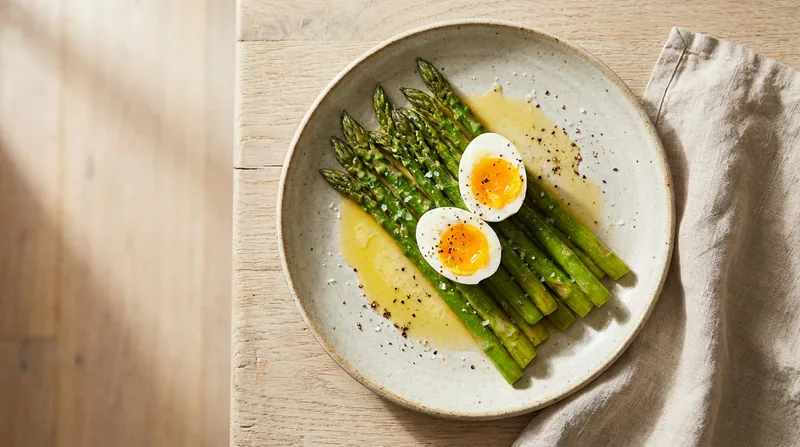
Breakfast · British
Asparagus and Soft Boiled Eggs
Soft-boiled eggs served with warm, buttered asparagus spears for dipping.
Ingredients
- Asparagus spears, trimmed 300 g
- Large eggs 228 g
- Butter, salted 20 g
- Salt 2 g
- Black pepper 1 g
Method
- Bring a saucepan of water to the boil.
- Lower the eggs into the water and boil for five minutes.
- Steam the asparagus spears in a basket over the boiling water for four minutes.
- Remove the eggs, place them in egg cups, and slice off the tops.
- Coat the warm asparagus with the butter, salt, and black pepper.
- Serve the asparagus immediately alongside the eggs.
Per serving, from 5 USDA FoodData Central records. Cooking changes weight and some nutrients; treat these as close rather than exact.
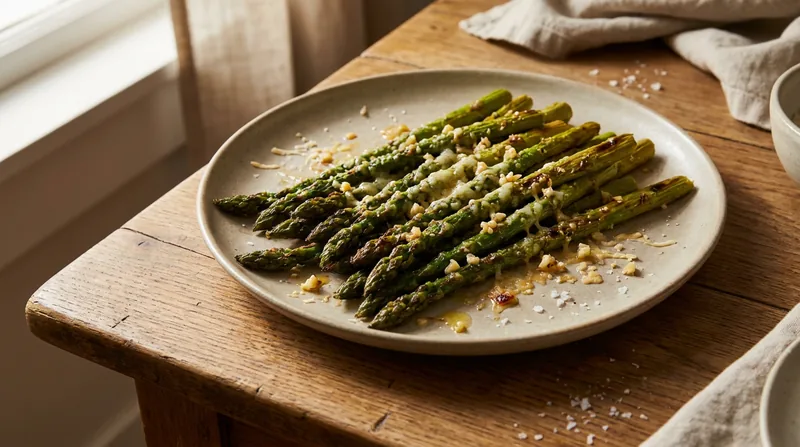
Side · Mediterranean
Garlic and Parmesan Roasted Asparagus
Oven-roasted asparagus tossed with olive oil, garlic, and grated parmesan cheese.
Ingredients
- Asparagus, trimmed 400 g
- Olive oil 14 g
- Garlic, minced 6 g
- Parmesan cheese, grated 30 g
- Salt 2 g
- Black pepper 1 g
Method
- Preheat the oven to 200 degrees Celsius.
- Toss the asparagus with the olive oil, garlic, salt, and black pepper on a baking tray.
- Spread the asparagus in a single layer.
- Roast in the oven for twelve minutes.
- Sprinkle the parmesan cheese over the asparagus and roast for two further minutes.
6 USDA records went into this total. It describes the ingredients as weighed, not the dish after cooking losses.
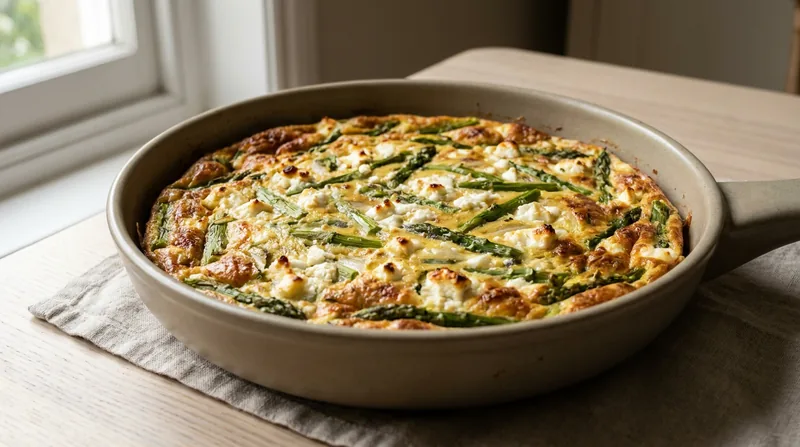
Lunch · European
Asparagus and Goat's Cheese Frittata
A quick stovetop frittata with chopped asparagus, onions, and crumbled goat's cheese.
Ingredients
- Asparagus, cut into 3cm pieces 250 g
- Large eggs 342 g
- Goat's cheese 100 g
- Olive oil 14 g
- Onion, chopped 110 g
- Salt 3 g
Method
- Whisk the eggs and salt together in a bowl.
- Heat the olive oil in a non-stick frying pan over medium heat.
- Fry the onion and asparagus for five minutes until they soften.
- Pour the eggs into the pan and cook without stirring for four minutes.
- Scatter the goat cheese over the surface and place the pan under a hot grill for three minutes.
Per serving, from 6 USDA FoodData Central records. Cooking changes weight and some nutrients; treat these as close rather than exact.

Calorie Counter Team, food critic
A plate built around asparagus
A worked example, every line from the same USDA data as the table above. Swap any of it; the arithmetic is the point, not the menu.
| Item | Serving | Calories | Protein (g) |
|---|---|---|---|
| Asparagus | 1 cup | 27 | 2.9 |
| Chicken wing, roasted | 1 piece | 216 | 20 |
| Pasta | 1 cup spaghetti not packed | 196 | 7.2 |
| Together | 439 | 30 |
Asparagus beside its neighbours
Same weight for every row, 100 g, so differences are not portion effects. The form column shows whether a row is raw, cooked or as sold.
| Food | Form | Calories | Protein (g) | Carbs (g) | Fat (g) |
|---|---|---|---|---|---|
| Corn | Raw | 86 | 3.3 | 19 | 1.4 |
| Beets | Raw | 43 | 1.6 | 9.6 | 0.2 |
| Onion | Raw | 40 | 1.1 | 9.3 | 0.1 |
| Mushroom | Raw | 22 | 3.1 | 3.3 | 0.3 |
| Asparagus | Raw | 20 | 2.2 | 3.9 | 0.1 |
| Tomato | Raw | 18 | 0.9 | 3.9 | 0.2 |
| Lettuce | Raw | 17 | 1.2 | 3.3 | 0.3 |
Questions about asparagus
What is the calorie count for 1 cup of asparagus?
The USDA figure is 27 calories, or 20 per 100 g. It is taken from the record “Asparagus, raw”, FDC 168389.
Is there much protein in asparagus?
1 cup of asparagus has 2.9 g of protein. By weight that is 2.2 g per 100 g, and the serving covers 6 percent of the Daily Value.
Does asparagus fit a calorie deficit?
That depends on the rest of the day, not on asparagus. For planning: 1 cup of asparagus is 27 calories and 2.9 g of protein, 44 percent protein by energy, which is a favourable trade when calories are tight.
How many carbs are in asparagus?
1 cup of asparagus contains 5.2 g of carbohydrate. Fibre makes up 2.8 g of that and sugar 2.5 g.
How should I store fresh asparagus?
Store asparagus upright in a jar with a little water in the bottom, like a bouquet of flowers. Cover the tops loosely with a plastic bag and keep them in the fridge. This keeps the stalks plump and prevents them from drying out.
Do I need to peel asparagus before cooking?
Peeling is only necessary for thick or white asparagus. Use a vegetable peeler to gently remove the tough outer skin from the lower portion of the spear. This ensures the stalk cooks evenly without leaving stringy, fibrous bits in your mouth.
Sources
- Asparagus, raw — USDA FoodData Central, FDC ID 168389
- Asparagus, cooked, boiled, drained — USDA FoodData Central, FDC ID 168390
- Asparagus, canned, drained solids — USDA FoodData Central, FDC ID 169207
- Daily Values for nutrition labelling, 21 CFR 101.9
Stop doing this by hand.
You just looked up one food. CalorieCounter reads a whole plate from a photo, serving and preparation included. It is coming to the App Store for iPhone — leave your email and you get the link the day it is live.