Seafood
Shrimp nutrition, by serving and by method.
3 oz of raw shrimp comes to 60 calories. Protein accounts for 12 g of what is there. In USDA’s database this is “Crustaceans, shrimp, mixed species, raw (may contain additives to retain moisture)”. Between the lightest and heaviest preparation listed here, 100 g differs by 171 calories. The selector beneath handles other portions, and the nutrient table responds to it.
Figures: USDA FoodData Central, records 171972, 171970, 174210, 171971. Calculated in your browser; nothing is uploaded.
Shrimp calories by portion
Count 60 calories for 3 oz of raw shrimp, or 71 for every 100 g. The portion weights in the table are USDA’s own measurements.
| Serving | Weight (g) | Calories | Protein (g) | Carbs (g) | Fat (g) |
|---|---|---|---|---|---|
| 1 small | 5 | 4 | 0.7 | 0 | 0.1 |
| 1 medium | 6 | 4 | 0.8 | 0.1 | 0.1 |
| 4 large | 28 | 20 | 3.8 | 0.3 | 0.3 |
| 3 oz | 85 | 60 | 12 | 0.8 | 0.9 |
| 100 g | 100 | 71 | 14 | 0.9 | 1 |
Shrimp and its protein content
The protein count for 3 oz of raw shrimp is 12 g, equal to 23 percent of the Daily Value. Few foods beat it on density. 77 percent of the energy in shrimp is protein, so almost nothing else comes along for the ride.
Looked at as a share of calories: carbohydrate 5 percent, fat 14 percent, protein 81 percent.
How preparation changes shrimp
There is a 241 percent spread between raw shrimp (71 calories per 100 g) and fried (242). The cause is the cooking fat, which stays in the food after the water has gone.
Weight is fixed at 85 g throughout, so the rows differ only in how the shrimp was prepared.
| Preparation | Calories | Protein (g) | Fat (g) | What it involves |
|---|---|---|---|---|
| Raw shrimp | 60 | 12 | 0.9 | Nothing added |
| Canned shrimp | 85 | 17 | 1.2 | Packed |
| Boiled shrimp | 101 | 19 | 1.4 | Water only |
| Fried shrimp | 206 | 18 | 10 | Breaded, in cooking fat |
A photograph can identify fried shrimp; it cannot measure the fat the shrimp absorbed. That limit applies to every calorie app, ours included, and this guide to AI calorie accuracy explains it.
What to know before you cook shrimp
Shrimp are decapod crustaceans sold raw or cooked, often frozen at sea to preserve quality. Look for firm translucent flesh. Avoid any shells with black spots or yellowing edges. Frozen bags should have no ice crystals inside. Choose head-on wild shrimp for deep flavour, or peeled tails for convenient prep.
Shrimp cook rapidly. The flesh curls and changes from translucent grey to opaque pink as the proteins contract. Overcooking is the most common error, making the meat rubbery and dry. Keep the shells on during boiling or grilling to protect the delicate meat and lock in the natural juices.
These shellfish pair naturally with acidic citrus, pungent garlic, and fresh herbs. They absorb spicy chillies in Thai curries and rich butter in French sautés. Toss the cooked tails through cold Spanish salads, or thread them onto skewers for quick grilling. Always save the discarded shells for making deep seafood stock.
Shrimp: the full nutrient profile
What 3 oz of raw shrimp supplies most of: selenium (46 percent of the Daily Value), vitamin B12 (39 percent of the Daily Value), phosphorus (17 percent of the Daily Value). All rows below respond to the serving you chose.
| Nutrient | Amount | % Daily Value |
|---|
Sodium is the figure to watch here: 566 mg per 100 g is 25 percent of a day’s limit, which is what usually decides how often shrimp fits.
Putting shrimp into a day of eating
Against the standard 2,000 calorie reference, 3 oz of raw shrimp takes up 3 percent of the energy and supplies 23 percent of the protein. For a figure that fits you, start with the TDEE calculator, then set grams with the macro calculator.
Three ways to cook shrimp
The Calorie Counter Team wrote these. Under every recipe the numbers are added up from the USDA record for each ingredient and split across the servings.
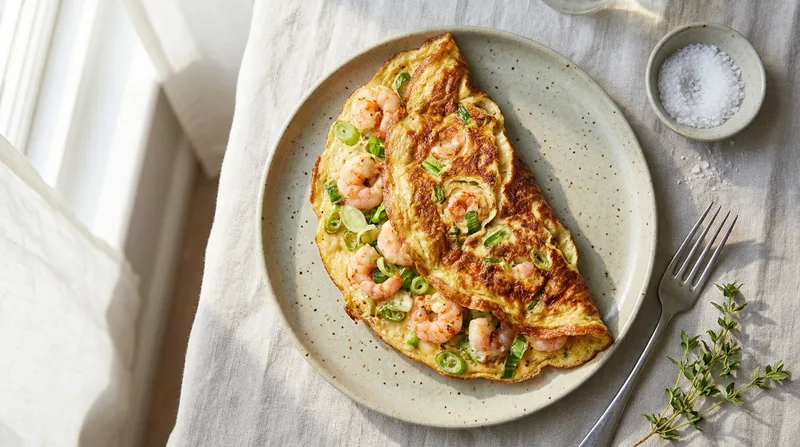
Breakfast · British
Shrimp and Spring Onion Omelette
A quick pan-fried omelette containing shrimp and sliced spring onions.
Ingredients
- Raw peeled shrimp 120 g
- Large eggs 120 g
- Unsalted butter 15 g
- Spring onions, sliced 20 g
- Table salt 2 g
Method
- Whisk the eggs and table salt in a bowl until combined.
- Melt the unsalted butter in a frying pan over medium heat.
- Fry the shrimp and spring onions for 120 seconds until the shrimp turn pink.
- Pour the whisked eggs into the pan and cook for 180 seconds until the mixture sets.
- Fold the omelette in half and slide it onto a plate.
Nutrition per serving, calculated across 5 USDA ingredient records. Expect small differences once cooked.
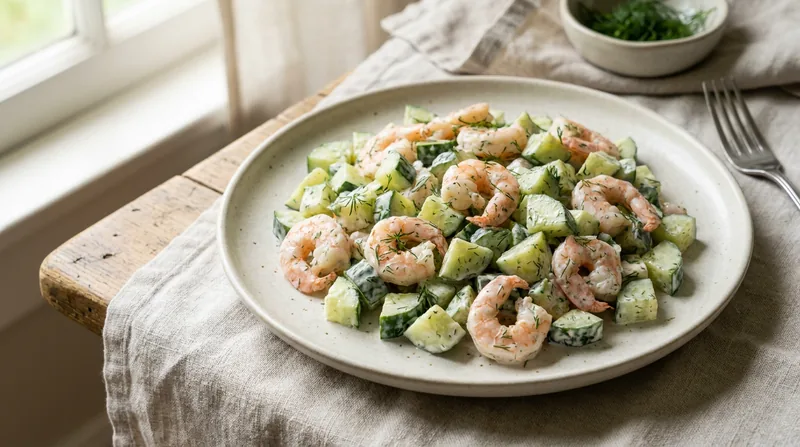
Lunch · Nordic
Cold Shrimp and Cucumber Salad
A cold salad of cooked shrimp and diced cucumber tossed in a dill and yogurt dressing.
Ingredients
- Cooked peeled shrimp 150 g
- Cucumber 100 g
- Plain yogurt 60 g
- Lemon juice 15 g
- Fresh dill, chopped 5 g
- Table salt 2 g
Method
- Chop the cucumber into one-centimetre cubes.
- Whisk the plain yogurt, lemon juice, chopped dill, and table salt in a medium bowl.
- Add the cooked shrimp and cucumber cubes to the bowl.
- Stir the mixture until the dressing coats the ingredients.
6 USDA records went into this total. It describes the ingredients as weighed, not the dish after cooking losses.
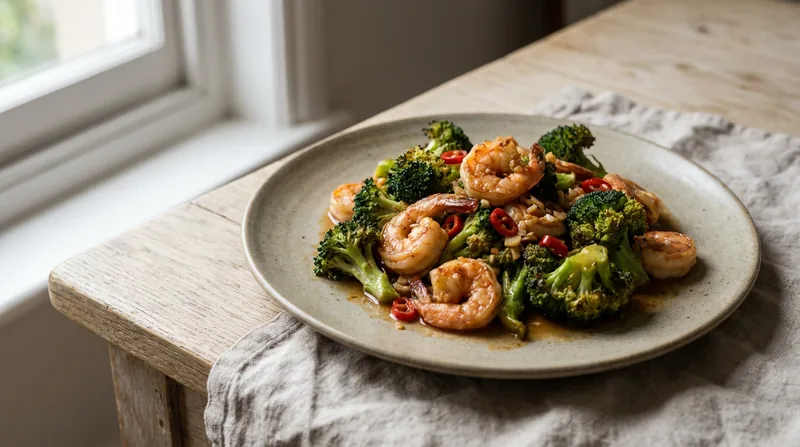
Dinner · Chinese
Garlic and Chilli Stir-Fried Shrimp with Broccoli
A high-heat stir-fry of raw shrimp, broccoli florets, fresh garlic, and red chilli.
Ingredients
- Raw peeled shrimp 200 g
- Broccoli 150 g
- Olive oil 14 g
- Garlic cloves, minced 9 g
- Red chilli pepper, sliced 5 g
- Soy sauce 15 g
Method
- Cut the broccoli into two-centimetre florets.
- Heat the olive oil in a frying pan over high heat.
- Add the minced garlic and sliced chilli, stirring constantly for 30 seconds.
- Add the broccoli florets and cook for 180 seconds.
- Stir in the raw shrimp and soy sauce, cooking for a further 180 seconds until the shrimp turn pink.
Nutrition per serving, calculated across 6 USDA ingredient records. Expect small differences once cooked.

Calorie Counter Team, food critic
What a meal with shrimp adds up to
A sample plate, not a prescription: shrimp plus two sides, each line sourced and the sum shown.
| Item | Serving | Calories | Protein (g) |
|---|---|---|---|
| Shrimp, boiled | 3 oz | 101 | 19 |
| Barley, cooked | 1 cup | 193 | 3.5 |
| Radish | 1 cup slices | 19 | 0.8 |
| Together | 313 | 24 |
Seafood: where shrimp sits
Same weight for every row, 100 g, so differences are not portion effects. The form column shows whether a row is raw, cooked or as sold.
| Food | Form | Calories | Protein (g) | Carbs (g) | Fat (g) |
|---|---|---|---|---|---|
| Tilapia | Raw | 96 | 20 | 0 | 1.7 |
| Tuna | Canned | 90 | 19 | 0.1 | 0.9 |
| Cod | Raw | 82 | 18 | 0 | 0.7 |
| Lobster | Raw | 77 | 17 | 0 | 0.8 |
| Shrimp | Raw | 71 | 14 | 0.9 | 1 |
| Scallops | Raw | 69 | 12 | 3.2 | 0.5 |
| Oysters | Raw | 51 | 5.7 | 2.7 | 1.7 |
Shrimp: common questions
How many calories are in 3 oz of raw shrimp?
3 oz of raw shrimp is 60 calories. That comes from the USDA record “Crustaceans, shrimp, mixed species, raw (may contain additives to retain moisture)” (FDC 174210), which is 71 calories per 100 g.
Is there much protein in shrimp?
12 g in 3 oz of raw shrimp, or 14 g per 100 g. That is 23 percent of the 50 g Daily Value.
Do the calories in shrimp change with how it is prepared?
The weight stays the same but the number moves. 85 g of shrimp is 60 calories raw, rising to 206 fried.
Can you eat shrimp when trying to lose weight?
No food causes or prevents weight loss on its own. The useful facts are that 3 oz of raw shrimp is 60 calories with 12 g of protein, which makes 77 percent of its calories protein; which is a favourable trade when calories are tight.
How do you know when shrimp is cooked through?
Cooked shrimp curves into a gentle shape resembling the letter C. If it curls tightly into an O, it is overcooked. The translucent grey flesh will become completely opaque white with pink highlights.
Should you remove the dark vein before cooking?
The vein is the digestive tract. It is harmless to eat but can contain grit which spoils the texture. Remove it by making a shallow cut along the back and lifting the dark thread out under running water.
Sources
- Crustaceans, shrimp, mixed species, raw (may contain additives to retain moisture) — USDA FoodData Central, FDC ID 174210
- Crustaceans, shrimp, mixed species, cooked, moist heat (may contain additives to retain moisture) — USDA FoodData Central, FDC ID 171971
- Crustaceans, shrimp, mixed species, cooked, breaded and fried — USDA FoodData Central, FDC ID 171970
- Crustaceans, shrimp, mixed species, canned — USDA FoodData Central, FDC ID 171972
- Daily Values for nutrition labelling, 21 CFR 101.9
Stop doing this by hand.
You just looked up one food. CalorieCounter reads a whole plate from a photo, serving and preparation included. It is coming to the App Store for iPhone — leave your email and you get the link the day it is live.