Seafood
Scallops nutrition, by serving and by method.
59 calories and 10 g of protein: that is 3 oz of raw scallops. Those numbers describe “Mollusks, scallop, mixed species, raw” in USDA FoodData Central. Change the way it is prepared and an identical weight swings from 69 up to 216 calories per 100 g. The selector beneath handles other portions, and the nutrient table responds to it.
Drawn from USDA FoodData Central, FDC 174220, 174221, 167742. No account, no upload, percentages against FDA Daily Values.
How many calories does scallops have?
At 69 calories per 100 g, 3 oz of raw scallops comes to 59. The weights shown for each portion come straight from the USDA record.
| Serving | Weight (g) | Calories | Protein (g) | Carbs (g) | Fat (g) |
|---|---|---|---|---|---|
| 3 oz | 85 | 59 | 10 | 2.7 | 0.4 |
| 100 g | 100 | 69 | 12 | 3.2 | 0.5 |
Protein in scallops, measured
For protein, 3 oz of raw scallops gives you 10 g, which fills 21 percent of the daily 50 g benchmark. Protein makes up 70 percent of the calories here, which places scallops among the leanest sources you can buy.
The calorie breakdown runs 74 percent protein to 7 percent fat to 19 percent carbohydrate. Functionally, that is a protein food.
Scallops calories by preparation
The cheapest way to eat scallops, in calorie terms, is raw at 69 per 100 g. Fried costs 216, which is 213 percent more, because of the cooking fat, which stays in the food after the water has gone.
Every row below is the same 85 g of scallops, so the only thing that differs is the method.
| Preparation | Calories | Protein (g) | Fat (g) | What it involves |
|---|---|---|---|---|
| Raw scallops | 59 | 10 | 0.4 | Nothing added |
| Steamed scallops | 94 | 17 | 0.7 | Steam only |
| Fried scallops | 184 | 15 | 9.3 | Breaded, in cooking fat |
Frying is where any estimate gets soft, because the oil taken up varies from pan to pan. We wrote about that uncertainty in how accurate AI calorie apps are.
Kitchen notes on scallops
Choose dry-packed scallops over wet-packed ones. Wet-packed scallops are treated with phosphates that make them absorb water, bloat, and leach liquid during cooking. Look for king scallops for searing, or smaller queen scallops for stews. Good scallops have a creamy, ivory, or slightly pinkish hue, rather than a stark, chemically bleached white appearance.
Scallops require intense, dry heat to brown their natural sugars. Before cooking, remove the tough crescent-shaped muscle on the side. Pat them completely dry with paper towels. The most common error is overcrowding the pan, which lowers the temperature and steams them. Overcooked scallops turn rubbery, tough, and lose their delicate, sweet flavour.
Serve seared scallops with pea purée or black pudding in British dining. In French cookery, they are often poached in white wine and baked in their shells with Gruyère cheese. In Chinese cuisine, dried scallops impart deep savoury depth to XO sauce, whilst fresh ones are stir-fried quickly with ginger and spring onions.
Everything USDA measures in scallops
Measured against FDA Daily Values, the strongest lines for 3 oz of raw scallops are 50 percent of a day’s vitamin B12, 23 percent of a day’s phosphorus, 20 percent of a day’s selenium. Adjust the panel at the top and these rows recalculate.
| Nutrient | Amount | % Daily Value |
|---|
Sodium is the figure to watch here: 392 mg per 100 g is 17 percent of a day’s limit, which is what usually decides how often scallops fits.
Putting scallops into a day of eating
3 oz of raw scallops uses 3 percent of a 2,000 calorie day and returns 21 percent of the protein reference. Your own budget is probably not 2,000; the TDEE calculator works it out, and the macro calculator splits it into protein, carbs and fat.
Three ways to cook scallops
These are the Calorie Counter Team’s recipes for scallops. Their nutrition panels are arithmetic: ingredient weights multiplied through USDA records, divided by servings.
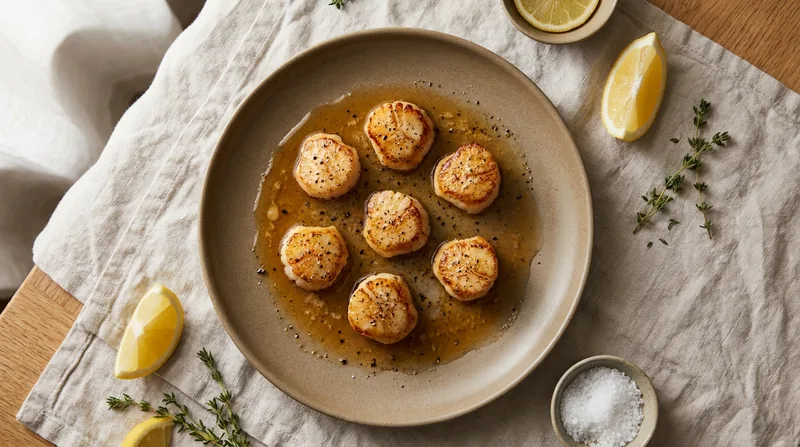
Dinner · British
Pan-Seared Scallops
Pan-seared scallops with a butter and lemon juice reduction.
Ingredients
- Raw sea scallops 300 g
- Unsalted butter 30 g
- Olive oil 15 g
- Table salt 3 g
- Ground black pepper 1 g
- Lemon juice 15 g
Method
- Pat the scallops dry with paper towels and season both sides with the salt and black pepper.
- Heat the olive oil and 15 grams of butter in a frying pan over high heat until smoking.
- Add the scallops to the pan and cook without moving for two minutes.
- Turn the scallops, add the remaining butter and lemon juice to the pan, and baste for one minute.
- Remove the scallops from the pan and serve immediately.
6 USDA records went into this total. It describes the ingredients as weighed, not the dish after cooking losses.
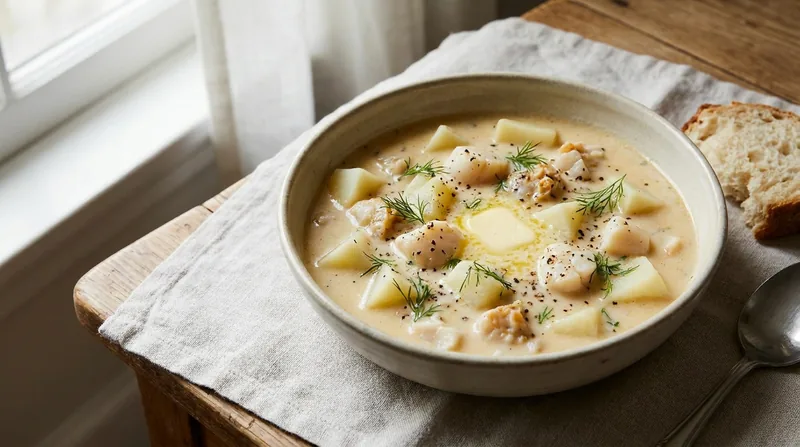
Lunch · British
Scallop and Potato Chowder
A warm, milk-based soup with potatoes and chopped scallops.
Ingredients
- Raw sea scallops 200 g
- Raw potatoes 250 g
- Raw onion 100 g
- Whole milk 400 g
- Unsalted butter 25 g
- Table salt 4 g
Method
- Melt the butter in a saucepan over medium heat and cook the chopped onion for five minutes until soft.
- Add the diced potatoes and milk, then simmer for fifteen minutes until the potatoes are tender.
- Cut the scallops into quarters and add them to the saucepan with the salt.
- Simmer the mixture for three minutes until the scallops are opaque throughout.
- Pour the chowder into bowls and serve warm.
Figures are per serving and come from 6 USDA FoodData Central entries; cooking will shift them slightly.
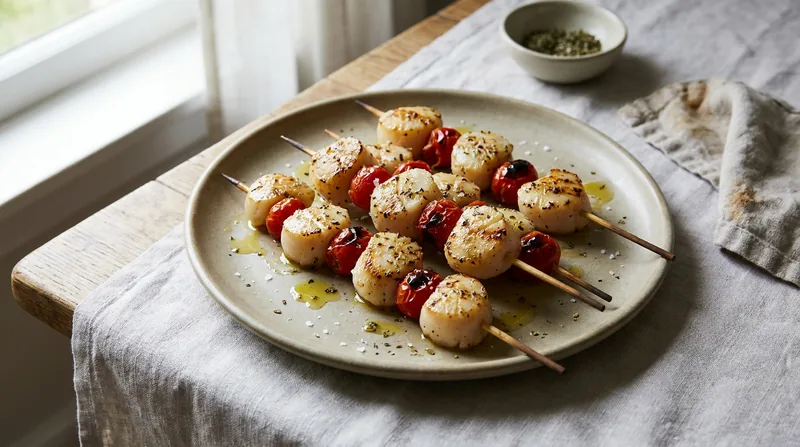
Snack · Mediterranean
Grilled Scallop Skewers
Threaded skewers of scallops and cherry tomatoes cooked under a grill.
Ingredients
- Raw sea scallops 240 g
- Cherry tomatoes 150 g
- Olive oil 20 g
- Dried oregano 2 g
- Table salt 3 g
Method
- Preheat the oven grill to high heat.
- Thread the scallops and cherry tomatoes alternately onto wooden skewers.
- Brush the skewers with the olive oil and season with the dried oregano and salt.
- Place the skewers on a baking tray and grill for three minutes on each side.
- Transfer the skewers to a plate and serve.
Per serving, from 5 USDA FoodData Central records. Cooking changes weight and some nutrients; treat these as close rather than exact.

Calorie Counter Team, food critic
One meal, costed: scallops
What a meal containing scallops comes to, using USDA numbers for every part of it.
| Item | Serving | Calories | Protein (g) |
|---|---|---|---|
| Scallops, steamed | 3 oz | 94 | 17 |
| Brown rice, cooked | 1 cup | 248 | 5.5 |
| Sweet potato | 1 sweet potato, 5 in long | 112 | 2 |
| Together | 454 | 25 |
How scallops compares with similar foods
Per 100 g, each in the form its own page leads with; the second column says which.
| Food | Form | Calories | Protein (g) | Carbs (g) | Fat (g) |
|---|---|---|---|---|---|
| Tilapia | Raw | 96 | 20 | 0 | 1.7 |
| Tuna | Canned | 90 | 19 | 0.1 | 0.9 |
| Crab | Raw | 87 | 18 | 0 | 1.1 |
| Cod | Raw | 82 | 18 | 0 | 0.7 |
| Lobster | Raw | 77 | 17 | 0 | 0.8 |
| Shrimp | Raw | 71 | 14 | 0.9 | 1 |
| Scallops | Raw | 69 | 12 | 3.2 | 0.5 |
Common questions on scallops
How many calories are in 3 oz of raw scallops?
Count 59 calories. The source is the USDA record “Mollusks, scallop, mixed species, raw” (FDC 174220), which lists 69 calories per 100 g.
Is there much protein in scallops?
10 g in 3 oz of raw scallops, or 12 g per 100 g. That is 21 percent of the 50 g Daily Value.
Do the calories in scallops change with how it is prepared?
The weight stays the same but the number moves. 85 g of scallops is 59 calories raw, rising to 184 fried.
Does scallops fit a calorie deficit?
It can fit any calorie target; no single food decides the outcome. What matters here is that 3 oz of raw scallops costs 59 calories and returns 10 g of protein, so 70 percent of its energy is protein — which is a favourable trade when calories are tight.
What is the orange part attached to the scallop?
This is the coral, or roe. It is completely edible, with a soft texture and a pronounced, rich seafood flavour. Many European chefs leave it attached, though some cooks remove it to use separately in sauces or fish stocks.
How do you know when a scallop is cooked?
Look for the flesh to turn from translucent to opaque throughout. The scallop should feel slightly firm to the touch, with a gentle springiness. If it feels completely soft, it is underdone; if it feels hard, it is overcooked.
Sources
- Mollusks, scallop, mixed species, raw — USDA FoodData Central, FDC ID 174220
- Mollusks, scallop, (bay and sea), cooked, steamed — USDA FoodData Central, FDC ID 167742
- Mollusks, scallop, mixed species, cooked, breaded and fried — USDA FoodData Central, FDC ID 174221
- Daily Values for nutrition labelling, 21 CFR 101.9
Stop doing this by hand.
You just looked up one food. CalorieCounter reads a whole plate from a photo, serving and preparation included. It is coming to the App Store for iPhone — leave your email and you get the link the day it is live.