Seafood
Tuna nutrition, and what the pan changes.
1 can of drained tuna comes to 96 calories. Protein accounts for 20 g of what is there. Specifically, this is the USDA record “Fish, tuna, light, canned in water, drained solids”. How it reaches the plate decides the rest, with 100 g measured at 90 calories one way and 184 another. Use the selector that follows to match your own portion; the panel and the nutrient table track it.
Every value traces to USDA FoodData Central (334194, 173706, 173707); Daily Values follow the FDA label rules.
How many calories does tuna have?
Count 96 calories for 1 can of drained tuna, or 90 for every 100 g. The portion weights in the table are USDA’s own measurements.
| Serving | Weight (g) | Calories | Protein (g) | Carbs (g) | Fat (g) |
|---|---|---|---|---|---|
| 1 can, drained | 107 | 96 | 20 | 0.1 | 1 |
| 1 can, total can contents | 142 | 128 | 27 | 0.1 | 1.3 |
| 100 g | 100 | 90 | 19 | 0.1 | 0.9 |
How much protein does tuna provide?
1 can of drained tuna provides 20 g of protein. Set beside the 50 g reference intake, that is 41 percent. With 84 percent of its calories coming from protein, tuna is close to pure protein in practical terms.
The calorie breakdown runs 90 percent protein to 10 percent fat to 0 percent carbohydrate. Functionally, that is a protein food.
Does the method change tuna?
A caution on this table: each preparation is its own USDA record, taken from its own sample. For tuna that accounts for much of the 104 percent difference you will see.
Same tuna, same 107 g, different treatment:
| Preparation | Calories | Protein (g) | Fat (g) | What it involves |
|---|---|---|---|---|
| Canned tuna | 96 | 20 | 1 | Packed, drained |
| Raw tuna | 154 | 25 | 5.2 | Nothing added |
| Roasted tuna | 197 | 32 | 6.7 | Dry heat, no added fat |
What to know before you cook tuna
Tuna is a large saltwater fish sold as fresh steaks, frozen fillets, or tinned in oil or spring water. When buying fresh, look for deep red, moist flesh with a clean, metallic lustre. Avoid steaks with dark brown patches or dry, gaping muscle fibres, which indicate poor handling and age.
This fish behaves more like beef than white fish. High heat sears the outside quickly, but prolonged cooking turns the dense flesh dry, grey and crumbly. The most common error is cooking it all the way through. Keep the centre pale pink and warm, whilst the exterior gets a dark crust.
Fresh steaks suit Japanese raw preparations or brief grilling with sesame and soy. Tinned chunks pair naturally with Mediterranean ingredients like olives, capers, and olive oil. Use it in French Niçoise salads, Italian pasta sauces, or mixed with mayonnaise for cold fillings.
Vitamins and minerals in tuna
Against the Daily Value, 1 can of drained tuna stands out for 132 percent of a day’s selenium, 115 percent of a day’s vitamin B12, 66 percent of a day’s niacin. The table follows the selector above, so change the serving or the method and it updates.
| Nutrient | Amount | % Daily Value |
|---|
How far tuna goes in a day
On a 2,000 calorie day, 1 can of drained tuna is 5 percent of the budget and 41 percent of the protein Daily Value. Whether that is a lot depends on your own numbers rather than on 2,000: the TDEE calculator gives you what you burn, and the macro calculator turns a target into grams.
Cooking with tuna: three recipes
From the Calorie Counter Team: three dishes built around tuna, with per-serving nutrition calculated from the USDA data for every ingredient that goes in.
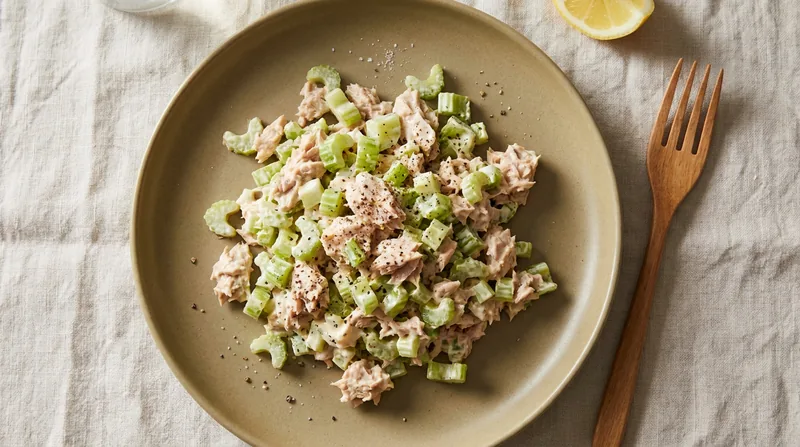
Lunch · British
Tuna and Celery Salad
This cold salad combines canned tuna, celery, and mayonnaise for a light lunch.
Ingredients
- canned tuna in spring water 160 g
- raw celery 50 g
- regular mayonnaise 40 g
- lemon juice 10 g
- table salt 2 g
- ground black pepper 1 g
Method
- Drain the liquid from the tuna tin.
- Chop the celery into five-millimetre pieces.
- Combine the tuna, celery, mayonnaise, lemon juice, salt, and black pepper in a bowl.
- Mix the ingredients with a fork until the tuna is flaked and evenly coated.
Figures are per serving and come from 6 USDA FoodData Central entries; cooking will shift them slightly.
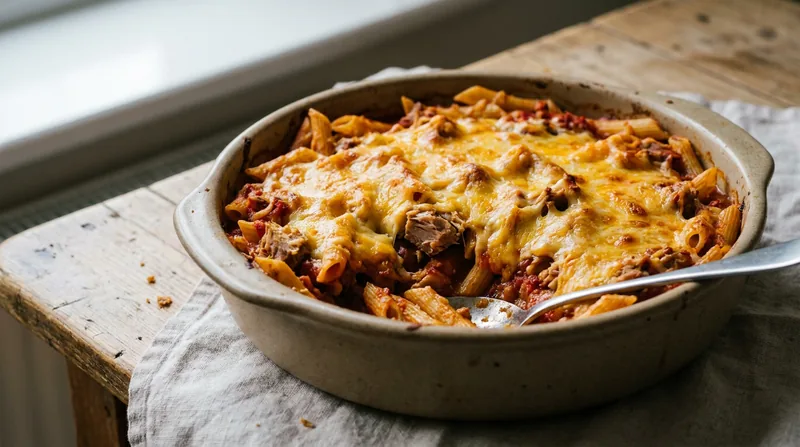
Dinner · British
Tuna and Tomato Pasta Bake
This baked pasta dish combines canned tuna, tomatoes, and melted cheddar cheese.
Ingredients
- dry penne pasta 250 g
- canned tuna in oil 320 g
- canned chopped tomatoes 400 g
- cheddar cheese 100 g
- olive oil 15 g
- raw garlic 6 g
- table salt 4 g
Method
- Boil the pasta in salted water for ten minutes, then drain it.
- Heat the olive oil in a saucepan and fry the minced garlic for one minute.
- Add the chopped tomatoes, drained tuna, and salt to the saucepan and simmer for five minutes.
- Stir the drained pasta into the sauce and transfer the mixture to an ovenproof dish.
- Scatter the grated cheddar cheese over the top.
- Bake at two hundred degrees Celsius for fifteen minutes until the cheese melts.
Nutrition per serving, calculated across 7 USDA ingredient records. Expect small differences once cooked.
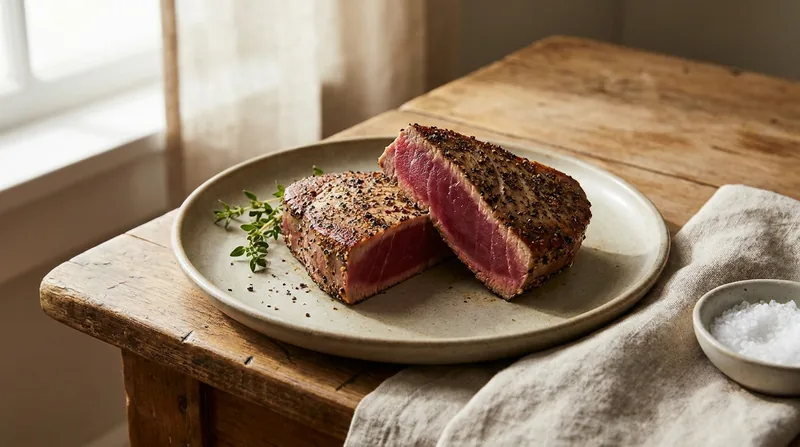
Dinner · Mediterranean
Pan-Seared Tuna Steaks
These fresh tuna steaks are seasoned with black pepper and quickly seared in a hot pan.
Ingredients
- fresh tuna steaks 300 g
- olive oil 14 g
- table salt 3 g
- ground black pepper 2 g
Method
- Pat the tuna steaks dry with a paper towel.
- Rub both sides of the tuna steaks with the olive oil, salt, and black pepper.
- Heat a heavy frying pan over high heat until it is hot.
- Place the tuna steaks in the pan and cook for two minutes on each side.
- Remove the steaks from the pan and let them rest for three minutes before serving.
Summed from 4 USDA records and divided by servings. Heat alters weight and a few nutrients, so read it as a close figure.

Calorie Counter Team, food critic
What a meal with tuna adds up to
To see how tuna adds up in a meal, here it is beside two ordinary companions, all three from USDA figures.
| Item | Serving | Calories | Protein (g) |
|---|---|---|---|
| Tuna, canned | 1 can, drained | 96 | 20 |
| Rice, cooked | 1 cup | 205 | 4.3 |
| Pumpkin | 1 cup | 30 | 1.2 |
| Together | 331 | 26 |
Seafood: where tuna sits
Compared gram for gram, with the form of each food stated. Follow any link for that food’s full page.
| Food | Form | Calories | Protein (g) | Carbs (g) | Fat (g) |
|---|---|---|---|---|---|
| Sardines | Canned | 208 | 25 | 0 | 11 |
| Tilapia | Raw | 96 | 20 | 0 | 1.7 |
| Tuna | Canned | 90 | 19 | 0.1 | 0.9 |
| Crab | Raw | 87 | 18 | 0 | 1.1 |
| Cod | Raw | 82 | 18 | 0 | 0.7 |
| Shrimp | Raw | 71 | 14 | 0.9 | 1 |
| Oysters | Raw | 51 | 5.7 | 2.7 | 1.7 |
Common questions on tuna
What is the calorie count for 1 can of drained tuna?
1 can of drained tuna is 96 calories. That comes from the USDA record “Fish, tuna, light, canned in water, drained solids” (FDC 334194), which is 90 calories per 100 g.
Is there much protein in tuna?
You get 20 g from 1 can of drained tuna, equal to 41 percent of the daily reference amount; 100 g holds 19 g.
Can you eat tuna when trying to lose weight?
It can fit any calorie target; no single food decides the outcome. What matters here is that 1 can of drained tuna costs 96 calories and returns 20 g of protein, so 84 percent of its energy is protein — a strong ratio for staying full on fewer calories.
Which nutrients is tuna highest in?
Per 1 can of drained tuna, the standouts against the Daily Value are selenium at 132 percent, vitamin B12 at 115 percent, niacin at 66 percent. The full table above lists every nutrient USDA reports for this record.
Why does fresh tuna turn grey in the fridge?
Exposure to oxygen causes the red pigment, myoglobin, to oxidise and turn brown or grey. This natural colour change occurs quickly and does not mean the fish has spoiled, provided it smells clean and fresh.
Can you use tinned tuna in hot dishes?
Yes, but add it near the end of cooking. Because tinned tuna is already fully cooked, heating it for too long makes the flakes woody, dry and unpleasantly chewy in pasta sauces or bakes.
Sources
- Fish, tuna, fresh, bluefin, raw — USDA FoodData Central, FDC ID 173706
- Fish, tuna, fresh, bluefin, cooked, dry heat — USDA FoodData Central, FDC ID 173707
- Fish, tuna, light, canned in water, drained solids — USDA FoodData Central, FDC ID 334194
- Daily Values for nutrition labelling, 21 CFR 101.9
Stop doing this by hand.
You just looked up one food. CalorieCounter reads a whole plate from a photo, serving and preparation included. It is coming to the App Store for iPhone — leave your email and you get the link the day it is live.