Dairy
Parmesan nutrition, every number, sourced.
Weigh out 1 oz of parmesan and you are looking at 119 calories, with 8.1 g of protein inside them. The source is the USDA entry “Cheese, parmesan, grated”. What it supplies in quantity is calcium and selenium. The selector beneath handles other portions, and the nutrient table responds to it.
Figures: USDA FoodData Central, record 171247. Calculated in your browser; nothing is uploaded.
How many calories are in parmesan?
1 oz of parmesan is 119 calories. Per 100 g it is 420. USDA publishes the serving weights below, so these are measured portions rather than rounded guesses.
| Serving | Weight (g) | Calories | Protein (g) | Carbs (g) | Fat (g) |
|---|---|---|---|---|---|
| 1 tbsp | 5 | 21 | 1.4 | 0.7 | 1.4 |
| 1 oz | 28 | 119 | 8.1 | 4 | 7.9 |
| 1 cup | 100 | 420 | 28 | 14 | 28 |
Parmesan and its protein content
For protein, 1 oz of parmesan gives you 8.1 g, which fills 16 percent of the daily 50 g benchmark. By calories parmesan is 27 percent protein, so it adds to your intake but will not anchor it.
Of every 100 calories, 27 come from protein, 60 from fat and 13 from carbohydrate.
What to know before you buy parmesan
Genuine Parmigiano Reggiano carries dotted stencilling on the rind. Look for wedge shapes cut straight from the wheel rather than pre-grated tubs. The cheese should have a pale straw colour, not a bright yellow hue. Avoid pieces with white powdery coats, but look for tiny white spots within the paste, which indicate proper ageing.
High heat makes this cheese stringy and oily because the proteins clump together. Grating it finely helps it dissolve smoothly into warm liquids. The most common error is boiling the cheese after adding it to a sauce. Instead, stir the gratings into the pan off the heat, letting the residual warmth melt them.
Shave this cheese over Italian carpaccio or stir it into risotto for a rich finish. It also brings savoury depth to French onion soup or roasted Mediterranean vegetables. Use the hard rind to flavour simmering broths, discarding the softened skin before serving the finished soup.
The complete parmesan breakdown
What 1 oz of parmesan supplies most of: 19 percent of a day’s calcium, 18 percent of a day’s selenium, 17 percent of a day’s vitamin B12. All rows below respond to the serving you chose.
| Nutrient | Amount | % Daily Value |
|---|
Sodium is the figure to watch here: 1,804 mg per 100 g is 78 percent of a day’s limit, which is what usually decides how often parmesan fits.
Where parmesan fits in a day
1 oz of parmesan: 6 percent of 2,000 calories, 16 percent of the protein Daily Value. Those are reference numbers; the TDEE calculator finds yours, and the macro calculator converts them to grams.
Three recipes built around parmesan
Each of these comes from the Calorie Counter Team, and each carries nutrition worked out from its ingredients’ USDA entries rather than estimated from the finished dish.
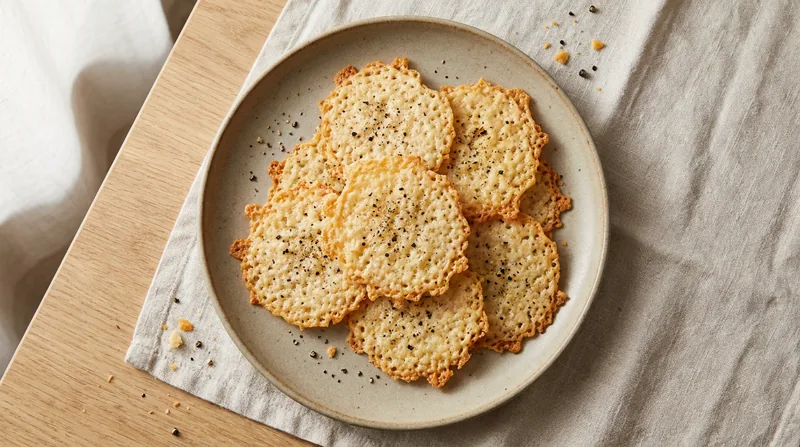
Snack · Italian
Parmesan Crisps
Thin, oven-baked wafers made from grated Parmesan cheese and cracked black pepper.
Ingredients
- Grated Parmesan cheese 100 g
- Ground black pepper 2 g
Method
- Heat the oven to 200C.
- Line a baking sheet with greaseproof paper.
- Mix the grated Parmesan cheese and black pepper in a bowl.
- Spoon the mixture into eight flat mounds on the baking sheet.
- Bake for five minutes until golden.
- Cool the crisps on the baking sheet for ten minutes.
Built from 2 USDA ingredient records. A cooked dish never matches its raw sum exactly, but it stays close.
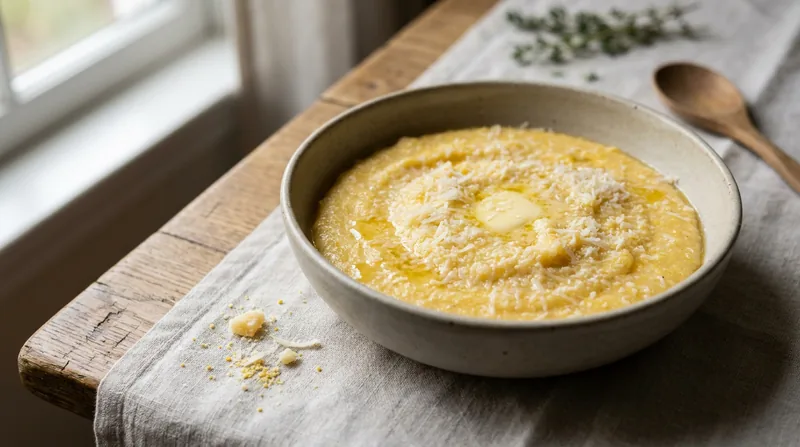
Side · Italian
Parmesan Polenta
A warm, smooth cornmeal porridge enriched with butter and a high proportion of grated Parmesan cheese.
Ingredients
- Water 500 g
- Coarse yellow cornmeal 100 g
- Grated Parmesan cheese 60 g
- Unsalted butter 25 g
- Table salt 3 g
Method
- Boil the water and salt in a saucepan.
- Whisk the cornmeal slowly into the boiling water.
- Cook on low heat for twenty minutes while stirring.
- Remove the saucepan from the heat.
- Stir the butter and grated Parmesan cheese into the hot polenta.
Figures are per serving and come from 5 USDA FoodData Central entries; cooking will shift them slightly.
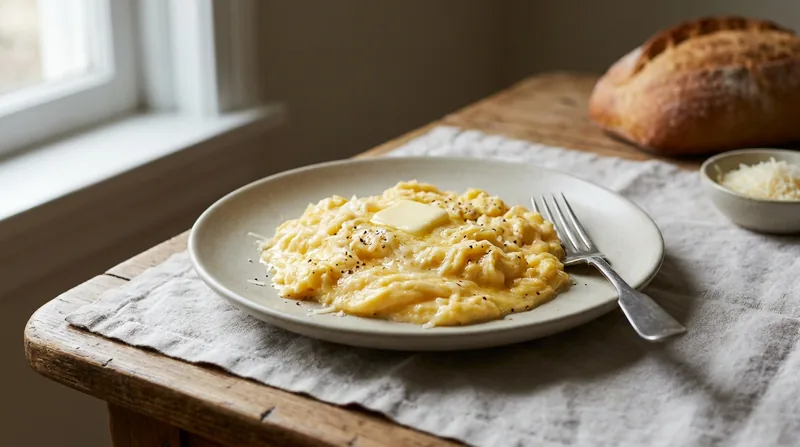
Breakfast · British
Parmesan Scrambled Eggs
Soft scrambled eggs cooked with grated Parmesan cheese and butter.
Ingredients
- Whole raw eggs 200 g
- Grated Parmesan cheese 40 g
- Unsalted butter 15 g
- Ground black pepper 1 g
Method
- Whisk the eggs and grated Parmesan cheese together in a bowl.
- Melt the butter in a frying pan over low heat.
- Pour the egg mixture into the warm pan.
- Stir the eggs slowly with a spatula to form soft curds.
- Remove the pan from the heat while the eggs are slightly wet.
- Season the eggs with the black pepper.
Per serving, from 4 USDA FoodData Central records. Cooking changes weight and some nutrients; treat these as close rather than exact.

Calorie Counter Team, food critic
What a meal with parmesan adds up to
What a meal containing parmesan comes to, using USDA numbers for every part of it.
| Item | Serving | Calories | Protein (g) |
|---|---|---|---|
| Parmesan | 1 oz | 119 | 8.1 |
| Grapefruit | 1/2 fruit | 37 | 0.7 |
| Pecans | 1 oz (19 halves) | 196 | 2.6 |
| Together | 352 | 11 |
Parmesan against other dairy
Per 100 g, each in the form its own page leads with; the second column says which.
| Food | Form | Calories | Protein (g) | Carbs (g) | Fat (g) |
|---|---|---|---|---|---|
| Parmesan | As sold | 420 | 28 | 14 | 28 |
| Cheddar cheese | As sold | 408 | 23 | 2.4 | 34 |
| Cream cheese | As sold | 350 | 6.2 | 5.5 | 34 |
| Heavy cream | As sold | 340 | 2.8 | 2.8 | 36 |
| Sour cream | As sold | 198 | 2.4 | 4.6 | 19 |
| Cottage cheese | As sold | 84 | 11 | 4.3 | 2.3 |
| Milk | As sold | 61 | 3.2 | 4.8 | 3.3 |
Parmesan: common questions
How many calories does 1 oz of parmesan have?
119 calories, according to USDA FoodData Central: the record is “Cheese, parmesan, grated”, FDC 171247. That works out at 420 per 100 g.
Is there much protein in parmesan?
Per 100 g, parmesan contains 28 g of protein. 1 oz of parmesan therefore gives 8.1 g, which is 16 percent of a 50 g day.
Does parmesan fit a calorie deficit?
That depends on the rest of the day, not on parmesan. For planning: 1 oz of parmesan is 119 calories and 8.1 g of protein, 27 percent protein by energy, which means it needs a protein-rich partner on the plate.
What is parmesan a good source of?
Per 1 oz of parmesan, the standouts against the Daily Value are calcium at 19 percent, selenium at 18 percent, vitamin B12 at 17 percent. The full table above lists every nutrient USDA reports for this record.
Why does my parmesan have white spots on it?
These are harmless natural crystals that form as moisture evaporates during the ageing process. They are not mould. Instead, they provide the characteristic crunchy texture and deep, savoury taste of a well-matured cheese.
How should you store a wedge of parmesan to keep it fresh?
Wrap the wedge tightly in parchment paper, then cover it loosely with foil. This allows the cheese to breathe without drying out. Avoid plastic wrap, which traps moisture and encourages mould growth on the rind.
Sources
- Cheese, parmesan, grated — USDA FoodData Central, FDC ID 171247
- Daily Values for nutrition labelling, 21 CFR 101.9
Stop doing this by hand.
You just looked up one food. CalorieCounter reads a whole plate from a photo, serving and preparation included. It is coming to the App Store for iPhone — leave your email and you get the link the day it is live.