Eggs
Egg nutrition, raw, cooked and everything between.
Weigh out 1 large egg and you are looking at 72 calories, with 6.3 g of protein inside them. Specifically, this is the USDA record “Egg, whole, raw, fresh”. Change the way it is prepared and an identical weight swings from 143 up to 196 calories per 100 g. Set the serving below and the panel works it out, with the full nutrient table following your choice.
Figures: USDA FoodData Central, records 171287, 172188, 173423, 172185, 172186, 172187, 173424. Calculated in your browser; nothing is uploaded.
Egg calories by portion
72 calories is the figure for 1 large egg; 143 is the figure per 100 g. Below are the remaining portions USDA measured.
| Serving | Weight (g) | Calories | Protein (g) | Carbs (g) | Fat (g) |
|---|---|---|---|---|---|
| 1 small | 38 | 54 | 4.8 | 0.3 | 3.6 |
| 1 medium | 44 | 63 | 5.5 | 0.3 | 4.2 |
| 1 large | 50 | 72 | 6.3 | 0.4 | 4.8 |
| 1 extra large | 56 | 80 | 7 | 0.4 | 5.3 |
| 1 jumbo | 63 | 90 | 7.9 | 0.5 | 6 |
| 1 cup (4.86 large eggs) | 243 | 347 | 31 | 1.7 | 23 |
| 100 g | 100 | 143 | 13 | 0.7 | 9.5 |
What egg offers in protein
The protein count for 1 large egg is 6.3 g, equal to 13 percent of the Daily Value. About 35 percent of its calories are protein. That is a useful contribution rather than a protein source you would build a meal around.
Energy-wise, protein contributes 36 percent, fat 62 percent and carbohydrate 2 percent, which makes it mostly a fat.
Egg, method by method
Go from poached to fried and 100 g of egg climbs from 143 to 196 calories. That 37 percent rise is down to oil or butter taken up during cooking.
Weight is fixed at 50 g throughout, so the rows differ only in how the egg was prepared.
| Preparation | Calories | Protein (g) | Fat (g) | What it involves |
|---|---|---|---|---|
| Raw egg | 72 | 6.3 | 4.8 | Nothing added |
| Poached egg | 72 | 6.3 | 4.7 | Water only |
| Scrambled egg | 75 | 5 | 5.5 | Usually with milk and fat |
| Omelette egg | 77 | 5.3 | 5.8 | Milk and pan fat, no filling |
| Hard-boiled egg | 78 | 6.3 | 5.3 | Water only, shell on |
| Fried egg | 98 | 6.8 | 7.4 | In cooking fat |
| Dried egg | 296 | 24 | 22 | Water removed |
Treat the fried figure as an average. Nobody’s database knows how much fat your pan left behind, a point our piece on AI calorie accuracy goes into.
Egg in the kitchen
Look for whole hen eggs with clean, uncracked shells. They are sold by size and farming method, such as free-range or organic. Shake the carton gently to ensure they are not stuck to the cardboard from leaks. The shell colour, brown or white, depends on the breed of hen and does not affect the flavour.
Heat coaxes the liquid to bind and solidify. High heat or cooking them for too long squeezes out moisture, leaving the whites rubbery and yolks chalky. The most common mistake is using too much heat when scrambling. Cook them slowly over low heat, stirring constantly, and remove them from the pan while still slightly wet.
They are eaten fried for breakfast, soft-boiled with toast soldiers in Britain, or folded into French omelettes. In Asian cuisines, they are often marbled in soy broth or stirred into hot fried rice. They pair naturally with salted butter, fresh chives, smoked fish, and sharp cheeses.
Micronutrients in egg
Measured against FDA Daily Values, the strongest lines for 1 large egg are 28 percent of a day’s selenium, 27 percent of a day’s choline, 19 percent of a day’s vitamin B12. Adjust the panel at the top and these rows recalculate.
| Nutrient | Amount | % Daily Value |
|---|
Where egg fits in a day
On a 2,000 calorie day, 1 large egg is 4 percent of the budget and 13 percent of the protein Daily Value. Whether that is a lot depends on your own numbers rather than on 2,000: the TDEE calculator gives you what you burn, and the macro calculator turns a target into grams.
Cooking with egg: three recipes
Three recipes from the Calorie Counter Team, each costed ingredient by ingredient against USDA records, so the per-serving figures are sums, not guesses.
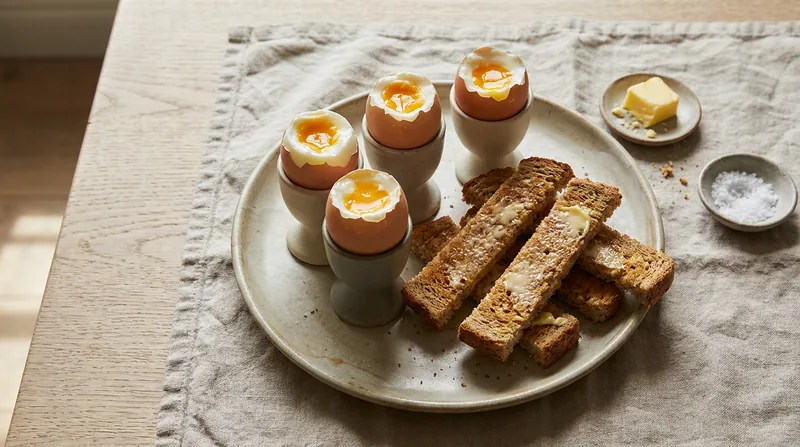
Breakfast · British
Soft-Boiled Eggs with Toast
Soft-boiled eggs served in cups with buttered toast cut into strips for dipping.
Ingredients
- 4 large eggs 200 g
- 4 slices wholemeal bread 160 g
- Salted butter 20 g
- Table salt 2 g
Method
- Bring a saucepan of water to a boil.
- Lower the eggs into the water.
- Simmer the eggs for five minutes.
- Butter the toasted bread.
- Slice the toast into strips.
Summed from 4 USDA records and divided by servings. Heat alters weight and a few nutrients, so read it as a close figure.
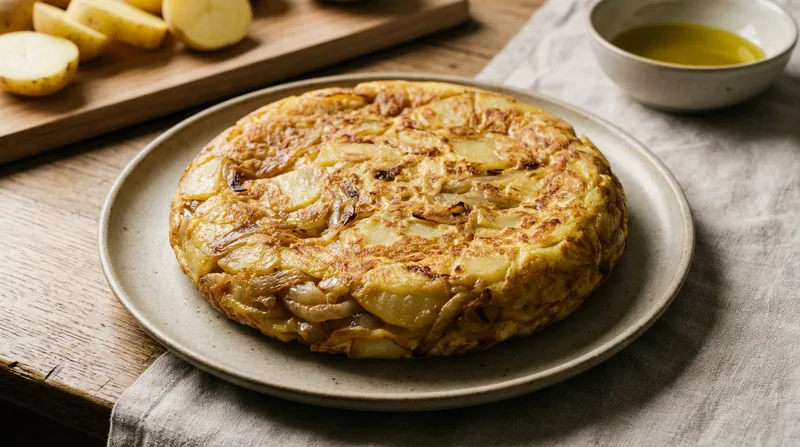
Lunch · Spanish
Spanish Omelette
A thick omelette made with eggs, potatoes, and onions, cooked in olive oil.
Ingredients
- 4 large eggs 200 g
- Waxy potatoes 300 g
- Onion 100 g
- Olive oil 60 g
- Table salt 3 g
Method
- Peel the potatoes and slice them into three-millimetre rounds.
- Fry the potatoes and onions in the olive oil.
- Whisk the eggs and salt in a bowl.
- Mix the drained potatoes and onions into the eggs.
- Pour the mixture into a hot oiled frying pan.
- Cook each side for five minutes until solid.
5 USDA records went into this total. It describes the ingredients as weighed, not the dish after cooking losses.
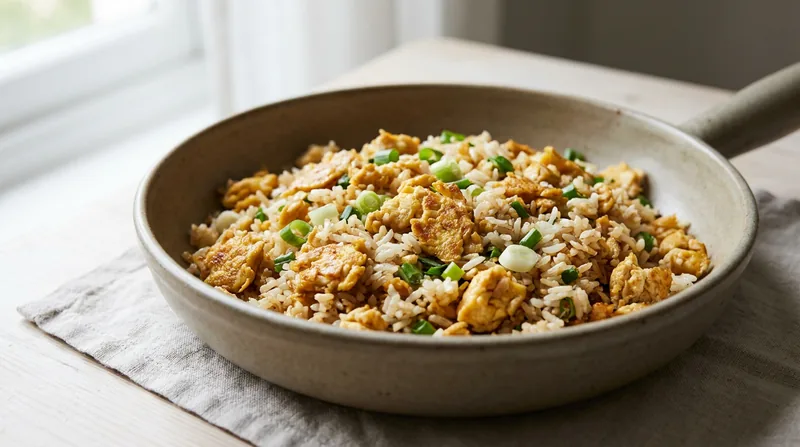
Dinner · Chinese
Egg Fried Rice
A stir-fry of cold cooked rice, scrambled eggs, and spring onions seasoned with soy sauce.
Ingredients
- 3 large eggs 150 g
- Cooked white rice 300 g
- Spring onions 40 g
- Sesame oil 15 g
- Soy sauce 15 g
- Table salt 2 g
Method
- Whisk the eggs and salt in a bowl.
- Heat the sesame oil in a wok.
- Scramble the eggs in the hot oil.
- Stir the cold cooked rice into the pan.
- Pour the soy sauce over the rice.
- Mix the sliced spring onions into the dish.
Figures are per serving and come from 6 USDA FoodData Central entries; cooking will shift them slightly.

Calorie Counter Team, food critic
Putting egg on a plate
One way to build a meal around egg, costed from the same records. Substitute freely; the method carries over.
| Item | Serving | Calories | Protein (g) |
|---|---|---|---|
| Egg | 1 large | 72 | 6.3 |
| Couscous, cooked | 1 cup, cooked | 176 | 6 |
| Radish | 1 cup slices | 19 | 0.8 |
| Together | 267 | 13 |
Egg or something else?
Per 100 g, each in the form its own page leads with; the second column says which.
| Food | Form | Calories | Protein (g) | Carbs (g) | Fat (g) |
|---|---|---|---|---|---|
| Egg yolk | Raw | 322 | 16 | 3.6 | 27 |
| Egg | Raw | 143 | 13 | 0.7 | 9.5 |
| Egg white | Raw | 52 | 11 | 0.7 | 0.2 |
Questions about egg
How many calories does 1 large egg have?
Count 72 calories. The source is the USDA record “Egg, whole, raw, fresh” (FDC 171287), which lists 143 calories per 100 g.
How much protein is in egg?
Per 100 g, egg contains 13 g of protein. 1 large egg therefore gives 6.3 g, which is 13 percent of a 50 g day.
Is egg higher in calories once it is prepared?
The weight stays the same but the number moves. 50 g of egg is 72 calories raw, rising to 98 fried.
Can you eat egg when trying to lose weight?
It can fit any calorie target; no single food decides the outcome. What matters here is that 1 large egg costs 72 calories and returns 6.3 g of protein, so 35 percent of its energy is protein — a strong ratio for staying full on fewer calories.
How can you tell if an egg is fresh without cracking the shell?
Place it in a bowl of cold water. Fresh eggs lie flat at the bottom. Older eggs stand upright or float because the pocket of air inside grows larger over time.
Why do some hard-boiled eggs have a green ring around the yolk?
This harmless discolouration is caused by overcooking. A natural chemical reaction occurs between the yolk and the white when subjected to high heat for too long. Cool them in icy water immediately after boiling to prevent this.
Sources
- Egg, whole, raw, fresh — USDA FoodData Central, FDC ID 171287
- Egg, whole, cooked, poached — USDA FoodData Central, FDC ID 172186
- Egg, whole, cooked, hard-boiled — USDA FoodData Central, FDC ID 173424
- Egg, whole, cooked, scrambled — USDA FoodData Central, FDC ID 172187
- Egg, whole, cooked, omelet — USDA FoodData Central, FDC ID 172185
- Egg, whole, cooked, fried — USDA FoodData Central, FDC ID 173423
- Egg, whole, dried — USDA FoodData Central, FDC ID 172188
- Daily Values for nutrition labelling, 21 CFR 101.9
Stop doing this by hand.
You just looked up one food. CalorieCounter reads a whole plate from a photo, serving and preparation included. It is coming to the App Store for iPhone — leave your email and you get the link the day it is live.