Fats and oils
Butter nutrition, where a spoonful counts.
1 tbsp of butter lands at 102 calories and brings 0.1 g of protein with it. USDA files this under “Butter, salted”, and that is the record used here. Pick a portion in the panel and it recalculates on the spot; the nutrient table further down moves with it.
Figures: USDA FoodData Central, record 173410. Calculated in your browser; nothing is uploaded.
How many calories are in butter?
1 tbsp of butter is 102 calories. Per 100 g it is 717. USDA publishes the serving weights below, so these are measured portions rather than rounded guesses.
| Serving | Weight (g) | Calories | Protein (g) | Carbs (g) | Fat (g) |
|---|---|---|---|---|---|
| 1 pat | 5 | 36 | 0 | 0 | 4.1 |
| 1 tbsp | 14 | 102 | 0.1 | 0 | 12 |
| 1 stick | 113 | 810 | 1 | 0.1 | 92 |
| 1 cup | 227 | 1,628 | 1.9 | 0.1 | 184 |
| 100 g | 100 | 717 | 0.9 | 0.1 | 81 |
How much protein is in butter?
1 tbsp of butter provides 0.1 g of protein. Set beside the 50 g reference intake, that is 0 percent. There is next to no protein in butter; nearly all of its energy is fat.
Of every 100 calories, 0 come from protein, 100 from fat and 0 from carbohydrate.
What to know before you buy butter
Butter is churned cream, sold salted or unsalted. Cultured butter has active ferments, offering a deeper, slightly acidic flavour. Block butter is best for baking. Look for high butterfat content for pastry work. Avoid rolls wrapped in thin paper if they smell of the shop fridge, as butter absorbs ambient odours easily.
Heating butter melts the fats and separates the milk solids. These solids burn quickly over high heat, which is the most common error. Clarifying removes these solids, allowing frying at higher temperatures. Cold butter must be rubbed into flour quickly for pastry, keeping the fat solid to create flaky layers.
Butter is melted over steamed vegetables, spread onto crusty bread, or beaten with sugar for European cakes. In French cooking, cold cubes are whisked into sauces at the final moment to add shine. In Indian kitchens, clarified butter coats flatbreads and finishes lentil dishes with a rich depth.
Butter: the full nutrient profile
Nothing in butter reaches a large share of a Daily Value per serving. The full record is tabulated below and follows the panel.
| Nutrient | Amount | % Daily Value |
|---|
Watch the sodium: 643 mg in 100 g, or 28 percent of the recommended maximum for a day.
Putting butter into a day of eating
On a 2,000 calorie day, 1 tbsp of butter is 5 percent of the budget and 0 percent of the protein Daily Value. Whether that is a lot depends on your own numbers rather than on 2,000: the TDEE calculator gives you what you burn, and the macro calculator turns a target into grams.
Using butter: three recipes
Each of these comes from the Calorie Counter Team, and each carries nutrition worked out from its ingredients’ USDA entries rather than estimated from the finished dish.
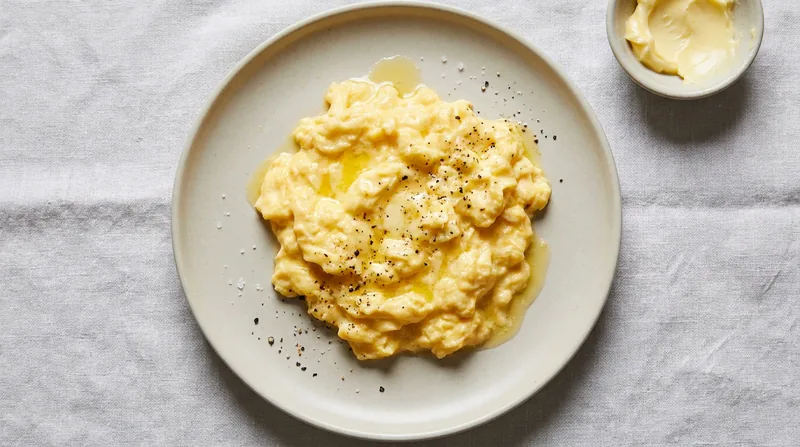
Breakfast · French
Butter-Rich Scrambled Eggs
Soft scrambled eggs cooked slowly with a high proportion of unsalted butter.
Ingredients
- large eggs 200 g
- unsalted butter 30 g
- fine salt 2 g
- ground black pepper 1 g
Method
- Whisk the eggs, salt, and black pepper in a bowl.
- Melt the unsalted butter in a saucepan over low heat.
- Pour the egg mixture into the saucepan.
- Stir the eggs slowly until soft curds form.
- Remove the saucepan from the heat while the eggs are slightly wet.
Built from 4 USDA ingredient records. A cooked dish never matches its raw sum exactly, but it stays close.
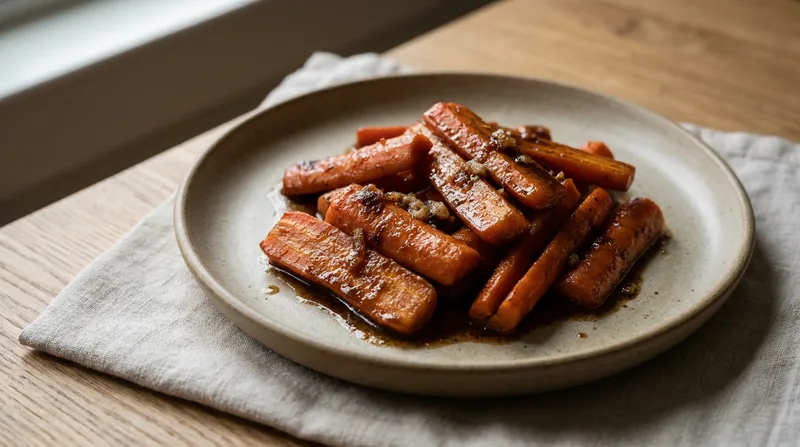
Side · French
Glazed Carrots in Brown Butter
Carrots cooked in water and unsalted butter until tender and coated in a nut-brown glaze.
Ingredients
- carrots 400 g
- unsalted butter 50 g
- water 100 g
- fine salt 3 g
Method
- Slice the carrots into rounds of five millimetres thickness.
- Place the carrots, water, unsalted butter, and salt into a saucepan.
- Simmer the mixture covered over medium heat for ten minutes.
- Remove the lid to evaporate the remaining water.
- Stir the carrots until the butter turns brown.
4 USDA records went into this total. It describes the ingredients as weighed, not the dish after cooking losses.
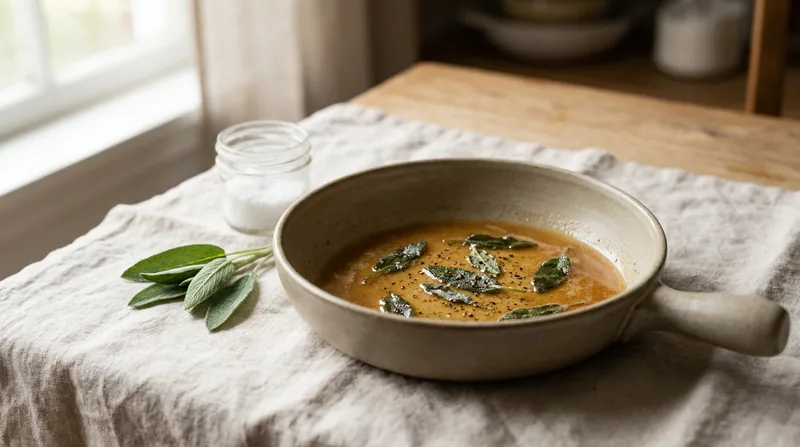
Dinner · Italian
Sage Brown Butter Sauce
A warm herb sauce made by browning butter to dress pasta or fish.
Ingredients
- Unsalted butter 100 g
- Fresh sage leaves 10 g
- Lemon juice 15 g
- Table salt 2 g
- Ground black pepper 1 g
Method
- Melt the unsalted butter in a saucepan over medium heat.
- Cook the butter until it turns golden brown and smells nutty.
- Add the sage leaves and fry for thirty seconds until crisp.
- Remove the pan from the heat and stir in the lemon juice, salt, and black pepper.
Nutrition per serving, calculated across 5 USDA ingredient records. Expect small differences once cooked.

Calorie Counter Team, food critic
One meal, costed: butter
One way to build a meal around butter, costed from the same records. Substitute freely; the method carries over.
| Item | Serving | Calories | Protein (g) |
|---|---|---|---|
| Butter | 1 tbsp | 102 | 0.1 |
| Pumpkin | 1 cup | 30 | 1.2 |
| Barley, cooked | 1 cup | 193 | 3.5 |
| Together | 325 | 4.8 |
Butter against other fats and oils
Each food is shown per 100 g, in the form named beside it.
| Food | Form | Calories | Protein (g) | Carbs (g) | Fat (g) |
|---|---|---|---|---|---|
| Coconut oil | As sold | 892 | 0 | 0 | 99 |
| Avocado oil | As sold | 884 | 0 | 0 | 100 |
| Olive oil | As sold | 884 | 0 | 0 | 100 |
| Butter | As sold | 717 | 0.9 | 0.1 | 81 |
| Mayonnaise | As sold | 680 | 1 | 0.6 | 75 |
Butter, asked and answered
What is the calorie count for 1 tbsp of butter?
1 tbsp of butter is 102 calories. That comes from the USDA record “Butter, salted” (FDC 173410), which is 717 calories per 100 g.
How much protein is in butter?
0.9 g per 100 g, so 1 tbsp of butter supplies 0.1 g. Against the Daily Value that is 0 percent.
Does butter fit a calorie deficit?
It can fit any calorie target; no single food decides the outcome. What matters here is that 1 tbsp of butter costs 102 calories and returns 0.1 g of protein, so 0 percent of its energy is protein — so pair it with something that carries more protein.
Why does butter foam when melted in a pan?
The foaming is caused by water escaping from the butter. As the fat heats, the water content boils off and creates bubbles. After the foaming stops, the milk solids will begin to brown and can burn quickly.
Can salted butter be substituted for unsalted butter in baking recipes?
Yes, but you must reduce the extra salt in the recipe. Salted butter contains varying amounts of salt depending on the brand, which makes it harder to control the final seasoning of delicate doughs and cakes.
Sources
- Butter, salted — USDA FoodData Central, FDC ID 173410
- Daily Values for nutrition labelling, 21 CFR 101.9
Stop doing this by hand.
You just looked up one food. CalorieCounter reads a whole plate from a photo, serving and preparation included. It is coming to the App Store for iPhone — leave your email and you get the link the day it is live.