Beans and soy
Edamame nutrition, by serving and by method.
Weigh out 1 cup of cooked edamame and you are looking at 188 calories, with 18 g of protein inside them. Specifically, this is the USDA record “Edamame, frozen, prepared”. How it reaches the plate decides the rest, with 100 g measured at 109 calories one way and 121 another. Choose how much you are eating and the panel does the arithmetic from there.
Drawn from USDA FoodData Central, FDC 168411, 168410. No account, no upload, percentages against FDA Daily Values.
How many calories does edamame have?
The short answer is 188 calories for 1 cup of cooked edamame. By weight that is 121 per 100 g, and the table gives the other common portions.
| Serving | Weight (g) | Calories | Protein (g) | Carbs (g) | Fat (g) |
|---|---|---|---|---|---|
| 1 cup | 155 | 188 | 18 | 14 | 8.1 |
| 100 g | 100 | 121 | 12 | 8.9 | 5.2 |
What edamame offers in protein
For protein, 1 cup of cooked edamame gives you 18 g, which fills 37 percent of the daily 50 g benchmark. Protein supplies 39 percent of the energy in edamame, which helps a day’s total without carrying it.
By calories rather than by weight the split is 37 percent protein, 36 percent fat and 27 percent carbohydrate, so in practice it is a protein food rather than anything else.
Edamame calories by preparation
Cooked edamame comes in at 121 calories per 100 g against 109 for as sold, a gap of 11 percent. What explains it is moisture lost to the heat, so the same weight holds more food.
Each line compares 155 g of edamame, prepared a different way.
| Preparation | Calories | Protein (g) | Fat (g) | What it involves |
|---|---|---|---|---|
| Edamame, as sold | 169 | 17 | 7.3 | As purchased |
| Cooked edamame | 188 | 18 | 8.1 | Prepared |
Choosing and cooking edamame
Edamame are young, green soya beans harvested before they harden. Grocers sell them whole in their fuzzy, bright green pods or pre-shelled as individual green kernels. Look for pods that are plump and firm. Avoid those with yellowing skins, dry brown patches, or loose, rattling beans inside. Frozen bags should contain loose beans, not a solid block of ice.
Boiling or steaming in salt water preserves the bright green colour and crisp texture of the pods. Overcooking is the common error, turning the beans mushy and greyish. Cook them briefly until the pods yield slightly to pressure. Drain immediately and plunge into cold water to stop the cooking process and lock in the firm bite.
Serve whole steamed pods warm, sprinkled with coarse sea salt, as a Japanese izakaya snack. Squeeze the pods between your teeth to pop the seeds directly into your mouth. Alternatively, toss the shelled green beans into Chinese stir-fries, cold grain salads, or blend them into dip with sesame oil and garlic.
Micronutrients in edamame
1 cup of cooked edamame delivers folate at 121 percent of a day, vitamin K at 34 percent of a day, thiamin at 26 percent of a day. Everything else USDA reports for it is in the table, scaled to your serving.
| Nutrient | Amount | % Daily Value |
|---|
Fibre runs to 5.2 g per 100 g, or 19 percent of the Daily Value.
Where edamame fits in a day
1 cup of cooked edamame: 9 percent of 2,000 calories, 37 percent of the protein Daily Value. Those are reference numbers; the TDEE calculator finds yours, and the macro calculator converts them to grams.
Three ways to cook edamame
The Calorie Counter Team wrote these. Under every recipe the numbers are added up from the USDA record for each ingredient and split across the servings.
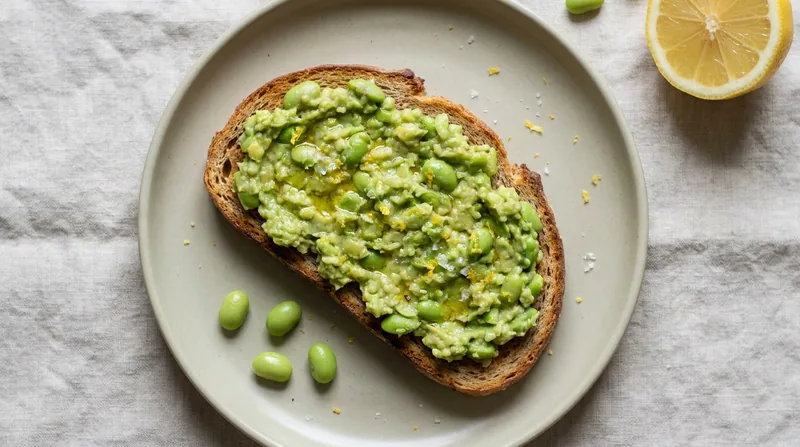
Breakfast · British
Mashed Edamame Toast
A spread of mashed edamame and lemon on toasted wheat bread.
Ingredients
- Frozen shelled edamame 150 g
- Olive oil 10 g
- Lemon juice 15 g
- Table salt 2 g
- Whole wheat bread 80 g
Method
- Boil the edamame in water for 4 minutes, then drain.
- Mash the edamame with the olive oil, lemon juice, and salt using a fork.
- Toast the bread until it is brown.
- Spread the edamame mixture evenly onto the toasted bread.
Per serving, from 5 USDA FoodData Central records. Cooking changes weight and some nutrients; treat these as close rather than exact.
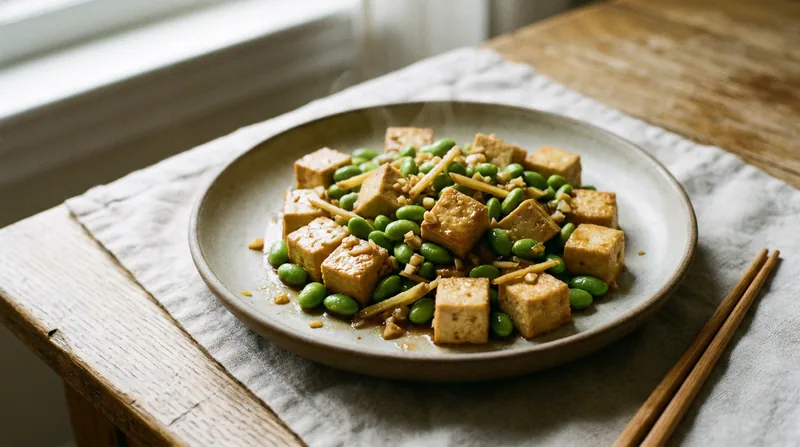
Dinner · Chinese
Tofu and Edamame Stir-Fry
A stir-fry of firm tofu and edamame with garlic, ginger, and soy sauce.
Ingredients
- Firm tofu 200 g
- Frozen shelled edamame 150 g
- Canola oil 15 g
- Raw garlic 6 g
- Fresh ginger root 10 g
- Soy sauce 20 g
Method
- Cut the tofu into 2-centimetre cubes and pat dry with paper towels.
- Mince the garlic and grate the ginger.
- Heat the canola oil in a frying pan over medium-high heat.
- Add the tofu and fry for 6 minutes, turning until all sides are brown.
- Add the edamame, garlic, ginger, and soy sauce to the pan.
- Stir-fry for 3 minutes until the edamame is hot.
Nutrition per serving, calculated across 6 USDA ingredient records. Expect small differences once cooked.
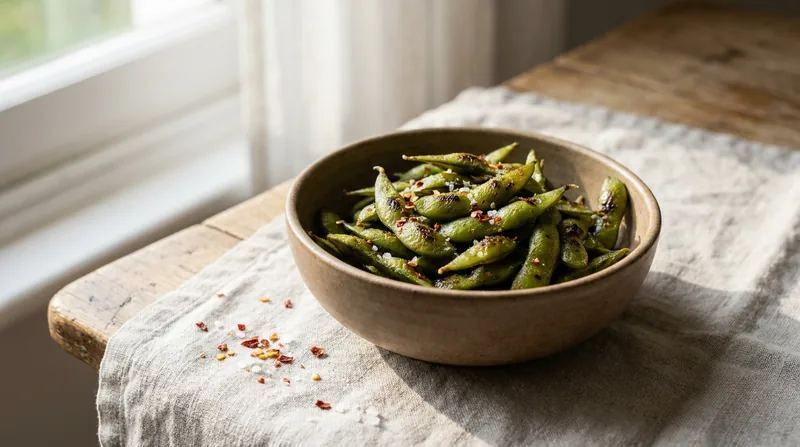
Snack · Japanese
Chilli Garlic Edamame Pods
Whole edamame pods boiled and tossed with chilli flakes and sea salt.
Ingredients
- frozen edamame in pods 300 g
- sesame oil 5 g
- coarse sea salt 8 g
- dried chilli flakes 2 g
Method
- Boil 1 litre of water in a saucepan with 5 grams of the salt.
- Add the frozen edamame pods and boil for 5 minutes.
- Drain the pods and transfer them to a bowl.
- Toss the warm pods with the sesame oil, remaining salt, and chilli flakes.
- Serve immediately.
Built from 4 USDA ingredient records. A cooked dish never matches its raw sum exactly, but it stays close.

Calorie Counter Team, food critic
What a meal with edamame adds up to
A worked example, every line from the same USDA data as the table above. Swap any of it; the arithmetic is the point, not the menu.
| Item | Serving | Calories | Protein (g) |
|---|---|---|---|
| Edamame, cooked | 1 cup | 188 | 18 |
| Bagel | 1 medium bagel | 289 | 11 |
| Radish | 1 cup slices | 19 | 0.8 |
| Together | 496 | 30 |
Edamame against other beans and soy
All figures are for 100 g. Check the form column before comparing a raw food with a cooked one.
| Food | Form | Calories | Protein (g) | Carbs (g) | Fat (g) |
|---|---|---|---|---|---|
| Tempeh | As sold | 192 | 20 | 7.6 | 11 |
| Pinto beans | Boiled | 143 | 9 | 26 | 0.7 |
| Black beans | Boiled | 132 | 8.9 | 24 | 0.5 |
| Kidney beans | Boiled | 127 | 8.7 | 23 | 0.5 |
| Edamame | Cooked | 121 | 12 | 8.9 | 5.2 |
| Lentils | Boiled | 116 | 9 | 20 | 0.4 |
| Tofu | Raw | 78 | 9 | 2.9 | 4.2 |
Common questions on edamame
What is the calorie count for 1 cup of cooked edamame?
The USDA figure is 188 calories, or 121 per 100 g. It is taken from the record “Edamame, frozen, prepared”, FDC 168411.
How much protein does edamame have?
Per 100 g, edamame contains 12 g of protein. 1 cup of cooked edamame therefore gives 18 g, which is 37 percent of a 50 g day.
Does cooking change the calories in edamame?
Yes. At 155 g, as sold is 169 calories and cooked is 188. The table above compares each preparation of edamame covered on this page.
Is edamame good for weight loss?
It can fit any calorie target; no single food decides the outcome. What matters here is that 1 cup of cooked edamame costs 188 calories and returns 18 g of protein, so 39 percent of its energy is protein — a ratio that tends to make a target easier to hold.
Should you eat the outer pods of edamame?
No, the outer pods are extremely tough, woody and unpleasant to chew. They are virtually impossible to swallow comfortably. Eat only the tender green beans inside, discarding the fuzzy outer hulls after squeezing the inner beans into your mouth.
How do you shell frozen edamame quickly?
Thaw the pods in warm water, then pinch the closed end of each pod. The internal seeds will slide out of the opposite split seam easily. Do not try to peel them like green peas.
Sources
- Edamame, frozen, unprepared — USDA FoodData Central, FDC ID 168410
- Edamame, frozen, prepared — USDA FoodData Central, FDC ID 168411
- Daily Values for nutrition labelling, 21 CFR 101.9
Stop doing this by hand.
You just looked up one food. CalorieCounter reads a whole plate from a photo, serving and preparation included. It is coming to the App Store for iPhone — leave your email and you get the link the day it is live.